L'Orangerie
- 01CuisineFrench Nouvelle Cuisine
- 02CityEugénie-les-Bains, France
- 03RecognitionOne Michelin Star
Guérard classics through a lighter pass
- 1 Michelin Star · Michelin Guide
- Relais Chateaux Award · 2026
- Michelin 1 Star · 2026
- Michelin 1 Star · 2025
- Opinionated About Dining Classical in Europe Ranked #159 · 2024
- Opinionated About Dining Classical in Europe Highly Recommended · 2023
A chef holding a borrowed flame
At the pass, L'Orangerie in Eugénie-les-Bains works inside a house shaped by Michel Guérard's long argument for pleasure without heaviness. The station is not presented as authorship detached from place. It sits within Les Prés d'Eugénie, the Famille Guérard estate in the Landes, where nouvelle cuisine, spa culture, garden produce, and southwestern appetite have been asked to live together for decades. The house does not name a current chef, and the leadership it does claim is the family's: Guérard's influence runs through the emblematic recipes rather than through a signature on the carte. L'Orangerie is the estate's winter-garden restaurant, separate from the three-star Restaurant Michel Guérard and La Ferme aux Grives, and its work is to carry that repertoire in a room with a lighter gait. The lineage is visible in the carte rather than announced over it: cuisine minceur, terroir chic, végétale cooking, grilled Landes meats, and the old pleasure of a pie cut for sharing. The hand has to know when to remove weight, and when to leave richness alone.
The pie, the hearth, the low-calorie wager
The kitchen's grammar is built around contrast: a dish may begin in the garden, move through the hearth, and still answer to the thermal-spa idea of balance. The pigeon pie with foie gras and sour cherries has been served since 1983, a Guérard classic with grand jus and pastry doing the work of concentration. The verbena-infused soufflé, dated 1986, pulls in the garden more directly. Smoked lobster with dune butter brings the hearth into the plate, the shellfish taking on smoke without becoming a barbecue gesture. The minceur side of the program is more exacting than its soft name suggests. A 590-calorie menu can include asparagus salad, guinea fowl stuffed with foie gras, and a chocolate liégeois, which means the kitchen has to season, reduce, aerate, and portion with unusual clarity. The same discipline runs through the regional meat work, especially Blonde d'Aquitaine, Bazadaise beef, and local poultry cooked over the cheminée. Whole-animal thinking sits beside vegetable lightness. That is the point here: not abstinence, and not excess, but a method that treats appetite as something to tune.
A winter garden with a formal pulse
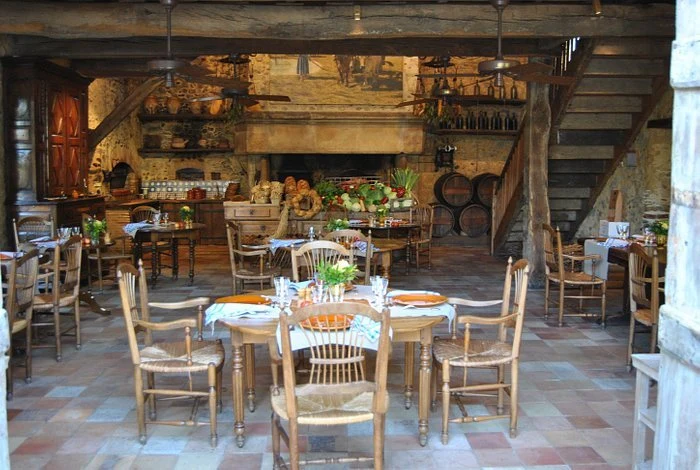
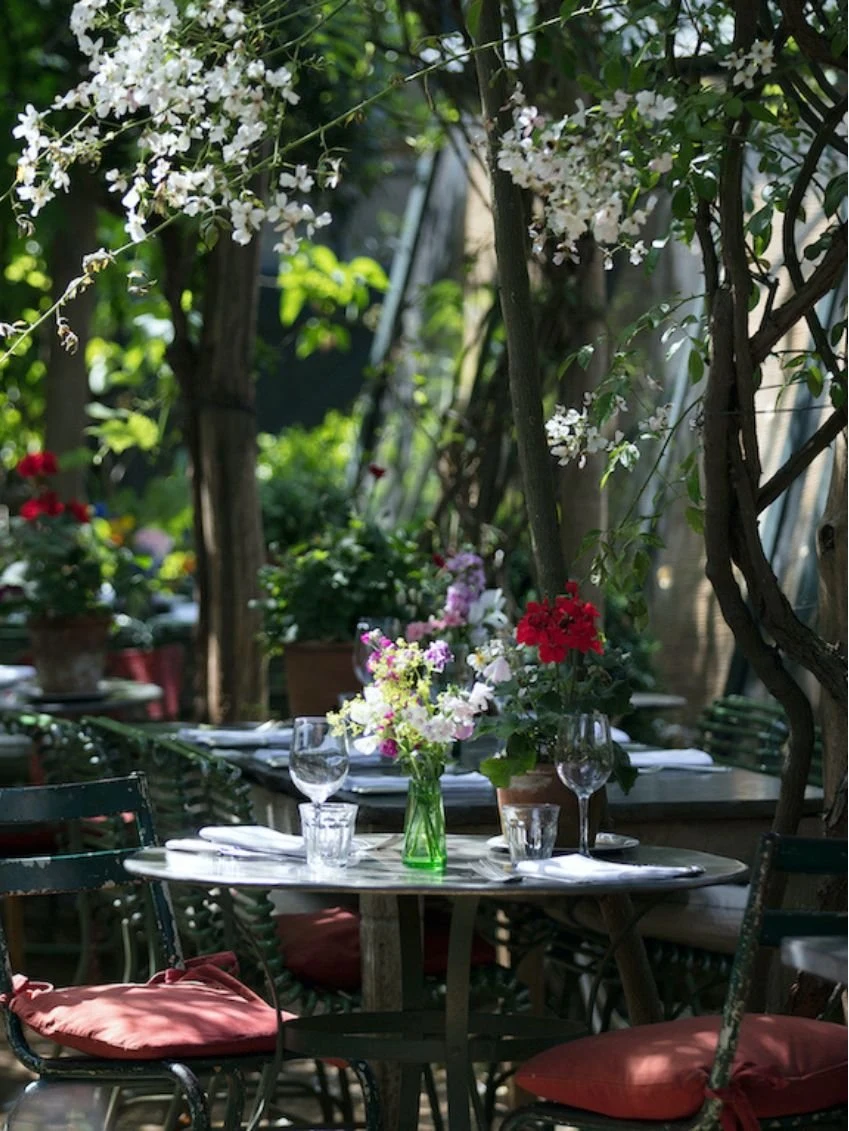
The room gives the cooking enough air. L'Orangerie is set as a luminous winter garden, with naturalistic fabrics, paintings, and a nostalgic Nouvelle-Angleterre note that softens the formality without loosening it. Service moves in the old rhythm: the pass stays composed, the table receives the plate fully dressed, the wine program follows the menu rather than competing with it. Terraces open toward baroque fountains and manicured gardens, so the estate is not background scenery; it presses gently against the meal. The dining format can stretch from à la carte to prix fixe to tasting menu, but the room keeps a conversational level. That matters for food with this much inheritance. The guest can notice the pastry edge, the smoke on lobster, the verbena in the soufflé. Nothing needs to be raised above the craft.
Why this room still matters
L'Orangerie holds one Michelin star of its own, not as a shadow of the flagship, but as a more flexible expression of the same estate thinking. Its place in the domain is useful because it keeps Guérard's ideas in service rather than under glass: the calorie count, the hearth, the garden, the regional animal, the dessert trolley with its nineteenth-century echo. A room that carries recipes dated 1983 and 1986 has to keep proving them at every service rather than displaying them. For now, L'Orangerie's measure remains the 1983 pigeon pie.
Questions
Frequently asked
What kind of restaurant is L'Orangerie?
L'Orangerie is the winter-garden restaurant at Les Prés d'Eugénie in Eugénie-les-Bains, serving French nouvelle cuisine in a formal room.
Who is behind the cooking here?
The restaurant works inside the Famille Guérard estate, and the page copy says the house claims the family's leadership rather than naming a current chef.
What dishes is L'Orangerie known for?
The signature dishes include pigeon pie with foie gras and sour cherries, smoked lobster with dune butter, verbena-infused soufflé, and foie gras cooked in fig leaves with truffle.
What is the booking policy?
Reservation is essential, and bookings are taken through TheFork.
Does L'Orangerie have any recognition?
L'Orangerie holds one Michelin star.
The field
How it compares
| Place | Awards | Cuisine | Notes |
|---|---|---|---|
| L'Orangerie | Michelin 1 Star | French Nouvelle Cuisine | Eugénie-les-Bains, $$$$ |
| Belcanto | Michelin 2 Stars, World's 50 Best | Contemporary Portuguese Fine Dining | Lisbon |
| Döllerer | Michelin 2 Stars | Modern Alpine Cuisine | Golling an der Salzach |
| HAJIME | Michelin 3 Stars, World's 50 Best | Avant-Garde Japanese Fine Dining | Osaka |
| L'Effervescence | Michelin 3 Stars, World's 50 Best | Modern French with Japanese Influences | Tokyo |
| La Ferme aux Grives | · | Traditional French Farmhouse | Eugénie-les-Bains |
| Quintessence | Michelin 3 Stars | Modern French Fine Dining | Tokyo |
Similar places
Contemporary Portuguese Fine Dining
Belcanto
Lisbon, Portugal
★★ · 50 Best
Modern Alpine Cuisine
Döllerer
Golling an der Salzach, Austria
★★
Avant-Garde Japanese Fine Dining
HAJIME
Osaka, Japan
★★★ · 50 Best
Modern French with Japanese Influences
L'Effervescence
Tokyo, Japan
★★★ · 50 Best
Traditional French Farmhouse
La Ferme aux Grives
Eugénie-les-Bains, France
Modern French Fine Dining
Quintessence
Tokyo, Japan
★★★