Muthu's Curry
In Residence
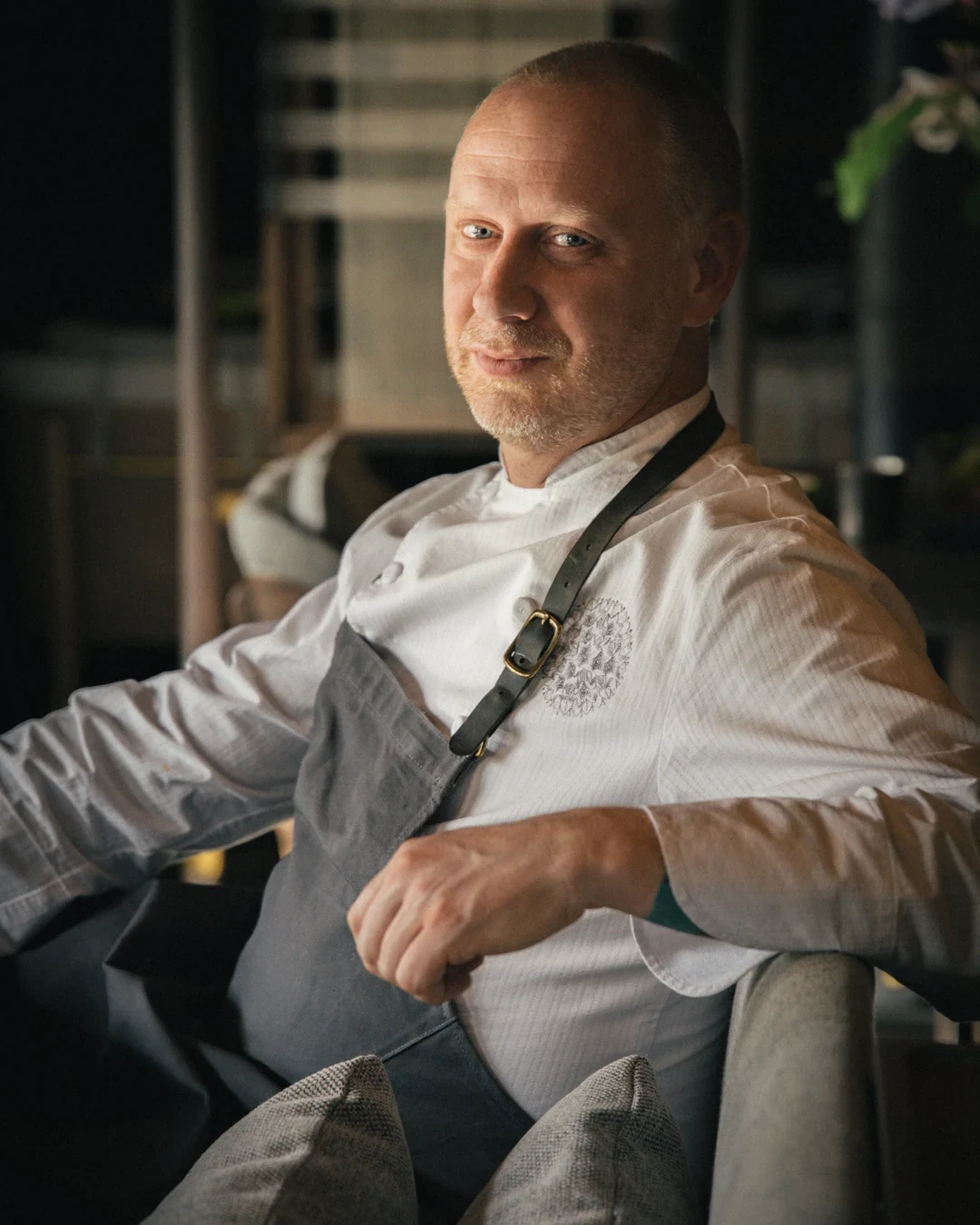
Kasivishvanaath Ayyakkannu
Chef
- 01CuisineAuthentic Chettinad Indian Curry House
- 02CitySingapore, Singapore
- Michelin Bib Gourmand · Michelin Guide
- Michelin Guide Bib Gourmand · 2026
- Michelin Bib Gourmand · 2025
- Michelin Bib Gourmand · 2024
Race Course Road and the Grammar of a South Indian Meal
Race Course Road arrives with a particular kind of sensory weight. The street runs through the heart of Little India, and by mid-morning the air carries cumin, curry leaf, and the faintly charred edge of something cooking over high heat in a narrow kitchen. The shophouses here have been serving Tamil food for generations, and the rhythm of the street, deliveries stacked outside, metal trays being polished on the pavement, the low hum of ceiling fans, reads less like a tourist precinct and more like a working neighbourhood that happens to feed people extraordinarily well.
Muthu's Curry sits at 138 Race Course Road, occupying a ground-floor unit that has long been part of this particular corridor's dining identity. The format is direct: arrive, sit, order. There is no choreography to manage. The value proposition is the food itself, and the Michelin Bib Gourmand, awarded in both 2024 and 2025, confirms what regular visitors have known for some time: this is a reliable address for accessible South Indian cooking in Singapore.
The Sunday letter
Find new places through the people who run them.
Our Sunday email brings you the chefs, winemakers and hoteliers behind our newest stories. See a sample before you subscribe.
See a sample of the Sunday emailOne email a week. Unsubscribe from any issue.
The Bib Gourmand Tier and What It Signals
Singapore's Michelin Bib Gourmand category has become a meaningful credentialling mechanism for mid-price restaurants across the city. The designation requires both quality and value, specifically, a two-course meal (or equivalent) under a price threshold, and the venues that hold it year-on-year occupy a different competitive position than those that earned it once. Muthu's Curry has now held the Bib Gourmand in consecutive years, which places it in the sustained-recognition tier: not a flash newcomer, but a kitchen operating at consistent standard across changing economic conditions.
At the $$ price point, Muthu's Curry sits in the same band as Summer Pavilion for category comparison, though the cuisines are entirely different. The more relevant comparable set is along Race Course Road itself, and within Singapore's broader Indian dining spectrum, where the split between heritage-style South Indian cooking and contemporary reinterpretation has become increasingly pronounced. Venues like Bhoomi and Lagnaa occupy adjacent positions in Singapore's Indian dining scene, and Mustard represents the Bengali end of the spectrum, each drawing a different kind of regulars. Muthu's is the one that Michelin keeps returning to for the traditional South Indian register.
South Indian Cooking and the Question of Sourcing
Any serious conversation about Indian restaurant cooking eventually arrives at the sourcing question, and South Indian cuisine makes it particularly visible. The canonical spices of Tamil cooking (mustard seed, fenugreek, dried red chilli, asafoetida, curry leaf) are not interchangeable commodities. Quality variation in raw tamarind, the freshness of curry leaves, the provenance of coconut, these details register in the finished dish in ways that diners rarely articulate but consistently feel. The kitchens on Race Course Road that have lasted operate with supply chains built over years, not seasons.
This is where the sustainability angle in Indian restaurant cooking tends to be most honest: not in formal certifications or published sourcing statements, but in the structural preference for whole-ingredient cooking, minimal processing waste, and the traditional use of every part of a protein or vegetable. South Indian cuisine, especially the Tamil tradition, was developed in conditions of material constraint and has built-in efficiencies that modern sustainability frameworks are only now articulating in other culinary contexts. A rasam made from tamarind water, tomato, and lentil, a dish that appears on almost every South Indian menu, is, technically, a zero-waste soup. The lentils used to make the water are pressed into dal. Nothing is discarded.
Chef Kasivishvanaath Ayyakkannu operates within this tradition, and it gives the kitchen a structural alignment with low-waste cooking that does not require external validation to be real. At the $$ price bracket, the economics also reinforce discipline: consistency matters when margins are thin and return visits are the goal.
Little India's Position in Singapore's Dining Geography
Singapore's dining reputation internationally defaults to hawker culture and the Orchard Road fine-dining corridor. The Indian dining scene, particularly the South Indian and Tamil expression of it, sits somewhat to the side of that dominant narrative, which has the effect of keeping Race Course Road's leading tables off the international radar even when they are holding Michelin recognition. This is a structural quirk of how Singapore food media tends to organise itself, not a reflection of quality.
For visitors arriving with a broader appetite for the city's full range, Little India operates as a self-contained food quarter: the density of good eating within a few blocks is higher than in most of the city's more photographed districts. Those building a Singapore itinerary around the table can cross-reference with Anglo Indian in Shenton Way for a contrasting register of the subcontinent's cuisines.
The international context is useful here too. Indian fine dining has expanded considerably in the last decade, Trèsind Studio in Dubai, Opheem in Birmingham, Chaat in Hong Kong, INDDEE in Bangkok, Jamavar in Dubai, Musaafer in Houston, Rania in Washington D.C., and Avatara in Dubai are all part of a global shift toward refined Indian formats, but the foundation-level cooking that those kitchens draw on for reference exists in places like Race Course Road. The tradition precedes the fine-dining translation of it.
Planning Your Visit
| Venue | Cuisine | Price Tier | Michelin Recognition | Booking Difficulty |
|---|---|---|---|---|
| Muthu's Curry | South Indian | $$ | Bib Gourmand 2024, 2025 | Walk-in friendly |
| Les Amis | French | $$$$ | Three Stars | Advance booking required |
| Burnt Ends | Australian Barbecue | $$$ | One Star | Competitive online queue |
| Zén | European Contemporary | $$$$ | Three Stars | Months ahead |
| Summer Pavilion | Cantonese | $$ | One Star | Advance booking advised |
Muthu's Curry is at 138 Race Course Road, #01-01, Singapore 218591. The 4.1 Google rating across 3,134 reviews reflects a consistent performance over time.
Questions
Frequently asked
What recognition does Muthu's Curry hold?
Muthu's Curry holds a Michelin Bib Gourmand.
Who works at Muthu's Curry?
Made By profiles Kasivishvanaath Ayyakkannu (Chef) at Muthu's Curry.
How expensive is Muthu's Curry?
Muthu's Curry is listed at a price level of $$.
Where is Muthu's Curry and what does it serve?
Muthu's Curry is in FARRER PARK, Singapore, serving Authentic Chettinad Indian Curry House.
The field
How it compares
| Place | Cuisine | Notes | Awards |
|---|---|---|---|
| Muthu's Curry | Authentic Chettinad Indian Curry House | FARRER PARK, $$ | · |
| Born | Contemporary Fusion Fine Dining | Singapore | Michelin 1 Star, World's 50 Best |
| Burnt Ends | Modern Australian Barbecue | Singapore | Michelin 1 Star, World's 50 Best |
| Jaan by Kirk Westaway | Modern British Fine Dining | Singapore | Michelin 2 Stars, World's 50 Best |
| Les Amis | Classic French Haute Cuisine | Singapore | Michelin 3 Stars, World's 50 Best |
| Odette | Modern French Fine Dining | Singapore | Michelin 3 Stars, World's 50 Best |
| Zén | Neo-Nordic with Japanese Influences | Singapore | Michelin 3 Stars, World's 50 Best |
In residence
Similar places
Contemporary Fusion Fine Dining
Born
Singapore, Singapore
★ · 50 Best
Modern Australian Barbecue
Burnt Ends
Singapore, Singapore
★ · 50 Best
Modern British Fine Dining
Jaan by Kirk Westaway
Singapore, Singapore
★★ · 50 Best
Classic French Haute Cuisine
Les Amis
Singapore, Singapore
★★★ · 50 Best
Modern French Fine Dining
Odette
Singapore, Singapore
★★★ · 50 Best
Neo-Nordic with Japanese Influences
Zén
Singapore, Singapore
★★★ · 50 Best
The Sunday letter
Get the next Made By story in your inbox.
We send one email every Sunday morning with the places and people we covered that week.
See a sample of the Sunday emailOne email a week. Unsubscribe from any issue.