Nadas Winery
- 01CityEtyek, Hungary

- Falstaff Winery - Listed · 2026
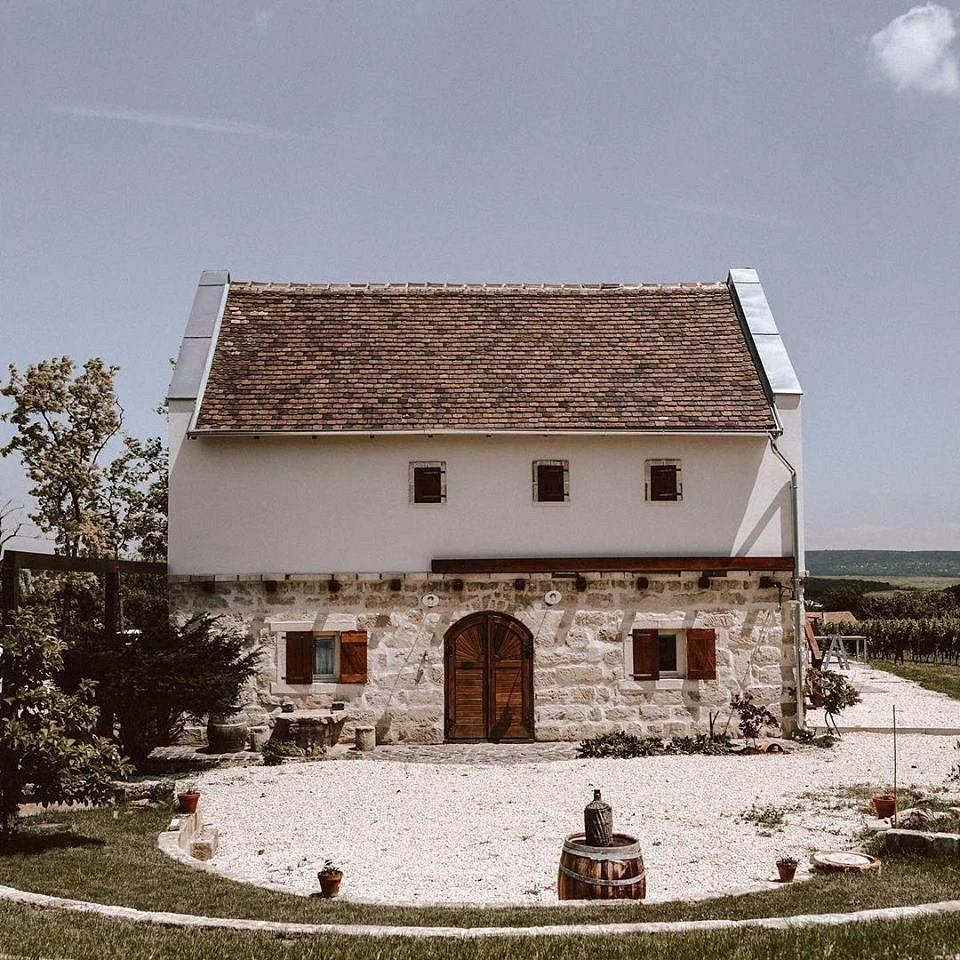
The approach to Etyek’s old wine hills is part of the argument for drinking here. Cellar doors, press houses, and small vineyard parcels explain the region better than a tasting note ever could: this is a wine area built for proximity, not grand distance. Nadas Winery fits that pattern with unusual clarity, working from a 150-year-old Swabian press house and a protected underground cellar where the building is not decoration, but evidence of how Etyek’s wine culture has long organized itself around compact, cellar-led production.
Etyek-Buda has a different rhythm from Hungary’s more monumental wine regions. Its appeal rests on access from the capital, cooler-climate varieties, and a cellar culture that rewards conversation over ceremony. In that context, Nadas Winery’s value is its scale. Production is listed at roughly 14,000 to 15,000 bottles from about 6 hectares, which puts the experience closer to a working family cellar than a hospitality estate. That matters for travelers trying to understand Etyek rather than simply drink through it.
A small Etyek cellar built around place, not spectacle
The strongest reading of Nadas Winery is architectural and regional. The Swabian press house places the visit inside one of Etyek’s defining cultural forms, while the underground cellar links the wines to the practical conditions that shaped local production: stable maturation spaces, compact holdings, and a direct line between maker and guest. The setting on Öreghegy gives the winery a vineyard-facing identity without turning the visit into a resort-style production.
The portfolio also makes sense in Etyek-Buda terms. Whites such as Királyleányka, Grüner Veltliner, Chardonnay, Sauvignon Blanc, and Pinot Gris sit naturally in a region associated with freshness and aromatic definition, while Pinot Noir and Cabernet Sauvignon broaden the range without making red wine the whole story. Orange wine, sparkling wine made by méthode champenoise, and dessert styles add breadth, but the more useful point is structural: this is a small cellar using multiple categories to show what the site and cellar can handle.
That breadth gives the tasting its educational value. Etyek visitors often arrive with a Budapest-day-trip mindset, but the region rewards anyone willing to compare style against place. A flight that moves across still white, red, orange, sparkling, and sweeter categories gives context for how grape choice and cellar method can shift the expression of a compact vineyard area. The absence of named trophy cuvées is not a weakness in this format; the point is range, not hierarchy.
Winemaker Szilárd Nádas brings a useful credential set to that regional story: formal study in Budapest and harvest experience in Bordeaux, Australia, and Canada. Those details matter because Etyek’s stronger small producers often benefit from a double perspective, local cellar culture on one side and broader technical exposure on the other. Here, the biography supports the wine program rather than taking over the narrative.
Where Etyek's day-trip wine culture becomes personal
Hungarian wine tourism can split between polished estate visits and highly personal cellar encounters. Nadas Winery belongs to the second category. The tasting format is guided, private, and educational in tone, with English and Hungarian listed for visits, and the atmosphere is described through small-scale hospitality rather than high-capacity service. For travelers, that means the encounter is likely to feel closer to a cellar conversation than a scripted brand presentation.
The family-run model is especially relevant in Etyek, where the region’s nearness to Budapest can encourage quick, surface-level visits. A cellar of this size asks for a slower reading. The details worth paying attention to are not only what is poured, but how the range is explained: why a Hungarian variety sits beside international grapes, why a traditional-method sparkling wine appears in a small producer’s lineup, and how orange wine fits into a cellar that otherwise works across familiar categories.
There is also a practical editorial distinction here. Nadas Winery is not trying to compete with larger hospitality-led wineries on infrastructure, restaurant programming, or broad estate facilities. Its case is narrower and more convincing: a protected old press house, an underground cellar, a small production footprint, and direct contact with the people behind the bottles. In Etyek, that combination gives a more specific sense of place than a bigger room with a longer menu.
For readers mapping a fuller Etyek itinerary, this cellar sits in a useful constellation of regional wine stops. Nearby pages worth comparing by format include Anonym Pince, Elõd Szijjártó, Etyeki Kúria, Haraszthy Pincészet, and Hernyák Birtok. For broader planning, see our full Etyek wineries guide, then build around meals, stays, drinks, and local programming through our full Etyek restaurants guide, our full Etyek hotels guide, our full Etyek bars guide, and our full Etyek experiences guide.
The wider Central European small-winery lens
Nadas Winery also fits a broader Central European pattern: small producers using heritage buildings, mixed grape programs, and guided tastings to make regional wine legible to visitors. That pattern is not exclusive to Hungary. Readers tracing comparable small-winery cultures across the region might look next to Árvay Winery in Rátka, Atilla Homonna in Erdőbénye, Babarczi Winery in Gyor, »der Steiner« Hans Steiner in Podersdorf am See, and & Handwein in Mannheim.
The editorial case for Nadas Winery is therefore specific, not inflated. Go for a small Etyek-Buda cellar where the historic press house, underground maturation space, and mixed Hungarian-international grape program do real interpretive work. Travelers seeking a grand estate experience should look elsewhere; those interested in how Etyek expresses itself at human scale will find the format more revealing.
Questions
Frequently asked
How expensive is Nadas Winery?
Nadas Winery is listed at a price level of $$.
The field
How it compares
| Place | Notes |
|---|---|
| Nadas Winery | Öreghegy, $$ |
| Elõd Szijjártó | Etyek |
| Etyeki Kúria | Etyek |
| Hernyák Birtok | Etyek |
| Kálna Pincze | Etyek |
| Orosz Gyula Family Winery | Etyek |
| Vizi Pincészet | Etyek |