
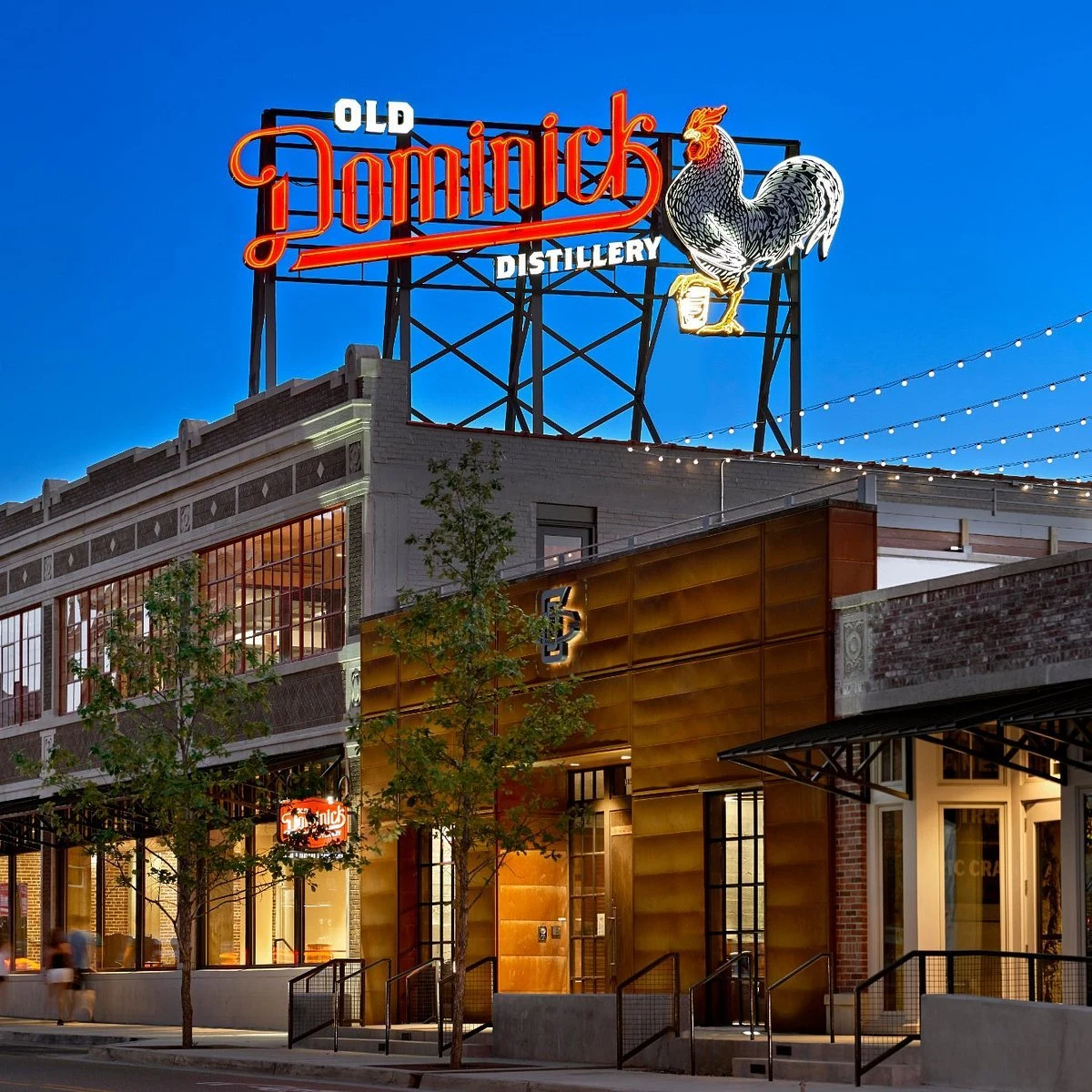
Where the River Meets the Barrel: Memphis Whiskey Culture at 305 South Front
South Front Street runs parallel to the Mississippi, and the buildings along it carry the weight of Memphis commerce going back to the cotton trade. Old Dominick Distillery occupies one of those warehouses, a 19th-century structure tied to the city's distilling history. That history matters here. Memphis was once a significant whiskey production city before national prohibition dismantled it, and the revival of craft distilling in Tennessee has given the city an opportunity to rebuild that identity. Old Dominick sits at the centre of that conversation, operating in a state where whiskey tourism has become a genuine draw alongside Nashville's more saturated scene.
The physical approach sets the tone before you reach the bar. The distillery occupies a substantial footprint on Front Street, and the industrial bones of the building, exposed brick, heavy timber, original iron detailing, shape the room. Craft distilleries across the American South have split between two models: purpose-built production facilities with tacked-on tasting rooms, and historic urban structures where the building itself becomes part of the product story. Old Dominick belongs firmly to the second category.
The Sunday email
Read about the people behind bars like Old Dominick Distillery in the Sunday email.
Every Sunday we send a lead story and up to four more about the chefs, winemakers, sommeliers and hoteliers behind the restaurants, bars, wineries and hotels we cover.
Recent stories
Free. One email a week, and you can unsubscribe from any issue.
Tennessee Whiskey, Bourbon Adjacency, and What the Glass Actually Contains
Tennessee whiskey occupies a specific legal and sensory niche within American spirits. Like bourbon, it must be made from a mash of at least 51% corn, aged in new charred oak containers, and produced within the state. The distinguishing step is the Lincoln County Process, in which the new spirit is filtered through charcoal before aging. This filtering rounds the spirit's edges before the barrel adds its own influence, producing a slightly softer profile than many bourbons at comparable age. It is a process that takes time and equipment, which is one reason the craft revival in Tennessee came later than in Kentucky or New York.
The drinks program at Old Dominick reflects this production reality. The house spirits, including whiskey expressions at various stages of maturation and age, form the backbone of the cocktail list. Across the broader American craft spirits tier, distilleries that control their own production from grain to glass tend to build cocktail programs around showcasing specific expressions rather than chasing trends in sourced-spirit bars. That means the cocktail list here functions differently from what you'd find at, say, Kumiko in Chicago or Bar Leather Apron in Honolulu, where the program draws from a global spirits library. At Old Dominick, the house product is the point of the menu, and cocktails are built to put specific whiskey characteristics in the foreground rather than to layer them under modifiers.
The Pairing Logic: Spirits and Food in a Production Context
Distillery tasting rooms across the South have developed a distinct approach to food. The challenge is that whiskey, at cask or near-cask strength, compresses the palate in ways that require specific food strategies. Fat, salt, and acid all work alongside whiskey in ways that beer or wine pairings do not. Smoked and cured proteins, in particular, interact with oak-aged spirits through a kind of parallel logic: the wood smoke in the spirit and the smoke in the food reinforce rather than compete. In Memphis, where the barbecue tradition runs as deep as the river, that pairing logic has obvious local backing.
The food program at Old Dominick reflects this regional context. Memphis barbecue culture is not a monolith: the city's tradition sits between dry-rub ribs finished in a smoker and wet-sauced pulled pork, with significant variation between pitmasters. A distillery tasting room that draws on this tradition, even partially, is engaging with something that bars elsewhere in the country cannot authentically replicate. For comparison, Jewel of the South in New Orleans and Julep in Houston both operate with strong regional food identities alongside their cocktail programs.
Memphis Bar Context: Where Old Dominick Sits
Memphis drinking culture has distinct tiers. Beale Street handles the tourist-facing live music bar circuit. Midtown and Cooper-Young carry the neighbourhood bar identity, with places like Alex's Tavern and Bardog Tavern anchoring that register. Downtown has seen a shift toward experiential drinking, where the venue itself, its history, its production process, or its setting, is part of the proposition. Old Dominick sits squarely in that third tier. It is not a neighbourhood bar and does not position itself as one.
Bars like Bayou and Andrew Michael operate with different identities, rooted in cocktail craft and restaurant adjacency rather than production tourism. Superbueno in New York City, ABV in San Francisco, and The Parlour in Frankfurt all represent bars where the cocktail program is the primary product. Old Dominick's program is built differently, with the production process as context and the house spirit as the constant anchor. Neither model is superior; they serve different reader decisions.
Questions
Frequently asked
Who works at Old Dominick Distillery?
Made By profiles Alex Castle (Master Distiller) at Old Dominick Distillery.
How expensive is Old Dominick Distillery?
Old Dominick Distillery is listed at a price level of $$.
The field
How it compares
| Place | Notes | Awards |
|---|---|---|
| Old Dominick Distillery | Memphis, $$ | · |
| Allegory | Washington DC | 50 Best |
| Attaboy | New York City | 50 Best |
| Best Intentions | Chicago | 50 Best |
| Cat Bite Club | Singapore | 50 Best |
| Gucci Giardino | Florence | 50 Best |
| Satan's Whiskers | London | 50 Best |
Similar places


The Sunday email
Read about the people behind bars like Old Dominick Distillery in the Sunday email.
Every Sunday we send a lead story and up to four more about the chefs, winemakers, sommeliers and hoteliers behind the restaurants, bars, wineries and hotels we cover.
Recent stories
Free. One email a week, and you can unsubscribe from any issue.