Peang-Prai
- 01CuisineSouthern Thai
- 02CityPhuket, Thailand
From the people index
Recommended by
One trusted voice points here.
- Michelin Plate · 2026
- Michelin Plate · 2025
- Michelin Plate · 2024
Where the Forest Eats Back
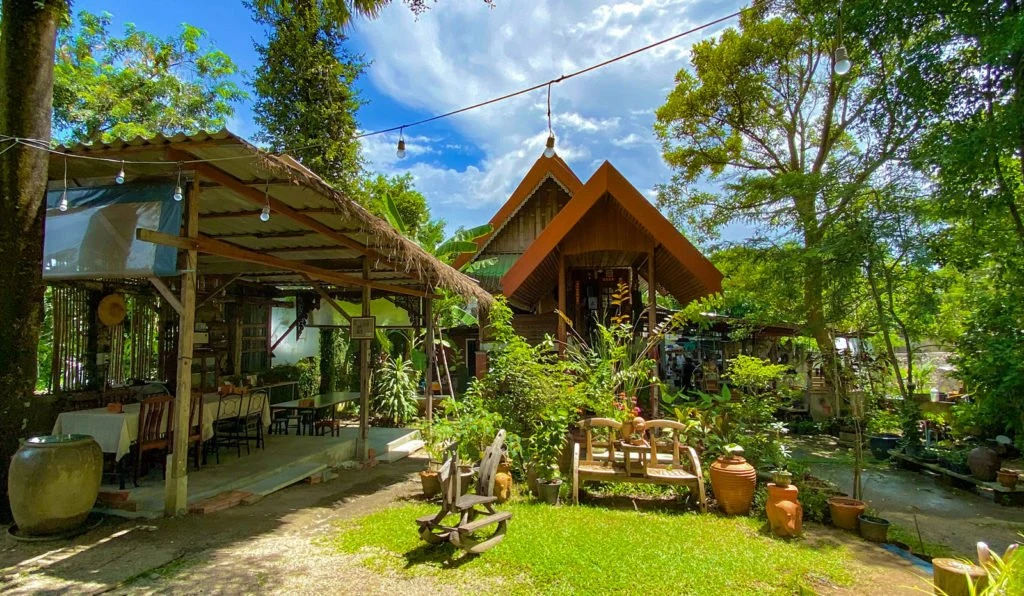
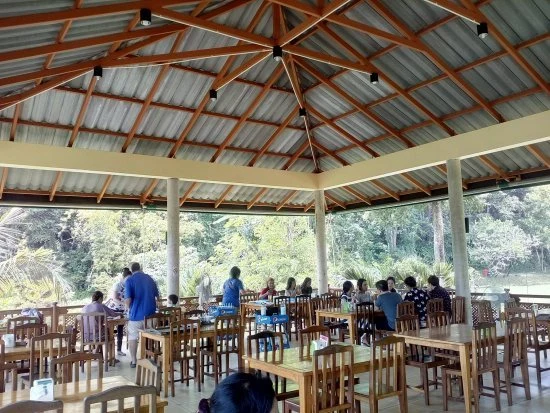
The road to Bang Pae waterfall in Thalang District does not announce itself with signage or streetlights. What arrives instead, as you turn off the main road and follow the tree line north, is a gradual shift in atmosphere: the air thickens with humidity, the canopy closes overhead, and the sounds of the island's tourist infrastructure fall away. By the time two wooden pavilions come into view at the forest edge, connected by a terrace walkway and facing a still lagoon, the setting has already done considerable work. Gibbons call from somewhere in the green wall opposite. Birds answer. The cooking has not yet begun and the meal is, in some sense, already underway.
This is where Peang-Prai operates, and the location is not incidental. Southern Thai cooking has always maintained a closer relationship with its landscape than the cuisine of Bangkok or the central plains. The forest, the coast, the estuaries of Phang Nga Bay, the clam beds along Phuket's western shore: these are not decorative references in a menu description but actual supply lines. Family-run restaurants at this price tier (฿฿, placing it well below Phuket's Michelin-starred fine-dining bracket) have historically been the keepers of that relationship, buying seasonally and locally not as a marketing position but because that is how the kitchen has always worked.
Southern Thai Cooking and What Sets It Apart
Thai cuisine as it is understood abroad tends to collapse into a handful of central-plains dishes: tom yam, pad thai, green curry. Southern Thai cooking operates from a different larder and a different logic. The influence of the Malay peninsula, the proximity to the Andaman Sea, and centuries of spice-trade contact produce a cuisine that runs hotter, more fermented, and more coastal than its northern or central counterparts. Turmeric appears in ways it does not elsewhere in Thailand. Dried shrimp and shrimp paste carry more weight. The curries are darker and the heat is less negotiable.
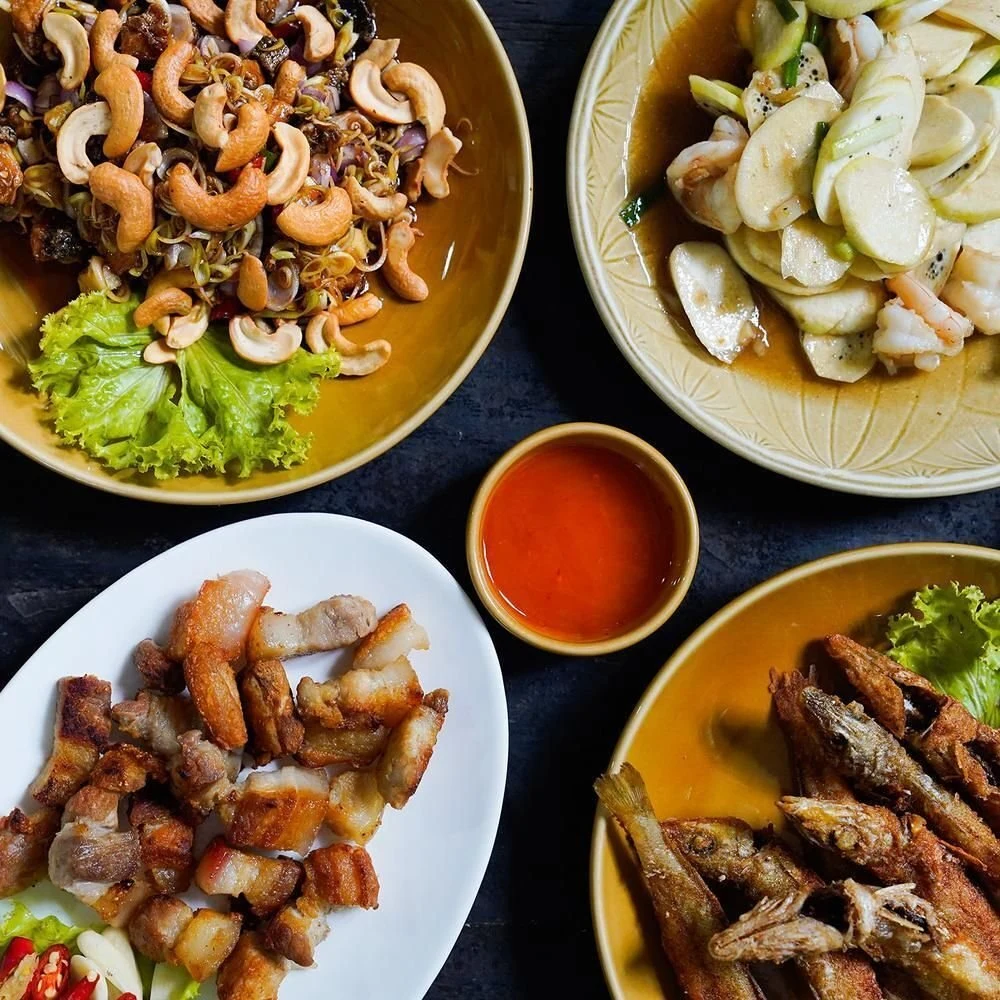
Phuket specifically has a further layer of culinary identity rooted in its Peranakan (Baba-Nyonya) history, the product of Chinese merchant communities who settled across the Malay peninsula and developed a hybrid cuisine of considerable complexity. Dishes that carry a distinctly Phuket identity, muu hong (braised pork belly), o-tao (oyster cake), or the various preparations built around local clams, sit within this tradition rather than the pan-Thai register that dominates resort menus. The Michelin Guide's 2025 recognition of Peang-Prai with a Plate distinction signals that the inspectors found cooking here that met a standard of quality and authenticity worth marking. At this price point, a Michelin Plate signals something about consistency and craft rather than luxury format.
For a wider map of where Southern Thai cooking sits within Thailand's recognized dining tier, Sorn in Bangkok holds two Michelin stars for its southern Thai tasting menu, and Samrub Samrub Thai in Bangkok has built recognition around deep-research Thai cooking more broadly. In Phuket itself, the comparison set spans a wide range: Blue Elephant operates at ฿฿฿ with a colonial-mansion format and refined Thai presentation; Baan Rim Pa Patong occupies the clifftop fine-dining tier; Chuan Chim sits at the same ฿฿ price tier as Peang-Prai with its own local following. What distinguishes Peang-Prai is not price position alone but the pairing of that accessible price with a forest setting that has no equivalent in the island's urban and coastal restaurant clusters.
What the Kitchen Emphasizes
The Michelin citation identifies local Phuket dishes as the kitchen's strength, with seasonal local clams singled out as a point of reference. The clams appear in multiple preparations, including stir-fried with chilli paste, and their presence on the menu is tied to availability rather than year-round consistency. This is how ingredient-led kitchens at this tier operate across Southern Thailand: the dish exists when the ingredient is right, and the kitchen pivots accordingly. Diners accustomed to fixed menus with guaranteed availability should recalibrate expectations, not as a caveat but as the operating logic of a kitchen that takes seasonal supply seriously.
The broader menu covers traditional Thai and Southern Thai cooking, with the family-run structure suggesting a kitchen that works from accumulated practice rather than formal brigade hierarchy. Across Thailand, family-run restaurants of this type have been the primary vehicle for preserving regional specificity: the recipes, the supplier relationships, the informal knowledge of which foraged or fished ingredient is worth waiting for. AKKEE in Pak Kret and Aeeen in Chiang Mai represent parallel examples of regional-specific cooking earning recognition outside the metropolitan fine-dining framework.
The Setting as a Structural Part of the Experience
Two pavilions and their connecting terrace are not incidental architecture. Wooden construction, open sides, lagoon orientation, and forest backdrop create a dining environment that has no close analogue in Phuket Town or the Patong-Kata-Karon resort corridor. The sounds recorded in the Michelin citation, birds and gibbons from the surrounding forest, are not ambient background. They are the acoustic character of the Bang Pae area, which sits within the Khao Phra Thaeo Non-Hunting Area, the island's largest remaining patch of rainforest. The restaurant's position at the waterfall entrance places it at the edge of that protected land.
This matters in the context of how Phuket's dining scene is organized. The majority of recognized restaurants cluster in Phuket Town, the Old Town neighborhood, or along the west coast resort strip. Peang-Prai sits in Pakhlok, in Thalang District in the island's north, a location that draws a different traffic pattern: visitors to the waterfall, residents of the area's villa developments, and diners specifically seeking the forest-setting experience rather than passing trade. A Google rating of 4.5 across 561 reviews suggests a sustained audience rather than a spike of novelty visitors.
Planning the Visit
Peang-Prai sits at 101 18 หมู่ที่ 3 ซอย น้ำตกบางแป, Pakhlok, Thalang District, Phuket 83110, Thailand. The address places it at the entrance to Bang Pae waterfall, which means driving north from Phuket Town through Thalang, then following signs for the waterfall. The ฿฿ price range makes this one of the more accessible Michelin-recognized options on the island, well below the ฿฿฿฿ tier occupied by venues like PRU. Given the setting and the family-run format, visiting at lunch or in the late afternoon allows the forest light and the lagoon view to work at their leading. The clam dishes are seasonal, so availability varies; arriving with flexibility on what the kitchen is emphasizing that week is more useful than arriving with a fixed order in mind.
For broader planning around a Phuket visit, our full Phuket restaurants guide covers the island's full dining range, while our full Phuket hotels guide, Phuket bars guide, Phuket wineries guide, and Phuket experiences guide address the broader stay. Phuket's recognized Thai dining options extend across a wide range of formats and price points, from Buabok and Gorjan to the regional Thai cooking documented at venues like Nahm in Bangkok, Angeum in Phra Nakhon Si Ayutthaya, The Spa in Lamai Beach, and Agave in Ubon Ratchathani, which together illustrate how far Thailand's regional cooking extends beyond the capital.
Questions
Frequently asked
How expensive is Peang-Prai?
Peang-Prai is listed at a price level of $$.
Where is Peang-Prai and what does it serve?
Peang-Prai is in Thalang, Phuket, serving Southern Thai.
The field
How it compares
| Place | Cuisine | Notes | Awards |
|---|---|---|---|
| Peang-Prai | Southern Thai | Thalang, $$ | · |
| Acqua | Modern Italian Fine Dining | Phuket | · |
| Jampa | Modern European Farm-to-Table | Phuket | · |
| Kin-Kub-Ei | Southern Thai Home Cooking | Phuket | · |
| Naam Yoi | Authentic Southern Thai | Phuket | · |
| PRU | Modern Thai Fine Dining | Phuket | Michelin 1 Star |
| Roti Thaew Nam | Phuket-Style Roti and Curry | Phuket | · |