Pikaia Lodge
- 01CuisinePeruvian-Ecuadorian Farm-to-Table with Local Seafood
- 02CityGalapagos Islands, Ecuador
- Relais Chateaux Award · 2025
- The Best Chef One Knife · 2025
Cooking at the Edge of the World's Most Protected Larder
Few dining contexts on the planet impose the kind of ingredient discipline that the Galápagos Islands demand. The archipelago sits under some of the strictest biosecurity regulations in the world: what enters the islands is tightly controlled, what can be harvested from the sea is governed by quotas and seasonal closures, and the movement of organic material between islands is itself regulated. For any serious kitchen operating here, sourcing is not a creative choice so much as a structural constraint, and how a kitchen responds to that constraint defines almost everything about the food it produces.
Pikaia Lodge, located on Ave Charles Darwin in Puerto Ayora on Santa Cruz Island, is a luxury restaurant in Ecuador serving Peruvian-Ecuadorian Farm-to-Table with Local Seafood, with chef Cristian Puente and a price tier of 4. The Relais & Châteaux membership is a meaningful credential in this context: the association's standards require demonstrated commitment to culinary quality alongside environmental responsibility, and in an archipelago where those two values are inseparable, the designation carries more weight than it might at a comparable property in, say, coastal France. The lodge holds Relais & Châteaux membership, a pairing of signals that suggests consistent delivery rather than occasional brilliance.
The Galápagos Larder: What the Kitchen Actually Has to Work With
Understanding what Chef Cristian Puente's kitchen can and cannot source goes a long way toward explaining the food's character. The Galápagos Marine Reserve is one of the largest protected marine areas on earth, and while that status limits commercial fishing, it also means that what is legally caught comes from waters that remain among the least degraded in the Pacific. The provenance argument writes itself, but it is the constraint, not the abundance, that shapes the menu's logic.
Mainland Ecuador supplies what the islands cannot produce: highland vegetables from the Andes, tropical fruits from the Pacific coast, dairy and charcuterie from producers who have learned to meet the biosecurity requirements for import. The result is a kitchen that functions as a kind of relay between two radically different ecologies, the volcanic, arid islands and the agricultural mainland, with the chef's role being to make that relay feel coherent on the plate. For context on how Ecuador's broader restaurant culture approaches this kind of regional sourcing, Tributo in Quito offers a useful reference point on the mainland, as does Casa Julián in Guayaquil, which anchors its menu in the coastal larder just as firmly as Pikaia anchors itself in the archipelago's.
Architecture, Setting, and the Relationship Between Space and Plate
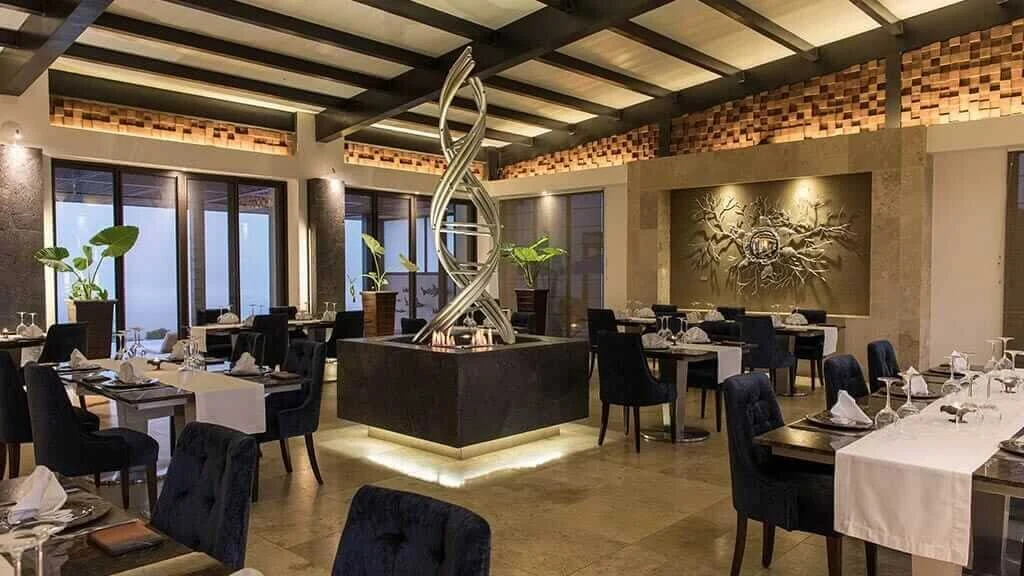
Relais & Châteaux properties in remote ecosystems tend to divide into two architectural approaches: those that impose a cosmopolitan aesthetic onto the landscape, and those that let the landscape set the terms. Pikaia belongs to the second category. The property's contemporary architecture is designed around the views rather than in spite of them, which in the Galápagos means sightlines onto lava fields, endemic flora, and a sky that, at this latitude and altitude, has a quality of light that shifts faster than most guests anticipate.
That integration between environment and interior is not merely aesthetic. In a destination where the wildlife is the primary reason anyone travels at all, a lodge that positions its dining spaces to face outward rather than inward is making a statement about priorities. The food and the setting are meant to reinforce each other, and the low-carbon approach the property highlights, solar energy, water conservation, waste management protocols, is part of the same logic. Dining at a property with serious sustainability credentials in the Galápagos carries a different weight than it would almost anywhere else, because the stakes of environmental failure here are measurable and immediate.
The All-Inclusive Format in a Remote Destination
All-inclusive lodge formats make particular sense in destinations where alternatives are limited and logistics are complex. In Puerto Ayora, the alternative dining scene is modest by the standards of what most international travelers are accustomed to, Evolution Restaurant (Ecuadorian Fusion) is among the few options that operates at a comparable level of ambition on the island. The all-inclusive structure at Pikaia means guests are not making daily decisions about where to eat, which suits a destination where the real decisions involve which island to visit, which dive site to prioritize, and whether the marine iguanas at Tortuga Bay are worth the afternoon walk. The kitchen absorbs the logistics so that attention can go elsewhere.
For the kitchen itself, the all-inclusive format creates a different kind of discipline: the menu must work across multiple meals and multiple days without repetition fatigue, and it must serve guests who arrive jet-lagged from long international connections as well as guests on day four who have spent the morning snorkeling with hammerhead sharks. That range of states and expectations is a more demanding brief than a single-service restaurant faces, and it shapes the food toward approachability without sacrificing the sourcing standards the property's classification demands.
Pikaia in the Context of Destination Lodge Dining
Remote-destination lodge dining occupies a distinct tier within international restaurant culture, one where the comparison set is not urban fine dining but rather other properties that make food a serious part of a place-led proposition. The benchmark properties in this category, whether in the Amazon, the East African savanna, or the Patagonian steppe, tend to share a common characteristic: the kitchen's quality is inseparable from the setting's quality, and neither makes full sense without the other.
Pikaia's Relais & Châteaux membership places it in a global network that includes properties with formidable culinary reputations. Restaurants such as Alain Ducasse – Louis XV in Monte Carlo and Aponiente in El Puerto de Santa María represent the urban and coastal fine-dining end of that association's spectrum. Pikaia occupies the remote-lodge end, where the criteria shift from tasting-menu execution toward the harder-to-quantify achievement of making a kitchen feel essential to a place that is already extraordinary on its own terms. The Relais & Châteaux rating suggests it meets that standard consistently.
Among Ecoventura - Galapagos and the handful of other Galápagos operations working at the premium end of the market, Pikaia distinguishes itself through the combination of land-based architecture, the Relais & Châteaux framework, and a kitchen that takes the archipelago's sourcing constraints as a starting point rather than an obstacle.
Questions
Frequently asked
How expensive is Pikaia Lodge?
Pikaia Lodge is listed at a price level of $$$$.
Where is Pikaia Lodge and what does it serve?
Pikaia Lodge is in highlands of Santa Cruz Island, Galapagos Islands, serving Peruvian-Ecuadorian Farm-to-Table with Local Seafood.
The field
How it compares
| Place | Cuisine | Notes | Awards |
|---|---|---|---|
| Pikaia Lodge | Peruvian-Ecuadorian Farm-to-Table with Local Seafood | highlands of Santa Cruz Island, $$$$ | · |
| Caprice | Contemporary French Fine Dining | Hong Kong | Michelin 3 Stars, World's 50 Best |
| Cocina Hermanos Torres | Modern Spanish Fine Dining | Barcelona | Michelin 3 Stars, World's 50 Best |
| Döllerer | Modern Alpine Cuisine | Golling an der Salzach | Michelin 2 Stars |
| Florilège | Modern French-Japanese Plant-Based Fine Dining | Tokyo | Michelin 2 Stars, World's 50 Best |
| Les Amis | Classic French Haute Cuisine | Singapore | Michelin 3 Stars, World's 50 Best |
| Mirazur | Modern French Fine Dining | Menton | Michelin 3 Stars, World's 50 Best |
Similar places
Contemporary French Fine Dining
Caprice
Hong Kong, Hong Kong
★★★ · 50 Best
Modern Spanish Fine Dining
Cocina Hermanos Torres
Barcelona, Spain
★★★ · 50 Best
Modern Alpine Cuisine
Döllerer
Golling an der Salzach, Austria
★★
Modern French-Japanese Plant-Based Fine Dining
Florilège
Tokyo, Japan
★★ · 50 Best
Classic French Haute Cuisine
Les Amis
Singapore, Singapore
★★★ · 50 Best
Modern French Fine Dining
Mirazur
Menton, France
★★★ · 50 Best