
Where Lusail Meets the Water
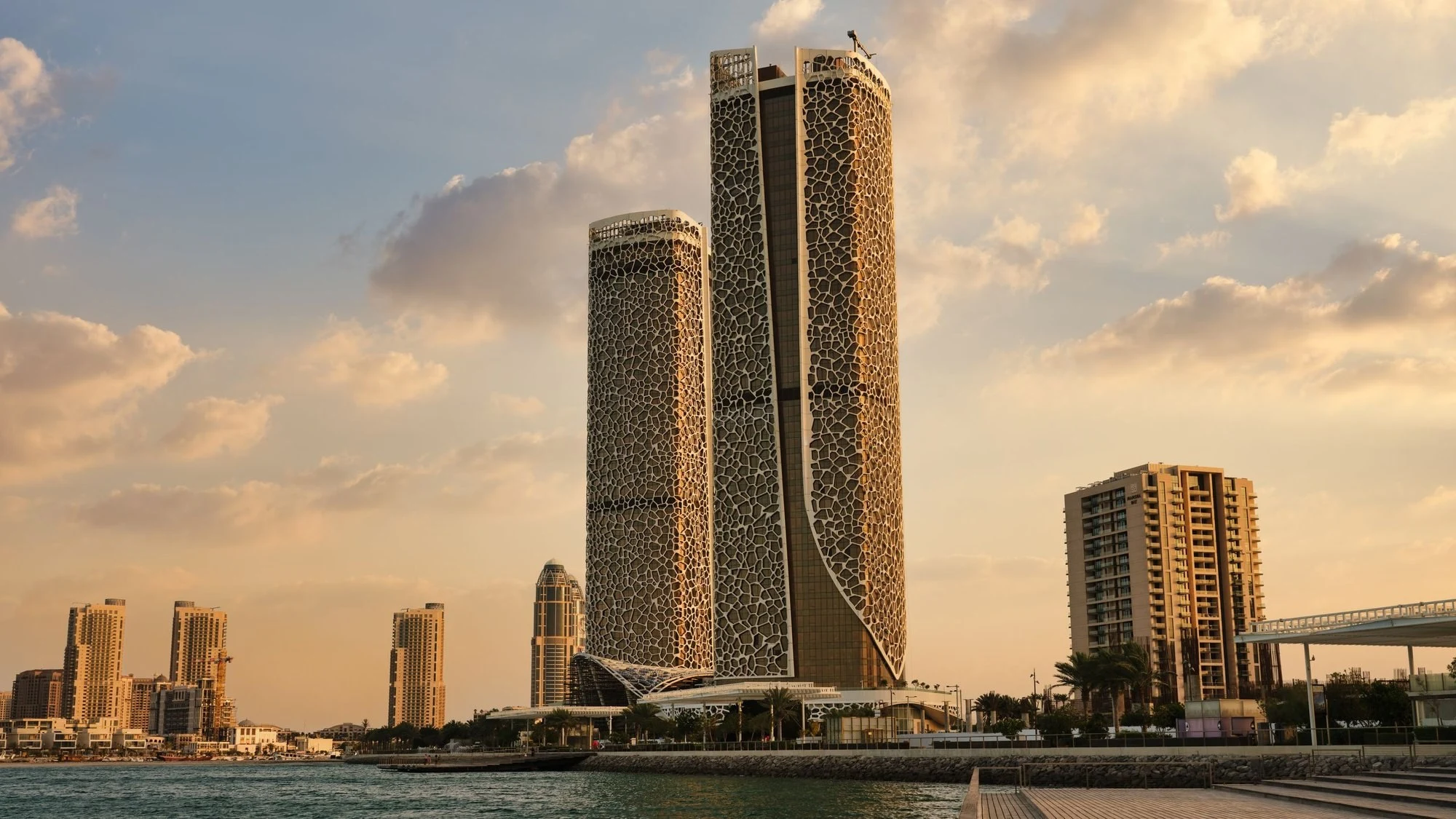
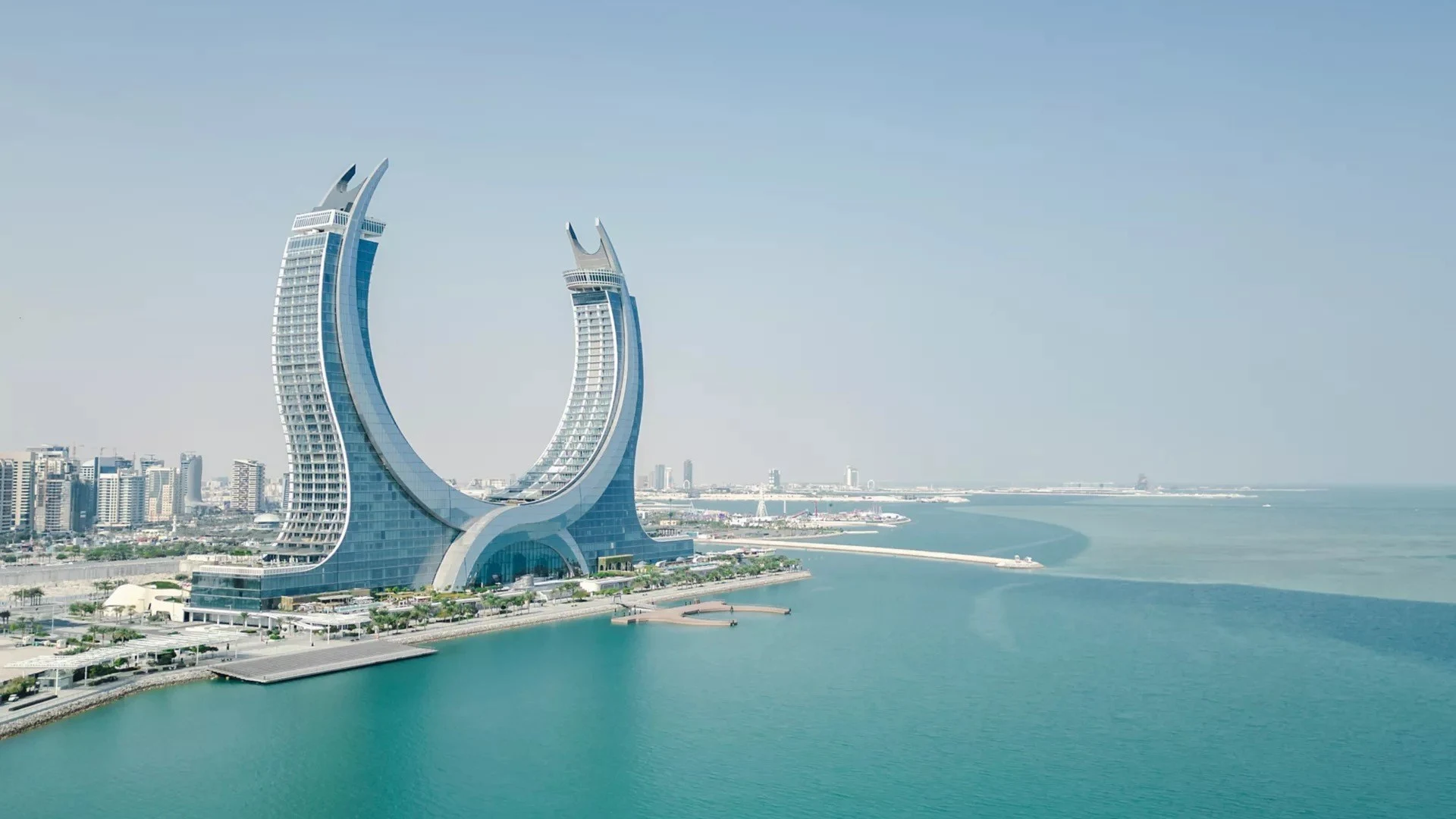
Lusail is not a neighbourhood that grew organically. Qatar built it from scratch on reclaimed land north of Doha's historical centre, and the city continues to take shape around a marina, a boulevard, and a skyline that is still being written. Within that context, Rosewood Doha occupies a deliberate position: two towers at the edge of the marina district, their coral-inspired façade casting geometric patterns of light across the interiors from sunrise to dusk. The architecture comes from Qatari architect Ibrahim M. Jaidah, whose design choices read as a considered argument for locally grounded luxury rather than the generic glass-and-chrome register that defines too much of the Gulf's hotel stock.
That commitment to place is visible in the materials palette throughout the property. Desert tones, warm stone finishes, and sea-glass blues reference both the Qatari landscape and the nearby waterfront without straining to make the connection explicit. Subtle nods to local design traditions appear at the level of detail: textiles, geometric patterning, and craftsmanship that position the hotel in a different tier from the international chain properties that furnish their interiors from the same European catalogues regardless of geography. The comparison set for Rosewood Doha is not Dusit Doha Hotel or the mid-market marina options, it sits closer to the design-led ambition of the Banyan Tree Doha At La Cigale Mushaireb or the Fairmont Doha, both of which trade on architectural presence as part of their value proposition.
The Sunday email
Read about the people behind hotels like Rosewood Doha in the Sunday email.
Every Sunday we send a lead story and up to four more about the chefs, winemakers, sommeliers and hoteliers behind the restaurants, bars, wineries and hotels we cover.
Recent stories
Free. One email a week, and you can unsubscribe from any issue.
155 Rooms in a City Still Finding Its Feet
The inventory sits at 317 rooms and suites, supplemented by long-stay residences and serviced apartments, a scale that reflects Lusail's dual function as both a tourist destination and a developing residential district. Globally, Rosewood properties tend to operate at this kind of contained footprint: sufficient to support multiple restaurants and full amenity programming without tipping into the anonymity that comes with 400-key convention hotels. The Four Seasons Hotel Doha, for context, also holds a tightly managed room count relative to its amenity offering, which creates a different quality of service density compared with the larger resort properties like Banana Island Resort Doha by Anantara.
Long-stay apartments within a luxury hotel tower are a format that has gained traction in Gulf markets where extended business travel, family relocations, and regional corporate mobility create sustained demand for something between a hotel suite and a private residence. Rosewood's inclusion of this tier at Lusail mirrors what properties in comparable new-city developments have found: that the accommodation mix, not the room count alone, determines whether a hotel becomes embedded in a district or merely passes through it.
Daytime and Evening at the Marina Edge
The editorial angle that matters most in Lusail is the day-to-evening shift. During daylight hours, the marina boardwalk functions as a genuine public promenade rather than a hotel amenity corridor. The property's position steps from the water means that daytime at Rosewood Doha involves the actual texture of the developing city around it: the boardwalk pedestrian traffic, the low-angle Gulf light across the marina, the unfinished quality of a neighbourhood that has not yet settled into routine. That rawness is part of what makes Lusail interesting right now, and the hotel is early enough in the district's evolution to feel like a participant rather than a fixture.
By evening, the dynamic inverts. The marina lights, the cooler temperatures that arrive in the October-to-April window when Qatar becomes genuinely liveable outdoors, and the relative quiet of a planned city after business hours shift Rosewood Doha into a more contained register. Gulf luxury hotels in this temperature band do their leading atmospheric work in the post-sunset hours: terraces, water-facing perspectives, and the kind of unhurried pace that Doha's older waterfront, the Corniche, has sustained for decades. Lusail's version of this is newer and less worn-in, but the hotel's marina adjacency gives it access to that evening quality regardless. Travellers considering a visit should weight October through March as the meaningful travel window; summer heat in Doha compresses outdoor activity and changes the daytime calculus entirely.
Within the Gulf luxury market, the daytime-versus-evening question also runs through the comparison between Rosewood Doha and properties at different geographic remove. Hilton Salwa Beach Resort and Villas in Abu Samra and the Zulal Wellness Resort by Chiva-Som in Al Ruwais operate as destination retreats where daytime programming carries the weight of the guest experience. Rosewood Doha, by contrast, is a city-edge property where the surrounding district provides daytime context and evening becomes the hotel's own terrain.
Lusail in the Broader Doha Picture
Doha's hotel geography has shifted meaningfully since the 2022 FIFA World Cup accelerated construction timelines and brought properties online that would otherwise have taken longer to open. Lusail, which hosted the tournament's final match, now functions as a second node in the city's premium accommodation geography, alongside the West Bay cluster and the older Corniche-facing properties. Aleph Doha Residences and the Doha Tower Hotel represent the variety within that broader market. Rosewood's placement in Lusail rather than West Bay signals a deliberate bet on the newer district, one that makes more sense as Lusail's retail, dining, and cultural infrastructure fills in around the marina.
For readers building a Doha itinerary, the choice of district is not trivial. West Bay and the older city offer proximity to the Museum of Islamic Art, Souq Waqif, and the established restaurant scene. Lusail offers the marina, a cleaner urban grid, and the sense of being present in something still forming. Rosewood Doha is the anchor property for that second option.
Globally, the Rosewood brand occupies the same design-conscious tier as properties like Cheval Blanc Paris or Aman New York: hotels where the architectural and material choices are intended as a primary differentiator rather than a backdrop. In Doha, that positioning reads clearly against comparators like the 21 High Street Residence by The Torch, which operates in a different format and price register entirely.
Questions
Frequently asked
What recognition does Rosewood Doha hold?
Rosewood Doha holds 1 Michelin key.
Who works at Rosewood Doha?
Made By profiles Joao Sancheira (Other) at Rosewood Doha.
How expensive is Rosewood Doha?
Rosewood Doha is listed at a price level of $$$$.
The field
How it compares
| Place | Awards | Notes |
|---|---|---|
| Rosewood Doha | Michelin 1 Key | Lusail Marina, $$$$ |
| Raffles Doha | Michelin 2 Keys | Doha |
| The Chedi Katara Hotel & Resort | Michelin 2 Keys | Doha |
Similar places
The Sunday email
Read about the people behind hotels like Rosewood Doha in the Sunday email.
Every Sunday we send a lead story and up to four more about the chefs, winemakers, sommeliers and hoteliers behind the restaurants, bars, wineries and hotels we cover.
Recent stories
Free. One email a week, and you can unsubscribe from any issue.