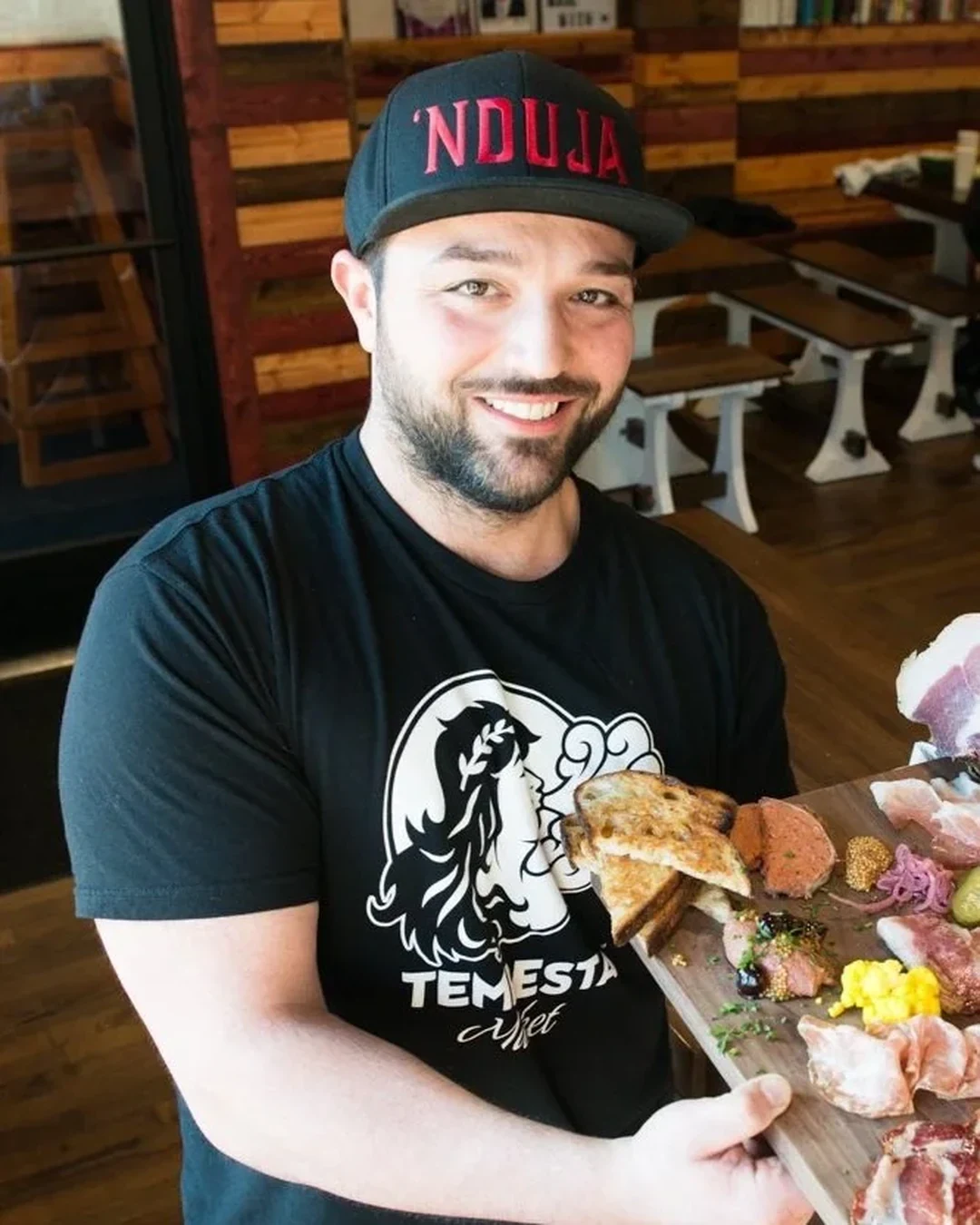
Antonio Fiasche, chef at Tempesta Market in Chicago, builds a sandwich counter from salumi, ’nduja and family charcuterie discipline.
- Opinionated About Dining Cheap Eats in North America Recommended · 2026
The cure sets the pace
The salumi sets the rhythm before the sandwich does. At Tempesta Market in Chicago, chef Antonio Fiasche works from the charcutier’s discipline: seasoning, cure, texture, restraint. His path into that work ran through Publican Quality Meats, where private events cooking put him close to the kind of repetition that turns handling into instinct. At Tempesta, that discipline moves from the cured-meat case to the counter, into sandwiches that treat salumi as the center of the build rather than a garnish.
Fiasche is not working alone in the family sense. Tempesta Market was founded by the father-and-son team Agostino and Tony Fiasche, the same family line behind Nduja Artisans Salumeria. Antonio’s own words keep that inheritance close: “For me, Nonno is more than my grandpa. He is my namesake and my inspiration to better the artisanal craft he continues to teach us all at Tempesta.” The sentence matters because it locates the work where it belongs, not as nostalgia, but as a bench-side instruction carried forward through the hands. His public recognition as StarChefs Chicago Rising Stars Award, Rising Star Charcutier (2018), sits inside that same frame: salumi as daily practice, not decorative heritage.
A deli program built from salumi outward
The method here begins with cured meat and lets the rest of the program answer to it. Tempesta Market is a hybrid deli, sandwich shop, grocery market and Italian eatery, but the grammar is charcuterie. The best-known marker is ’nduja, the spicy, spreadable Calabrian sausage that also anchors Nduja Artisans. In Fiasche’s hands it appears as a signature in its own right and as a seasoning force, including ’nduja aioli and ’nduja arancini.
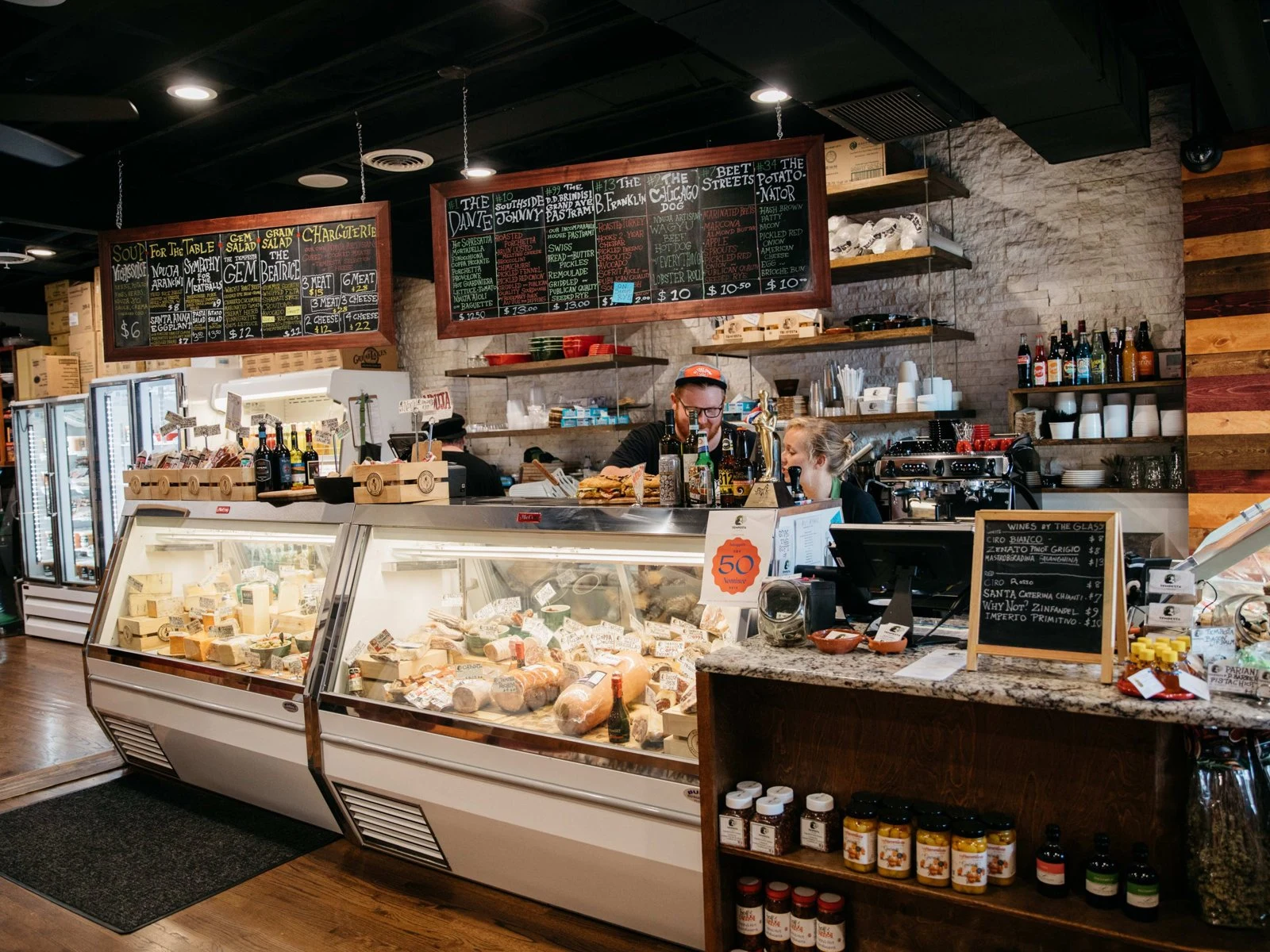
The Dante shows the house style plainly: hot sopressata, mortadella, genoa, hot capicola, porchetta, provolone, hot giardiniera, ’nduja aioli, lettuce and tomato on a baguette. It is a sandwich built like a salumi lesson, layered by heat, fat, acid and crunch. The B. Franklin works in another register, with roasted turkey, Hooks 2-year cheddar, pickled fresno, sprouts, pickled red onion, avocado and sofrito aioli on sourdough. Southside Johnny brings porchetta, brun-uusto cheese, broccolini, chimichurri, pickled fennel, pickled red onion and rosemary broth into the same counter language. Even the colder edge of Fiasche’s practice stays tied to the pantry: ’Nudja Panna Cotta Gelato carries the same cured-meat vocabulary into a form that should not, by habit, accept it.
The counter on Grand Avenue
The room is compact, with the deli counter doing the work of a pass. A line forms close to the glass, and the sequence is tight: order, cut, toast, wrap, hand over. The smell is not abstractly Italian; it is cured meat warming against bread, giardiniera cutting through fat, cheese softening into a sandwich that still needs structure when it leaves the counter. Wooden tables give the room somewhere to slow down, but the counter keeps its own tempo.
Tempesta Market sits at 1372 W Grand Ave in West Town, near the edge of Noble Square, in a part of Chicago where industrial remnants and small food rooms still meet without much ceremony. The grocery side matters because it keeps the place from behaving only like a sandwich shop. Italian pantry items, cheeses, prepared foods and wine sit within reach of the same craft that shapes the sandwiches, so the room reads as a working larder as much as a place to eat. If the next movement is not announced, the current one is clear enough: the case, the bread, the hot giardiniera, and The Dante at the counter on Grand Avenue.
Questions
Frequently asked
What kind of place is Tempesta Market?
Tempesta Market is a hybrid deli, sandwich shop, grocery market and Italian eatery in Chicago's West Town, near the edge of Noble Square.
Who is behind the sandwiches at Tempesta Market?
Chef Antonio Fiasche works the counter there, and the market was founded by the father-and-son team Agostino and Tony Fiasche.
What is Tempesta Market known for?
The market builds its sandwiches from salumi, with ’nduja as a signature ingredient and seasoning force. The Dante, with hot sopressata, mortadella, genoa, hot capicola, porchetta, provolone, hot giardiniera and ’nduja aioli, shows that approach clearly.
What recognition has Antonio Fiasche received?
Antonio Fiasche received a StarChefs Chicago Rising Stars Award as Rising Star Charcutier in 2018.
What else does Tempesta Market sell besides sandwiches?
The grocery side carries Italian pantry items, cheeses, prepared foods and wine, alongside the cured meats that shape the sandwich program.
The field
How it compares
| Place | Cuisine | Awards | Notes |
|---|---|---|---|
| Tempesta Market | Sandwich Shop | · | · |
| Alinea | Avant-Garde Molecular Gastronomy | Michelin 3 Stars, World's 50 Best | Chicago |
| Asador Bastian | Basque-Inspired Steakhouse | · | Chicago |
| Ever | Modern American Fine Dining | Michelin 2 Stars | Chicago |
| Kumiko | Japanese Dining Bar | · | Chicago |
| Oriole | Modern French-Japanese Tasting Menu | Michelin 2 Stars | Chicago |
| Smyth | Modern American Tasting Menu | Michelin 3 Stars, World's 50 Best | Chicago |
In residence
Similar places
Avant-Garde Molecular Gastronomy
Alinea
Chicago, United States
★★★ · 50 Best
Basque-Inspired Steakhouse
Asador Bastian
Chicago, United States
Modern American Fine Dining
Ever
Chicago, United States
★★
Japanese Dining Bar
Kumiko
Chicago, United States
Modern French-Japanese Tasting Menu
Oriole
Chicago, United States
★★
Modern American Tasting Menu
Smyth
Chicago, United States
★★★ · 50 Best