Tenuta di Capezzana
- 01CityCarmignano, Italy
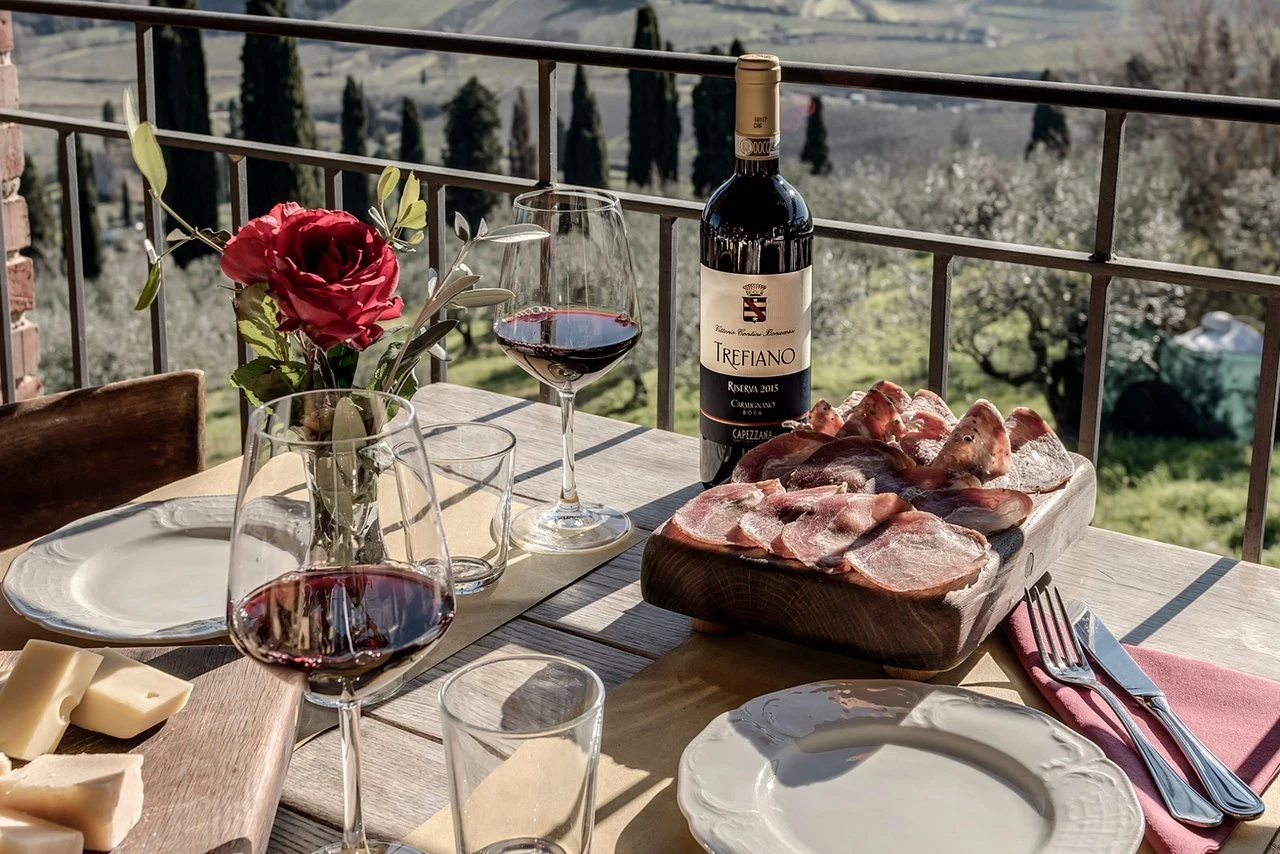
Where the Olive Grove Meets the Table
Approaching Tenuta di Capezzana means driving through a corridor of vines and silver-leafed olive trees that make the estate's logic apparent before you arrive. This is agricultural Tuscany in a form that predates the region's modern tourism infrastructure: the land is working land, and what appears on the table is, in the most literal sense, drawn from what grows immediately around you. Tenuta di Capezzana is a restaurant in Carmignano, in the Prato hills of Tuscany, with a 4.6 Google rating and a price tier of 3. The Carmignano DOC zone, a compact appellation in the Prato hills west of Florence, has operated at this scale for centuries, and Capezzana sits at its centre.
The estate sits within Carmignano, one of Tuscany's smaller and older wine denominations, recognised officially by the Grand Duke Cosimo III de' Medici in 1716, placing it among the earliest formally delimited wine zones in Europe. That historical weight matters not as a marketing point but as a structural one: the land here has been selected, cultivated, and evaluated across generations, and the character of what it produces reflects accumulated agricultural knowledge rather than recent intervention.
The Sunday email
Read about the people behind wineries like Tenuta di Capezzana in the Sunday email.
Every Sunday we send a lead story and up to four more about the chefs, winemakers, sommeliers and hoteliers behind the restaurants, bars, wineries and hotels we cover.
Recent stories
Free. One email a week, and you can unsubscribe from any issue.
The Source as the Story
In an era when provenance language has become ambient noise across Italian restaurants of every price tier, Capezzana represents a version of farm-to-table that requires no rhetorical flourish. The estate produces its own extra-virgin olive oil alongside wine, and both have been integral to the property's economic and culinary identity for decades. This is not supplementary production. The olive oil in particular has earned recognition through specialist channels, placing Capezzana in a comparable set that includes Italy's most closely watched agricultural producers rather than simply its most celebrated restaurants.
Tuscany's better-known dining destinations, particularly those in Florence, often source ingredients from producers across a wide radius. Estates like Capezzana compress that radius to near zero. What that means practically is that the olive oil pressed from trees on the property is the same oil used at the estate table, and the wine poured during a meal is made from grapes grown in sight of the dining room. For visitors accustomed to ingredient sourcing as a claim to be verified, the transparency here is structural rather than performative.
This positions Capezzana differently from Tuscany's recognised fine-dining circuit. Properties like Enoteca Pinchiorri in Florence operate at the top of the region's restaurant hierarchy, with extensive cellars and formal service formats. Capezzana's register is distinct: it is an agricultural estate first, and the hospitality it offers is an extension of that identity rather than a separate operation layered on top of it. The comparison set is not Osteria Francescana in Modena or Le Calandre in Rubano but rather the small group of Italian producer estates where visiting means engaging with the full production chain.
Carmignano's Position in the Tuscan Frame
Carmignano occupies an interesting position in Tuscany's wine and food geography. It sits between the Chianti Classico zone to the southeast and the Montalbano hills to the northwest, close enough to Florence to be accessible as a day visit but sufficiently removed to retain agricultural character. The appellation is small by any measure, with a fraction of the production volume of Chianti, and its relative obscurity within the international wine market means it has attracted less of the outside investment that has reshaped other Tuscan zones over the past three decades.
That comparative quietness is significant for visitors. Carmignano does not have the wine-tourism infrastructure of Montalcino or the Bolgheri coast. Estates here tend to receive guests who have sought them out rather than visitors swept up in a broader tourist circuit. If you are visiting from Florence, the drive west into the Carmignano hills is straightforward, and the agricultural density of the zone changes visibly as the suburban edges of the city give way to vineyards and olive groves.
The regional comparison is useful here. Northern Italian estates producing wine and food in close integration, such as those in Piedmont or Franciacorta, have benefited from consistent international media attention. Central Tuscany's producer estates, outside the Brunello and Super Tuscan headlines, remain relatively under-examined by the kind of editorial attention that shapes booking patterns. Capezzana benefits and suffers from this in equal measure: access is easier than at heavily trafficked Tuscan destinations, but information for first-time visitors requires more active research.
Questions
Frequently asked
How expensive is Tenuta di Capezzana?
Tenuta di Capezzana is listed at a price level of $$$.
The field
How it compares
| Place | Notes | Awards |
|---|---|---|
| Tenuta di Capezzana | Carmignano, $$$ | · |
| Azienda Agricola Podere Il Sassolo | Carmignano | · |
| Catena Zapata | Luján de Cuyo | 50 Best |
| Colline San Biagio | Carmignano | · |
| Fattoria Ambra | Carmignano | · |
| Podere Allocco | Carmignano | · |
| Tenuta di Artimino | Carmignano | · |
Similar places

The Sunday email
Read about the people behind wineries like Tenuta di Capezzana in the Sunday email.
Every Sunday we send a lead story and up to four more about the chefs, winemakers, sommeliers and hoteliers behind the restaurants, bars, wineries and hotels we cover.
Recent stories
Free. One email a week, and you can unsubscribe from any issue.