The Goods Shed

In Residence
Luke Frankie
Chef
- 01CuisineSeasonal British Gastropub
- 02CityCanterbury, United Kingdom
- The Good Food Guide Good Food Guide Best Local Restaurant: 125pts · 2026
- The Good Food Guide GFG Very Good · 2025
Where the Market Comes to the Table
There is a particular kind of restaurant that only makes sense in context. At Station Road West in Canterbury, the context is everything: a converted Victorian goods shed, a working farmers' market operating around you, and a kitchen that treats the stalls outside as its daily larder. Approaching Canterbury West station, you pass through the market before you reach the dining room, and that sequence is not incidental. It is the entire point. Few restaurants in the south of England make the relationship between producer and plate as physically legible as this one.
The Goods Shed marks its twenty-fifth year in 2025, a significant run for any independent restaurant, and a particularly telling one for a place built around the logic of seasonal availability rather than a fixed menu identity. That model demands a kitchen willing to recalibrate daily, and a dining room willing to follow it. Both conditions have held here across a quarter century, which is itself an editorial argument about the durability of sourcing-led cooking when it is genuinely practised rather than used as a positioning phrase.
Sourcing as Structure, Not Marketing
The farmers' market model that underpins The Goods Shed sits in a different tier from the tasting-menu destination restaurants that draw attention to the broader Kent and south-east England food scene. Places like hide and fox in Saltwood operate with multi-course precision built around a fixed creative vision. The Goods Shed operates on a different principle: the produce determines the menu, not the reverse. A chef walking from the kitchen to a market stall to select the morning's vegetables is not a staged moment for Instagram. Here, it is a functional part of mise en place.
This approach requires a specific kind of restraint. The blackboard typically offers around five choices per course, changing daily in response to what the market yields. There are no tasting menus, no amuse-bouches, no elaborate architectural plating implied by the format. The cooking that emerges from this structure tends toward directness: grilled squid with lemon and green sauce, cold roast pork with anchoïade, fried capers and pickled cucumber. These are dishes that declare what they are without preamble. The anchovy-based sauce alongside cold pork is an old European pairing deployed without apology. The fried capers and pickled cucumber add acidity in a way that shows kitchen thinking without performing it.
Contrast this with the register of a place like Le Manoir aux Quat' Saisons in Great Milton or Moor Hall in Aughton, where the ingredient sourcing story is embedded within a multi-course narrative and priced accordingly. The Goods Shed positions itself outside that competitive set entirely. Its peer group is not the destination fine-dining circuit but a smaller category of market-embedded restaurants where the sourcing is structural rather than decorative, a category that, in Britain, remains genuinely sparse.
The Kitchen Under Morgan Lewis
Former sous-chef Morgan Lewis now leads the kitchen, and the transition has preserved the menu's foundational character. The cooking continues to read as devotedly seasonal and without unnecessary elaboration. Generous main courses tend toward reinterpretations of established British and European formats: a meaty pork chop with cauliflower purée and cauliflower salad, finished with a glossy reduced sauce, or a brandade fishcake served with a butter sauce dotted with caviar and topped with rocket and salmon roe. The latter demonstrates something worth noting about the kitchen's range: fishcakes in British casual dining are rarely served with caviar and roe. The pairing signals a kitchen thinking carefully about salt, fat, and intensity across the plate rather than defaulting to comfort-food simplicity.
Desserts follow the same ethos of pleasure without over-engineering. Choux buns filled with strawberry and vodka ice cream and white chocolate have been cited as a strong close to the meal, a format familiar enough to read as welcoming but executed with enough precision to justify the finish.
The Room, the Drinks, and the Service
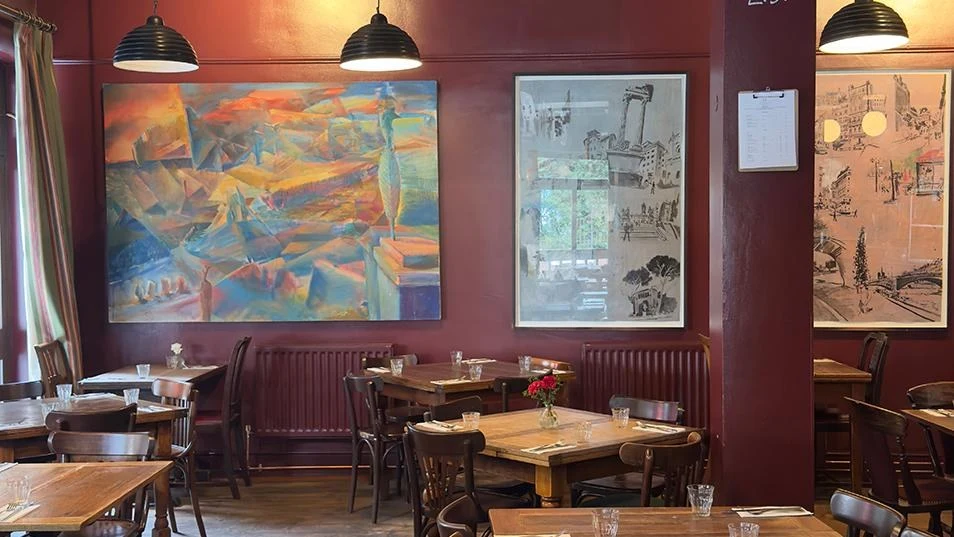
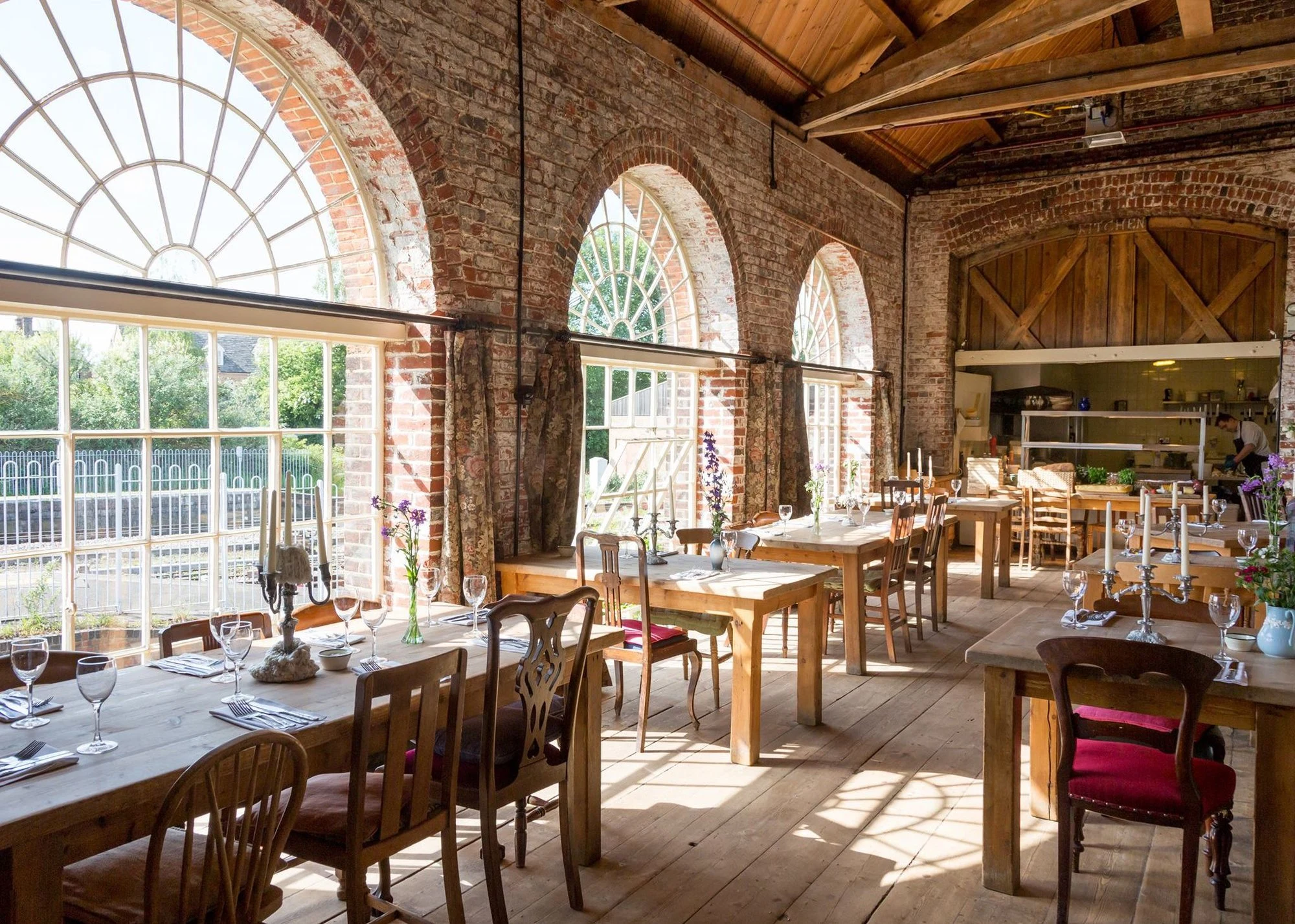
The setting inside the goods shed carries the industrial character of its original function: a high-ceilinged, utilitarian space made warm by the bustle of the market around it and the presence of regulars who have been coming for years. One long-term diner's comment that they have felt welcome and at home for many years reflects a continuity of atmosphere that is harder to engineer than it appears. Service described consistently as charming in independent assessments tends to reinforce the idea that the tone here is set by genuine hospitality rather than trained warmth.
The drinks list is brief and purposeful. A short selection of European wines is supplemented by English bottles, and there is a considered line-up of Kentish ales and ciders that makes direct reference to the surrounding county's agricultural character. The inclusion of Kent producers in the glass, not just on the plate, extends the sourcing logic consistently. A small cocktail selection rounds out the offer without expanding it into territory that would shift the tone.
Planning a Visit
The Goods Shed sits within the farmers' market building on Station Road West, a short walk from Canterbury West station. The market operates on set days, and the restaurant's menu follows what the market yields, so timing matters: visiting on a market day gives the kitchen the broadest palette. Given the daily-changing blackboard format, no fixed menu can be anticipated in advance. The format suits those who are comfortable with a limited choice built around what is genuinely available, rather than a wide menu assembled for range.
For readers who follow the sourcing-led, market-driven model of cooking across Britain, comparable approaches in very different settings and price brackets can be found at Hand and Flowers in Marlow and, at the opposite end of the investment scale, at L'Enclume in Cartmel, where Simon Rogan's farm-to-table model operates at the highest tier of British dining. The Goods Shed makes no attempt to occupy that tier. Its argument is different and, in its own terms, well-made over twenty-five years.
Questions
Frequently asked
Who works at The Goods Shed?
Made By profiles Luke Frankie (Chef) at The Goods Shed.
How expensive is The Goods Shed?
The Goods Shed is listed at a price level of $$.
Where is The Goods Shed and what does it serve?
The Goods Shed is in Canterbury West, Canterbury, serving Seasonal British Gastropub.
The field
How it compares
| Place | Cuisine | Notes | Awards |
|---|---|---|---|
| The Goods Shed | Seasonal British Gastropub | Canterbury West, $$ | · |
| Anchor & Hope | Seasonal British Gastropub | London | · |
| Atelier Crenn | Contemporary French Fine Dining | San Francisco | Michelin 3 Stars, World's 50 Best |
| Hélène Darroze at The Connaught | Three Michelin-Star Modern French Fine Dining | London | Michelin 3 Stars |
| Mugaritz | Avant-Garde Basque Fine Dining | Errenteria | Michelin 2 Stars, World's 50 Best |
| Myojaku | Modern Minimalist Kaiseki | Tokyo | Michelin 3 Stars, World's 50 Best |
| Ynyshir Hall | Modern Fusion Fine Dining | Machynlleth | Michelin 2 Stars |
In residence
Similar places
Seasonal British Gastropub
Anchor & Hope
London, United Kingdom
Contemporary French Fine Dining
Atelier Crenn
San Francisco, United States
★★★ · 50 Best
Three Michelin-Star Modern French Fine Dining
Hélène Darroze at The Connaught
London, United Kingdom
★★★
Avant-Garde Basque Fine Dining
Mugaritz
Errenteria, Spain
★★ · 50 Best
Modern Minimalist Kaiseki
Myojaku
Tokyo, Japan
★★★ · 50 Best
Modern Fusion Fine Dining
Ynyshir Hall
Machynlleth, United Kingdom
★★