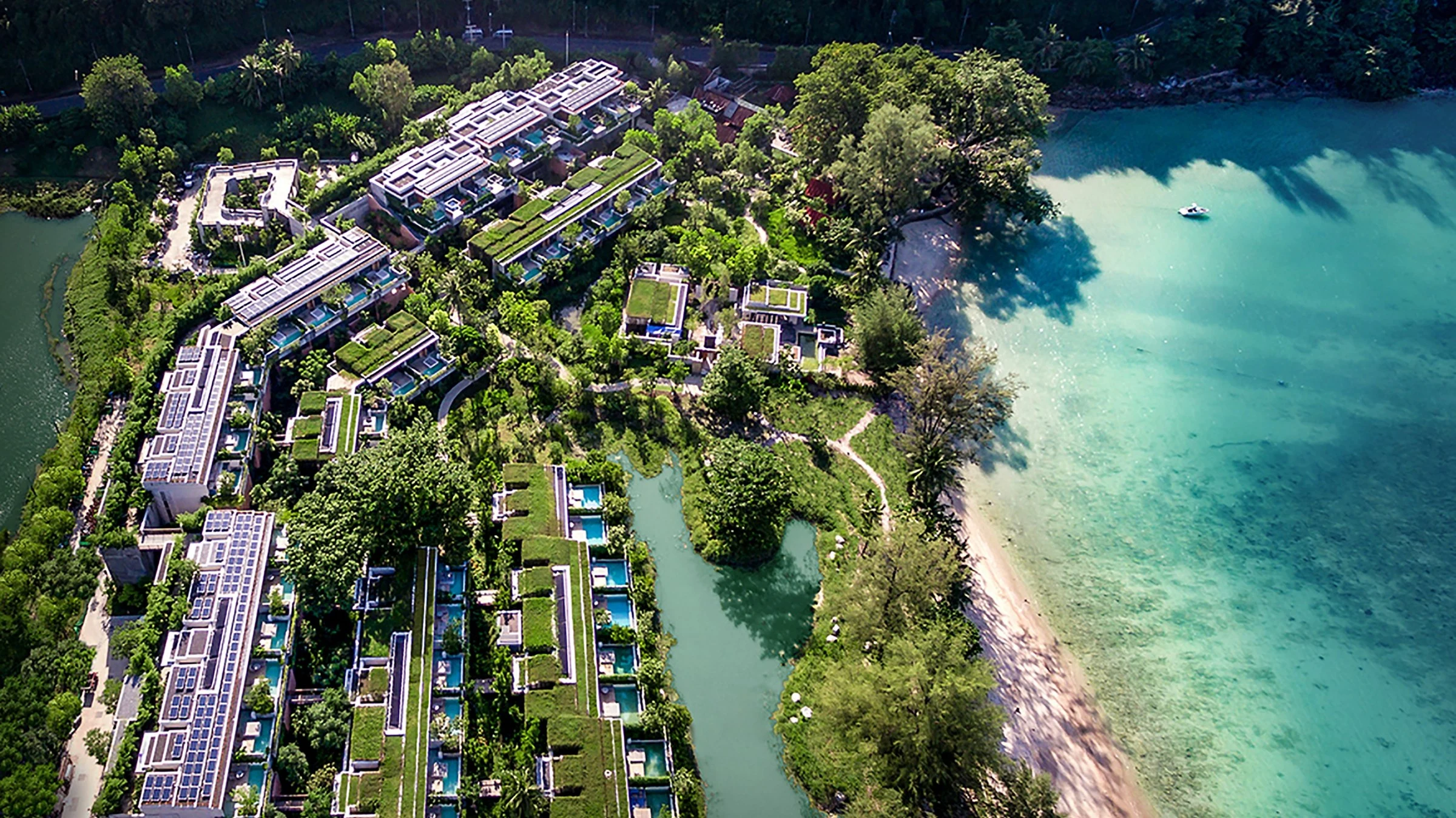
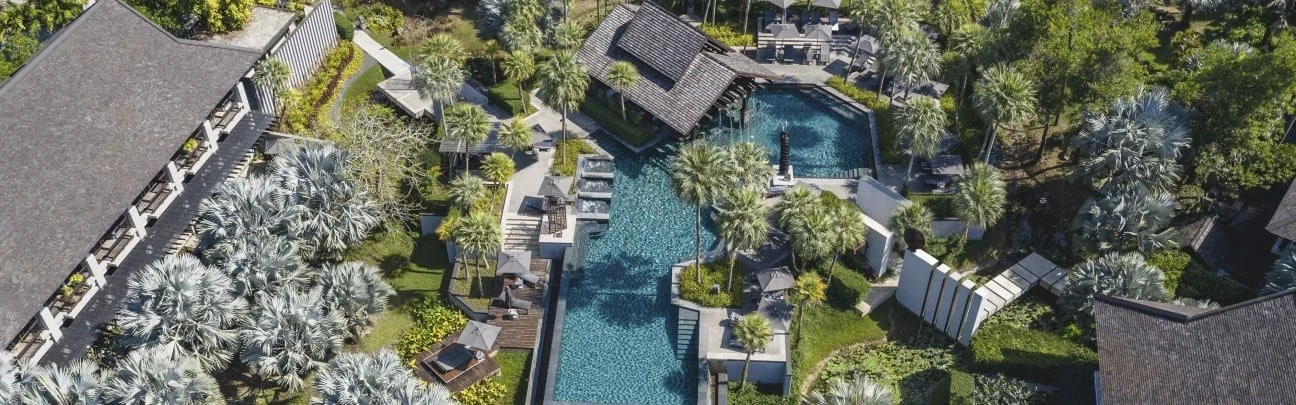
The Slate occupies a former tin mining site near Nai Yang Beach, channelling Phuket's industrial heritage through Bill Bensley's design language of exposed beams, blackened metals, and polished concrete. Awarded 94.5 points by La Liste 2026 and recognised as a Global Luxury Design Hotel, it offers 185 rooms across six categories from suites to Private Pool Pavilions, with rates from $277 per night.
<h2>When Phuket Stopped Playing It Safe</h2><p>For most of its modern resort history, Phuket has sold a consistent visual grammar: limestone infinity pools, Thai sala pavilions, and the soft-focus aesthetic of international luxury brands. That grammar worked. It still works at properties like <a href="https://www.enprimeurclub.com/hotels/amanpuri-phuket-hotel">Amanpuri</a>, <a href="https://www.enprimeurclub.com/hotels/keemala-phuket-hotel">Keemala</a>, and <a href="https://www.enprimeurclub.com/hotels/rosewood-phuket-phuket-hotel">Rosewood Phuket</a>. But by the early 2010s, a subset of travellers had grown fatigued by the formula, the rattan sunbeds, the ochre-washed walls, the predictable spa-villa choreography. The Slate is a 5-star hotel in Phuket near Nai Yang Beach, located at 116 Tambon Sa Khu, Amphoe Thalang, Chang Wat Phuket 83110.</p><p>The visual shift is apparent before you reach the lobby. Exposed structural beams, blackened metals, and polished concrete set the scene, materials drawn from industrial heritage rather than tropical tradition. Interior designer Bill Bensley, whose portfolio spans some of Southeast Asia's most recognised properties, calibrated the aesthetic to feel grounded in Phuket's extractive past rather than its postcard present. Thai silks and rattan furnishings remain, but they read as counterpoints to the raw industrial framework rather than the main event. The effect is something that resists easy categorisation, and that resistance is largely the point.</p><h2>A Design Vocabulary Built on Industrial Memory</h2><p>Phuket's tin mining era shaped the island's demographics, architecture, and economic character for well over a century. The Sino-Portuguese shophouses of Phuket Town are one legacy. The Slate draws on a different aspect of that same history: the physical apparatus of extraction, the machinery and the materials, repurposed as aesthetic language. This places the property in a growing cohort of hotels globally that use industrial heritage as a design anchor rather than a liability, comparable in approach, if not in geography, to properties like <a href="https://www.enprimeurclub.com/hotels/the-fifth-avenue-hotel-new-york-city-hotel">The Fifth Avenue Hotel in New York City</a>, where a building's material history informs its current identity.</p><p>The result at The Slate is a 185-room property across six distinct room grades, a range that allows it to function across different traveller budgets and group configurations within the same design framework. Entry-level suites carry all standard amenities including high-speed internet, satellite television, and air conditioning. The hierarchy moves upward through Private Pool Pavilions to the Pearl Shells, which run to one- or two-bedroom configurations with options that include private pools, jacuzzis, saunas, or personal massage tables depending on the specific unit. The breadth of that range is deliberate: it allows the property to hold guests across a wider spending spectrum without fracturing the design coherence of the site.</p><h2>Where It Sits in Phuket's Competitive Set</h2><p>Phuket's northern end, around Nai Yang Beach and the airport corridor, occupies a different tier in the island's hospitality ecosystem from the villa-heavy promontories of Surin and Kamala. The area is quieter, less commercially developed, and suited to guests who prioritise seclusion over proximity to the island's retail and nightlife infrastructure. At roughly a thirty-minute drive from Phuket's more built-up zones, The Slate trades some convenience for space and quiet, a trade-off that suits a specific traveller disposition and that mirrors choices made by properties like <a href="https://www.enprimeurclub.com/hotels/anantara-mai-khao-phuket-villas-phuket-hotel">Anantara Mai Khao Phuket Villas</a>, also positioned in the island's northern corridor.</p><p>Against the island's broader luxury set, The Slate's rate entry point of $277 per night positions it below the absolute ceiling occupied by <a href="https://www.enprimeurclub.com/hotels/amanpuri-phuket-hotel">Amanpuri</a> or <a href="https://www.enprimeurclub.com/hotels/andara-resort-villas-phuket-hotel">Andara Resort and Villas</a>, while still operating clearly within the design-led luxury tier. Its award tally includes one Michelin Key and five total awards, underscoring its design-led standing. For comparison within Thailand's broader luxury hotel circuit, properties like <a href="https://www.enprimeurclub.com/hotels/four-seasons-resort-chiang-mai-chiang-mai-hotel">Four Seasons Resort Chiang Mai</a> or <a href="https://www.enprimeurclub.com/hotels/mandarin-oriental-bangkok-bangkok-hotel">Mandarin Oriental Bangkok</a> compete on heritage and brand lineage; The Slate competes on a different axis entirely.</p><h2>The On-Site Offer and the Question of Self-Sufficiency</h2><p>The property's distance from the island's restaurant and bar density makes its on-site food and beverage infrastructure more consequential than it would be for a centrally located hotel. Multiple bars and restaurants operate within the grounds, giving guests sufficient range to remain on-site for multi-day stays without menu fatigue, a practical necessity given the thirty-minute transfer to Patong or Kata's dining circuits. This self-contained model is common across Thailand's island resorts that choose seclusion as a positioning signal: <a href="https://www.enprimeurclub.com/hotels/six-senses-yao-noi-phang-nga-hotel">Six Senses Yao Noi in Phang Nga</a> and <a href="https://www.enprimeurclub.com/hotels/anantara-koh-yao-yai-resort-villas-phuket-hotel">Anantara Koh Yao Yai Resort and Villas</a> operate on similar logic.</p><p>For guests whose itineraries do extend off-site, Nai Yang Beach itself provides a low-key alternative to the island's more crowded southern beaches, and the proximity to Phuket International Airport is a practical convenience for itineraries that begin or end in the north.</p><h2>How the Property Has Moved Over Time</h2><p>The Slate opened under the name Indigo Pearl, carrying the mining-heritage concept from the start. The rebrand represented more than a name change: it marked a conscious repositioning toward the design-hotel segment at a moment when that category was gaining clearer definition globally. The La Liste awards, both the design and art designations, reflect how the property's identity has sharpened over time, moving from a novel concept in a sea of spa resorts to a recognised participant in an international design conversation that also includes properties like <a href="https://www.enprimeurclub.com/hotels/aman-new-york-new-york-city-hotel">Aman New York</a> and <a href="https://www.enprimeurclub.com/hotels/aman-venice-venice-hotel">Aman Venice</a> at the top of the design-led luxury tier.</p><p>That trajectory matters because it signals durability. A novelty concept can draw early curiosity but struggles against competitive pressure as the market catches up. The sustained critical recognition from La Liste suggests the property has moved past novelty into something with longer staying power: a hotel that made a considered bet on a design direction and has held that position through a period when Phuket's luxury supply expanded significantly. Other parts of Thailand's premium circuit, <a href="https://www.enprimeurclub.com/hotels/phulay-bay-a-ritz-carlton-reserve-krabi-hotel">Phulay Bay in Krabi</a>, <a href="https://www.enprimeurclub.com/hotels/samujana-villas-surat-thani-hotel">Samujana Villas in Koh Samui</a>, or <a href="https://www.enprimeurclub.com/hotels/soneva-kiri-trat-hotel">Soneva Kiri in Trat</a>, have each found distinct identity anchors. The Slate's is industrial heritage, and it has not drifted from it.</p><h2>Planning Your Stay</h2><p>Rates start from $277 per night, with six room grades ranging from standard suites to the Pearl Shell villas. The property sits at 116 Tambon Sa Khu, Amphoe Thalang, roughly half an hour from Phuket Town and Patong, and under ten minutes from Phuket International Airport, making it a natural fit for arrivals and departures without a city-centre transfer. The northern location and self-contained F&B; offer suit guests planning stays of three nights or more, where the property's range of bars, restaurants, and room configurations becomes an asset rather than a constraint. Guests comparing options in the northern corridor should also consider <a href="https://www.enprimeurclub.com/hotels/intercontinental-phuket-resort-phuket-hotel">InterContinental Phuket Resort</a> and <a href="https://www.enprimeurclub.com/hotels/avista-grande-phuket-karon-mgallery-collection-phuket-hotel">Avista Grande Phuket Karon</a> as alternative reference points in the broader upper-midscale and luxury tier, though neither shares the same design-heritage positioning.</p>
The Slate has received recognition including: An ode to Phuket’s tin mining past, this one-of-a-kind resort marries industrial chic with traditional Thai design.; La Liste Top Hotels (2026): 94.5pts; Global Winner — Luxury Design Hotel; Country Winner — Luxury Art Hotel; Price: $277 Ro….
The Slate is located at 116 Tambon Sa Khu, Amphoe Thalang, Chang Wat Phuket 83110, Phuket.
The property offers six room grades, and the Private Pool Pavilions represent a strong middle-ground choice: self-contained, with direct pool access, without scaling up to the full Pearl Shell villa format. The Pearl Shell villas — available as one- or two-bedroom configurations — add options such as jacuzzis, saunas, or personal massage tables for guests who want the full on-property experience, especially given the resort's distance from Phuket's main dining and nightlife corridors.
The design concept, executed by Bill Bensley, translates Phuket's tin mining history into a physical aesthetic: exposed beams, blackened metals, polished concrete, and industrial plumbing fixtures sit alongside Thai silks and rattan. The property won both Global Luxury Design Hotel and Country Luxury Art Hotel at the La Liste Top Hotels awards in 2026, scoring 94.5 points — recognitions that reflect the design commitment rather than simply spa or service benchmarks.
The Slate is a resort property with 185 rooms, not a restaurant or bar operating on a drop-in basis, so room stays require advance booking. Its location near Nai Yang Beach — roughly a half-hour from Phuket's more densely developed southern areas — means the property functions as a self-contained destination rather than a stopping point, which makes pre-planned stays more practical than spontaneous visits.
The Slate opened under the name Indigo Pearl, which established the tin-mining design concept in its original form before a subsequent rebrand refined the property's identity. The 185-room resort in Thalang, Phuket has carried the same heritage-design premise across both chapters, earning La Liste Top Hotels recognition in 2026 with 94.5 points as The Slate — a sign the underlying concept has held its critical standing through the transition.
Travelers who want a Phuket resort stay that steps outside the standard limestone-and-sala formula will find the industrial-heritage aesthetic a genuine departure. Rates start from $277 per night across six room grades, placing the property within reach of design-conscious travelers who don't require proximity to Patong or Kata Beach, and who prefer the quieter northern end of the island around Nai Yang.
116 Tambon Sa Khu, Amphoe Thalang, Chang Wat Phuket 83110
Nai Yang, Thalang District