Ultraviolet by Paul Pairet
- 01CuisineAvant-Garde French Multi-Sensory
- 02CityShanghai, China
- 03RecognitionThree Michelin Stars
- 3 Michelin Stars · Michelin Guide
- World's 50 Best · #24 · World's 50 Best Restaurants
- Michelin 3 Stars · 2024
- Opinionated About Dining Top Restaurants in Asia Ranked #3 · 2024
- Opinionated About Dining Top Restaurants in Asia Ranked #1 · 2023
- World's 50 Best Best Restaurants #35 · 2021
- World's 50 Best Best Restaurants #48 · 2019
- World's 50 Best Best Restaurants #24 · 2018
- World's 50 Best Best Restaurants #41 · 2017
- World's 50 Best Best Restaurants #42 · 2016
- World's 50 Best Best Restaurants #24 · 2015
A Room That Doesn't Exist Until You're Inside It
Shanghai's premium dining scene has, over the past decade, cleaved into two recognizable streams: the Bund-facing spectacle restaurants where the room and the view share billing with the plate, and the increasingly intimate counter and tasting formats where the food is the entire architecture. Ultraviolet by Paul Pairet was a three-Michelin-starred restaurant in Shanghai serving avant-garde French multi-sensory cuisine; it served its final table on March 29, 2025 and is now closed. The room has no fixed postcode in the public imagination, the view is whatever the projection system puts on the walls, and the food arrived inside an experience where every sensory input had been composed in advance.
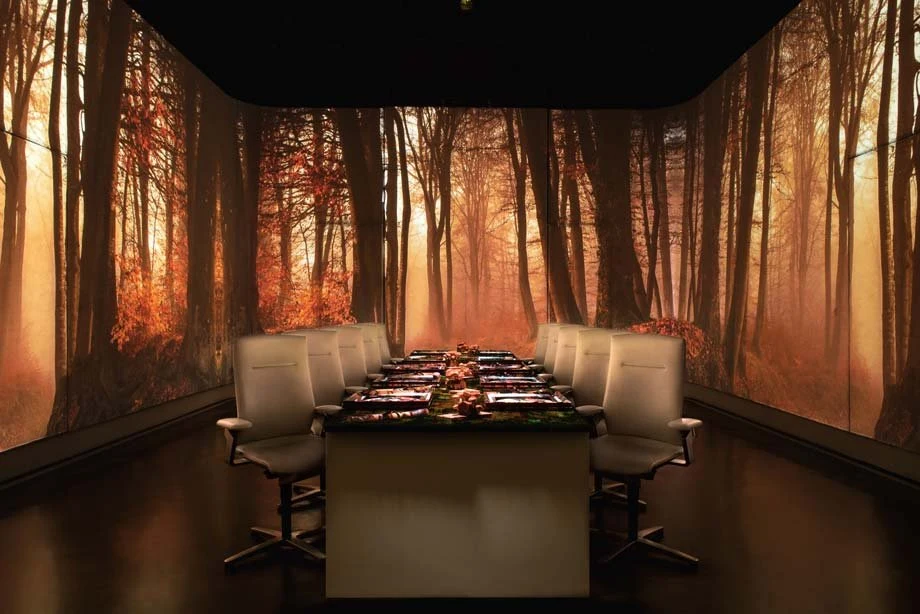
During its operating years, guests gathered at a staging point before being transported to the dining location. The single dining table seated ten. Every surface in the room became a projection canvas. Sound, scent, and temperature were adjusted course by course. This is not theatrical garnish applied to an otherwise conventional tasting menu, the environmental elements were woven into the dish logic, meaning that what guests smelled and heard was intended to alter how they read what was on the plate. Whether that premise lands depends partly on willingness to cede interpretive control, and partly on how seriously one takes the idea that context reshapes perception.
Where It Sits in the Rankings, and What That Means
Few Shanghai restaurants have maintained the kind of sustained global ranking presence that Ultraviolet has accumulated. It appeared in the World's 50 Best Restaurants in 2015 (#24), 2016 (#42), 2017 (#41), 2018 (#24), 2019 (#48), and 2021 (#35). That is six appearances across six separate assessment cycles, with scores clustered in the leading quarter of the list during its strongest years. By 2023, Opinionated About Dining had placed it first among all restaurants in Asia, a ranking methodology that draws on a wide base of frequent-diner votes rather than a panel of critics, and in 2024 it held third position on the same list.
For context within Shanghai's high-end tier, consider the competitive set. Taian Table operates a comparably intimate tasting format. Fu He Hui works at the ¥¥¥¥ price point through an entirely different lens, vegetarian, rooted in Chinese philosophical tradition. 102 House represents the Cantonese formalism end of the spectrum. 8½ Otto e Mezzo Bombana anchors the Italian side of Shanghai's international fine dining. Each of these occupies a different register. Ultraviolet did not compete for the same diner on the same night as any of them; it made a different proposition entirely, and its decade-long ranking trajectory suggests that proposition has been received seriously by the people who eat across this tier professionally.
The Wine Dimension at a Concept Like This
The editorial angle that mattered most at a format like Ultraviolet was not the wine list in isolation; it was the question of how wine service functioned when the room itself was the dominant sensory actor. At a conventional twelve- or fifteen-course tasting counter, the sommelier's job is to bridge the food and the glass, using cellar depth and pacing to support a menu built around flavour progression. There, the sommelier's task was more complicated. Each course arrived with an environmental setting, a particular light temperature, a diffused scent, a sound layer, that had already primed the diner's sensory state before the glass was raised. The wine pairing either worked in concert with that environmental framing or it worked against it.
This is a meaningful conceptual distinction. At restaurants like Xin Rong Ji on West Nanjing Road, where the cuisine tradition carries its own established flavour logic, wine selection can follow relatively well-mapped pairing conventions. The innovative format at Ultraviolet had no such map. The pairings had to account for the multisensory context of each course, not merely its flavour profile. That required a sommelier with both cellar access and interpretive flexibility, the ability to think about how a wine's aromatic architecture would interact with a scent already in the air, or how its acidity reads against a particular acoustic environment. Whether the programme executed this at the level the concept demanded varied by service, but the structural challenge remains part of its legacy.
What the format guaranteed was that the wine programme could not be treated as an afterthought. During its operating years, at ten covers per night, the pairing sequence was as rehearsed as the projections. There was no walk-in sommelier improvisation at this scale; every selection was tested in advance against the full environmental context of each course. That was a degree of pairing rigour that larger restaurants, however strong their cellars, could not replicate through service alone.
Closure and Legacy: The Practical Reality
Ultraviolet served its final table on March 29, 2025, after 13 years in Shanghai. Reservations are no longer available, and the former ten-cover format should now be understood as part of the restaurant's legacy rather than a current booking option.
The address historically associated with the restaurant was in Huangpu district, within the Bund corridor; the dinner location was disclosed only to confirmed guests during its operating years.
Logistics at a Glance: How Ultraviolet Compares to Peer Formats
| Venue | City | Covers | Price Tier | Format |
|---|---|---|---|---|
| Ultraviolet by Paul Pairet | Shanghai | 10 | ¥¥¥¥ | Multisensory fixed programme, secret location |
| Taian Table | Shanghai | Small counter | ¥¥¥¥ | Tasting menu, intimate counter format |
| Fu He Hui | Shanghai | Larger room | ¥¥¥¥ | Vegetarian tasting, traditional setting |
| Born | Singapore | Small counter | Premium | Creative, tasting menu |
| Bo Innovation | Hong Kong | Standard dining room | Premium | Innovative Chinese, tasting format |
For those building a broader China itinerary around serious dining, Xin Rong Ji in Beijing, Ru Yuan in Hangzhou, Xin Rong Ji in Chengdu, Chef Tam's Seasons in Macau, Imperial Treasure Fine Chinese Cuisine in Guangzhou, and Dai Yuet Heen in Nanjing each represent high-end reference points in their respective cities.
Questions
Frequently asked
What recognition does Ultraviolet by Paul Pairet hold?
Ultraviolet by Paul Pairet holds 3 Michelin stars and a place on the World's 50 Best list at number 24.
How expensive is Ultraviolet by Paul Pairet?
Ultraviolet by Paul Pairet is listed at a price level of $$$$.
Where is Ultraviolet by Paul Pairet and what does it serve?
Ultraviolet by Paul Pairet is in Lan Ni Du, Shanghai, serving Avant-Garde French Multi-Sensory.
The field
How it compares
| Place | Awards | Cuisine | Notes |
|---|---|---|---|
| Ultraviolet by Paul Pairet | Michelin 3 Stars, World's 50 Best #24 | Avant-Garde French Multi-Sensory | Lan Ni Du, $$$$ |
| 8 1/2 Otto e Mezzo Bombana (Shanghai) | Michelin 2 Stars | Modern Italian Fine Dining | Shanghai |
| Amazing Chinese Cuisine | Michelin 2 Stars | High-end Chaoshan Cuisine | Shanghai |
| Fu He Hui | Michelin 2 Stars, World's 50 Best | Modern Seasonal Vegetarian Fine Dining | Shanghai |
| Ling Long Shanghai | Michelin 1 Star, World's 50 Best | Modern Chinese Fine Dining | Shanghai |
| Meet the Bund | Michelin 1 Star, World's 50 Best | Modern Fujianese Fine Dining | Shanghai |
| Taian Table | Michelin 3 Stars | Modern European with Asian Influences | Shanghai |
Similar places
Modern Italian Fine Dining
8 1/2 Otto e Mezzo Bombana (Shanghai)
Shanghai, China
★★
High-end Chaoshan Cuisine
Amazing Chinese Cuisine
Shanghai, China
★★
Modern Seasonal Vegetarian Fine Dining
Fu He Hui
Shanghai, China
★★ · 50 Best
Modern Chinese Fine Dining
Ling Long Shanghai
Shanghai, China
★ · 50 Best
Modern Fujianese Fine Dining
Meet the Bund
Shanghai, China
★ · 50 Best
Modern European with Asian Influences
Taian Table
Shanghai, China
★★★