Winemaker
Berthold Haider
- Discipline
- Winemaker
- Based in
- Apetlon, Austria
i. Biography
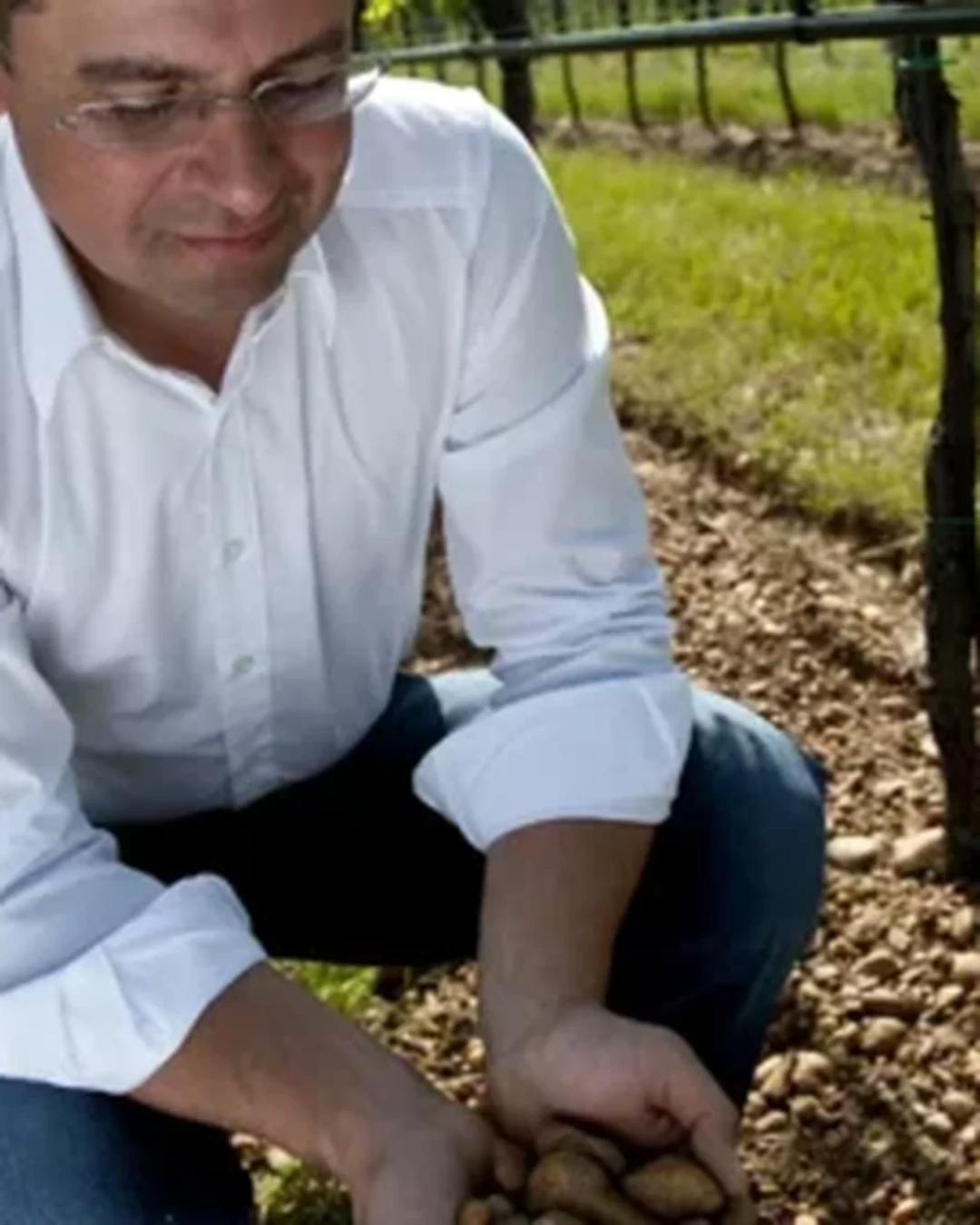
"the wines are left as natural as possible." Berthold Haider’s sentence is plain, almost severe, and it gives the work at BioDyn Weinhof Haider in Apetlon, Austria, its center of gravity: less command than attention, less correction than restraint. He heads, manages, and steers the activity in the vineyard and in the cellar, holding the estate’s daily decisions close to the vines, the tanks, and the character of the Seewinkel east of Lake Neusiedl.
The Idea
The Haider family has been producing grapes for four generations, a continuity that gives his work a long horizon without making it decorative. The estate is based in Apetlon in the Seewinkel, east of Lake Neusiedl, and its wines are tied to that setting through biodynamic agriculture practiced according to Demeter guidelines. That method is not presented as ornament; it is the estate’s way of preserving the character shaped by the soils and climate around the lake. Haider describes the approach as letting the vines flourish without intervention and keeping the wines as natural as possible, a belief that shows up both in the vineyard and in the cellar. The result is biodynamic natural wine from Apetlon, including PetNats, orange wine, Blaufränkisch, Welschriesling, and other Austrian varieties. The range is significant since it keeps the estate’s work grounded in place while allowing different textures, colors, and degrees of immediacy to speak.
The Execution
For white wines, the estate uses spontaneous fermentation from naturally occurring yeasts, a choice that keeps the cellar from imposing a standardized signature on the fruit. Haider puts the second half of that logic clearly: "We rely entirely on aging in stainless steel tanks for our white wines in order to preserve the actual aromatics of the grape and the original flavor profile." Sulfur is treated with the same restraint. The estate uses no added sulfur for white natural wines and only minimal sulfur for red natural wines, a cellar practice aligned with Haider’s stated wish to leave the wines natural. Among the named bottles, Jung & Sexy 2023 is a bubbly red PetNat made from Rösler and Blauburger, described as explosive, expressive, juicy, dark-berried, softly tannic, cheeky, and very drinkable. Artemis 2018, the estate’s orange wine, is made from Grüner Veltliner and Pinot Blanc with 101 days of skin contact. The red side carries its own emphasis. The Truth is a 100% Blaufränkisch described as lively, concentrated, better structured, and with potential to age well. Haider’s own hierarchy is direct: "For this reason, Blaufränkisch is by far the most important red grape variety for us." ATTILA Jahrgangscuvée extends that register as a cuvée of Zweigelt, Blaufränkisch, and Cabernet Franc, described by the estate as a strong yet elegant, complex red wine with impressive character. Across the range, Demeter certified wines are the formal credential behind a practice built on minimal intervention and a close reading of place.
On the Record
At BioDyn Weinhof Haider, Berthold Haider is the person guiding both vineyard and cellar activity. The family’s four-generation history with grapes gives that role an inherited depth, while the present work is defined by biodynamics, spontaneous fermentation, stainless-steel aging for whites, reduced sulfur, PetNat, orange wine, and Austrian red varieties. The most revealing detail may be how little the language leans on control. Vines are allowed to flourish; naturally occurring yeasts begin fermentation; stainless steel protects aromatics rather than adding flavor; sulfur is minimized or omitted according to the wine. In Apetlon, the idea is not to erase the maker, but to make enough room for grape, soil, climate, and vintage to arrive intact.
FAQ Where does Berthold Haider work? Berthold Haider works at BioDyn Weinhof Haider in Apetlon, Austria, where he heads, manages, and steers the activity in the vineyard and in the cellar. What is Berthold Haider's philosophy? His
Explore
In the same rooms
Similar Winemakers