i. Biography
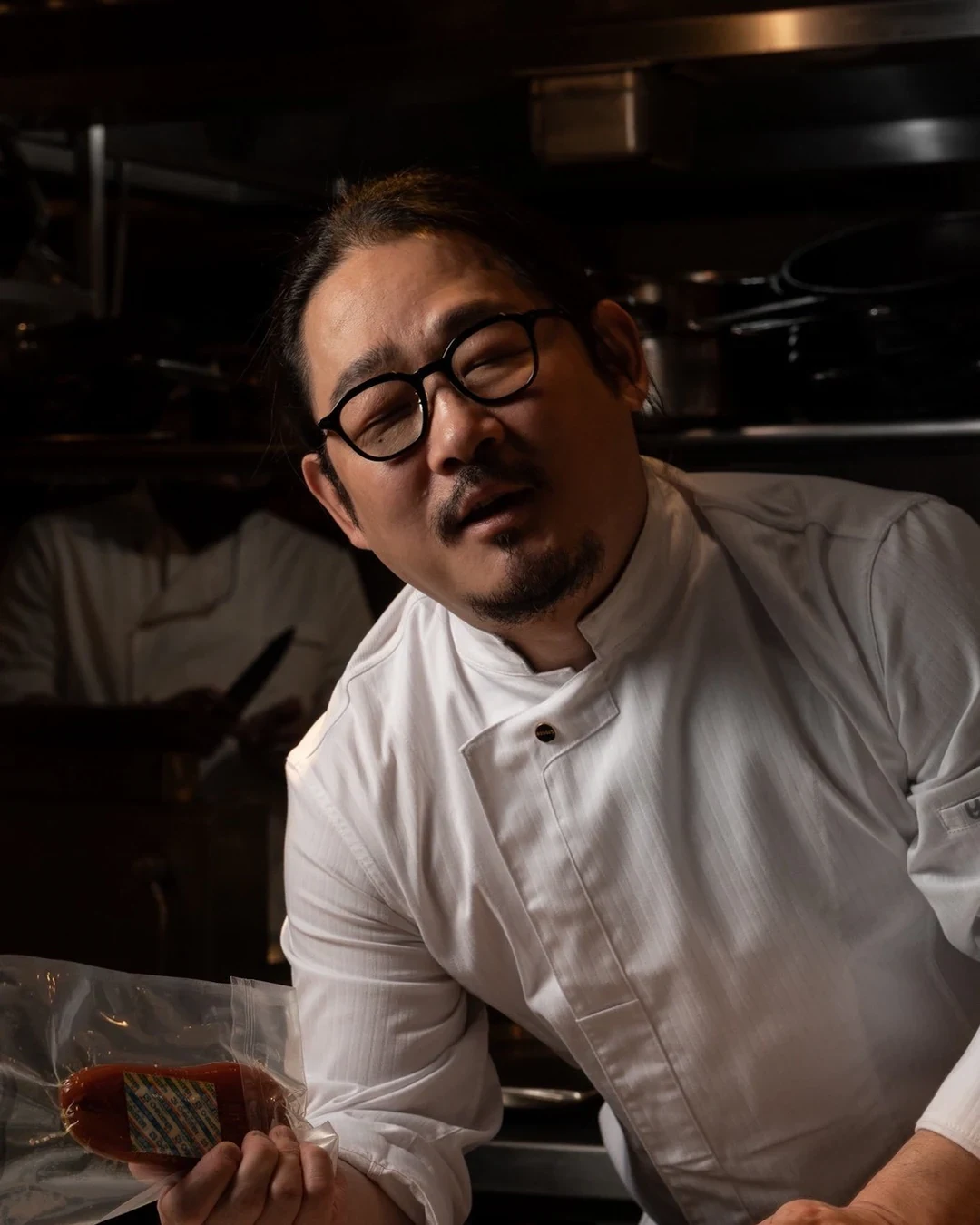
In Seoul, the material is noodle dough, bracken, whole wheat, meat, herbs, and the green gloss of raw perilla oil. At Myeon Seoul, owner Kim Do-yun gives Korean noodles the time and attention more often reserved for slower tables, treating them as slow food rather than fast-food-style ramyun or naengmyeon.
The Estate
Myeon Seoul is Kim Do-yun’s place in Seoul, South Korea, and Korean noodle craft is the center of its kitchen. The restaurant’s identity rests on a patient reading of myeon: not as a quick bowl to pass through, but as a subject with texture, temperature, grain, oil, and broth-like depth. That focus gives his work a clear material language. Bracken whole wheat noodles bring plant and grain into the same dish, while meat and herb noodles tossed in raw perilla oil place aroma directly on the surface of the noodle rather than hiding it behind excess. His cooking has also been connected to YUN in Seoul, South Korea, where the range included a variety of Korean noodle dishes, as well as fish and beef dishes. YUN earned one Michelin star from the MICHELIN Guide, a permanent marker of the restaurant’s recognition under that name.
In the Cellar
The method at Myeon Seoul is defined by resistance to speed. Kim’s kitchen is focused on Korean noodle craft, and that choice matters at a restaurant where the subject could easily be mistaken for something casual, instant, or merely comforting. Instead, the work asks diners to consider noodles as a crafted food: shaped by flour, handling, seasoning, oil, and the restraint of the cook. The contrast is direct, because his approach treats noodles as slow food rather than fast-food-style ramyun or naengmyeon. His public voice has carried a similar candor about the pressures around being seen. “It was tough for a while. The hardest part was that during Season 1, I didn't know what I was doing and just muddled through. In Season 2, since it was hidden, the setup changed each time, making it hard to adapt. The set was amazing.” He has also questioned the line between craft and performance: “We’re not entertainers; should a MICHELIN-starred chef really join a show like that?” The remark sits close to the way his restaurant work reads: serious about the bowl, wary of noise around it.
The Bottlings
The clearest signature releases are bracken whole wheat noodles and meat and herb noodles tossed in raw perilla oil. One leans into grain and fern; the other makes oil an aromatic carrier for meat, herbs, and noodle texture. Myeon Seoul received a Bib Gourmand from the MICHELIN Guide, recognition suited to a restaurant built around a focused craft rather than spectacle. The honor sits alongside the Michelin-starred recognition for YUN, tying Kim’s name to both Korean noodle work and a broader kitchen range that has included fish and beef dishes. Across those rooms, the through-line is not a grand catalog of cuisine but a tighter discipline: Korean noodles handled with patience. In a city where a bowl can be fast, familiar, and fleeting, Kim’s work at Myeon Seoul slows the form down and asks it to carry more weight.
Profile updated July 2026
FAQ
Asked of Kim
What style or method defines Kim Do-yun's work?
His work at Myeon Seoul treats Korean noodles as slow food rather than fast-food-style ramyun or naengmyeon.
What are Kim Do-yun's signature releases or dishes?
His signature dishes include bracken whole wheat noodles and meat and herb noodles tossed in raw perilla oil.
What is Kim Do-yun known for making?
He is known for Korean noodles at Myeon Seoul, South Korea.