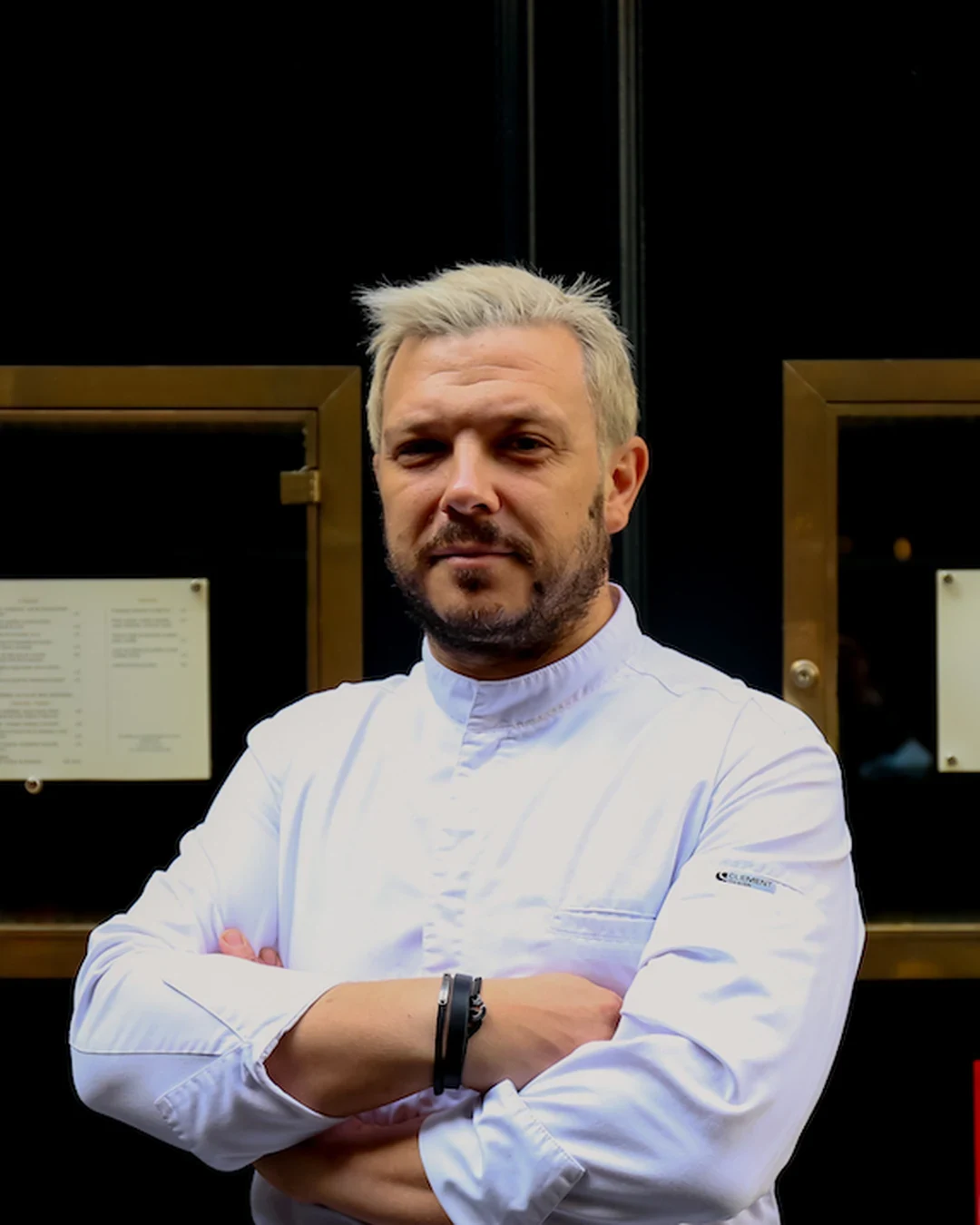
i. Biography
"I had had enough of the frills of haute cuisine. I wanted to return to simple, essential things: very French, bistronomic cooking, with good products and close attention to customers." At Le Tire-Bouchon Rodier in Paris, France, French chef Marc Favier gives that statement a tangible shape, stripping away ornament in favor of clarity, warmth, and the steady pleasures of the table. His cooking reads as a deliberate return: to flavor, to welcome, to the kind of cooking that speaks plainly and leaves a clean, lasting impression.
The Idea
Before the Paris kitchens and the Michelin recognition, Favier studied at the École Méditerranéenne de Tourisme et d'Hôtellerie in Béziers. That training sits at the beginning of a career defined less by display than by conviction. From the start, his thinking has stayed close to the plate and even closer to the person eating from it: cooking should be direct, legible, and hospitable, a matter of good sense as much as technique. His own explanation reaches back even earlier than school, to the sort of kitchen that is small, familiar, and shared. "Because I like eating well. With my friends, we used to make crêpes and waffles for our snacks. I loved cooking and sharing that with my friends." The memory is affectionate and communal, rooted in the easy pleasure of making something simple for others. It suggests a chef whose first lessons were not theatrical but social, learned at arm’s length around a table rather than under a spotlight. That background helps explain the precision of his stated preference for "simple, essential things." Favier does not speak in abstractions. He names "very French, bistronomic cooking," "good products," and "close attention to customers." Together, those phrases sketch a culinary philosophy that balances the material and the human: what is sourced, what is cooked, and how the guest is received.
The Execution
In Paris, Favier was chef at Thoumieux from 2009 to 2014. He was also chef at Hôtel Thoumieux, a separate point in the same city-based career arc. The years mark a period of sustained work, building a body of experience in a capital where reputation is earned plate by plate. From 2014 to 2018, he was chef at Bouillon. The span suggests continuity and focus, a longer chapter that followed Thoumieux and carried his approach forward without interruption. In 2020, he was chef at Marcore. That year, the restaurant earned one star from the Guide Michelin, a fixed achievement in Favier’s career rather than a passing adjective. His current role is chef of Le Tire-Bouchon Rodier. Set after those earlier Paris posts, it gathers the principles he has already made clear in his own words: restraint after haute-cuisine frill, French bistronomic focus, good products, and attentive service.
On the Record
Favier’s vocabulary often returns to contact, and not only in the abstract. One line speaks to the dining room as much as the kitchen: "It has allowed us to keep in touch with customers and also to open up to people in the neighborhood who perhaps had not dared to come in before." He has phrased the same idea with only slight variation: "That made it possible to maintain contact with customers but also to open up to people from the neighborhood who may not have dared to walk through the door before." In both versions, the emphasis falls on access, continuity, and the threshold between a restaurant and the neighborhood around it. Read beside his wish to leave behind "the frills of haute cuisine," the point becomes especially clear. Favier’s cooking is not a retreat from ambition; it is a choice about where ambition belongs — in the product, in the French bistronomic form, and in the relationship with the people who come to eat.
In Their Words “I had had enough of the frills of haute cuisine. I wanted to return to simple, essential things: very French, bistronomic cooking, with good products and close attention to customers.” “That made it possible to maintain contact