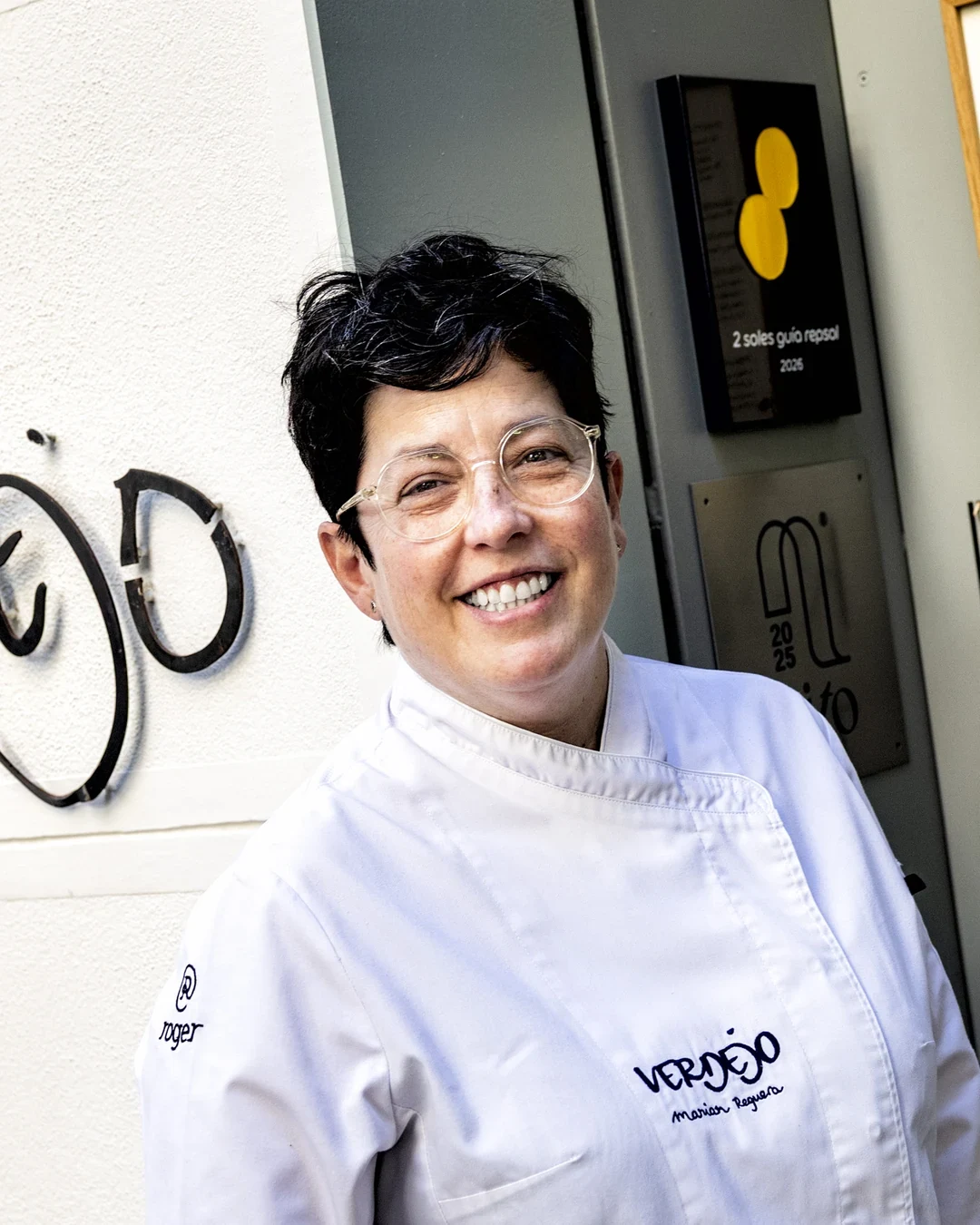
i. Biography
Owner of Taberna Verdejo in Madrid, Spain, Marian Reguera was born in the city and cooks from a formation that looks backward before it moves forward: mothers' and grandmothers' cooking, ancestral processes, seasonality, and the daily judgment of the market. Her Madrid table is not built around a formal tasting menu; it keeps Spanish cooking close to produce, doneness, and the old work of escabeche.
The Training Reguera gives her origin in a plain chronology: "Born in Madrid in 1973, in love with my profession and making others happy at Taberna Verdejo since 2013." The sentence carries the family feeling of her work: Madrid as birthplace, the restaurant as daily address, hospitality as the point of the exercise. At the restaurant, that profession is expressed through produce-led Spanish cooking without the fanfare of a formal tasting menu. The training visible in the food is not attached to a named school or chef; it is traditional renewed cooking rooted in mothers' and grandmothers' cooking, using ancestral processes and seasonality. Technique, for Reguera, is also timing. Many dishes are cooked à la minute, with special attention to doneness, and her own language makes that care specific: "I have respected the ingredients. But I have taken into account each one's cooking times. And I have added them according to their hardness. So that the whole was well stewed."
The Lineage The line she works in is Spanish, seasonal, and domestic in the deepest sense: a cuisine that remembers salting, marinating, stewing, and the darker pleasures of game and offal. Salted delicacies, homemade marinated dishes, stewed dishes, and market-fresh produce belong to the same table, not as nostalgia, but as living practice. Escabeches are central to that inheritance. Reguera introduced them at the restaurant because of her personal history and because they were being lost in Madrid; the dish became both memory and recovery, a way of carrying an older method back into daily appetite. Jerez wines form another marker of the house. Their place beside escabeches gives the Madrid address a clear signature: acidity, preservation, salinity, and wine culture speaking in the same register. The work has been recognized by Guía Repsol, which awarded the restaurant two Soles Repsol. That honor sits beside the more intimate achievement of a kitchen that treats inherited processes as living tools.
The Table A meal there can move through the sharp, savory clarity of Gilda de codorniz en escabeche, a named dish associated with Reguera and the restaurant. It can also arrive at escabeche de caballa, another named dish on the menu, where the signature method meets a fish long suited to vinegar, oil, time, and restraint. The broader cooking is seasonal market-fresh Spanish cooking, with salted delicacies, homemade marinated dishes, game, stewed dishes, and offal held within one vocabulary. Nothing in that list needs the architecture of a formal tasting menu; the structure comes instead from product, sequence, and the cook's decision about when each ingredient is ready. In Reguera's hands, lineage is practical. It is the hardness of one ingredient compared with another, the moment a stew becomes whole, the return of escabeche to a city where it was fading, and the quiet authority of a Madrid owner cooking through memory at her own table.
FAQ What tradition or house shaped Marian Reguera? Traditional renewed cooking rooted in mothers' and grandmothers' cooking, ancestral processes, and seasonality shapes her work at Taberna Verdejo. Who has Marian Reguera mentored? No named mentee is associated with her; the traceable lineage centers on the dishes and traditions she keeps alive in Madrid. Who did Marian Reguera train under? No named chef-teacher is attached to her formation; the stated source is mothers' and grandmothers' cooking.