Chef
Philip Tanaka
- Discipline
- Chef
- Based in
- Aspen, Colorado, United States
i. Biography
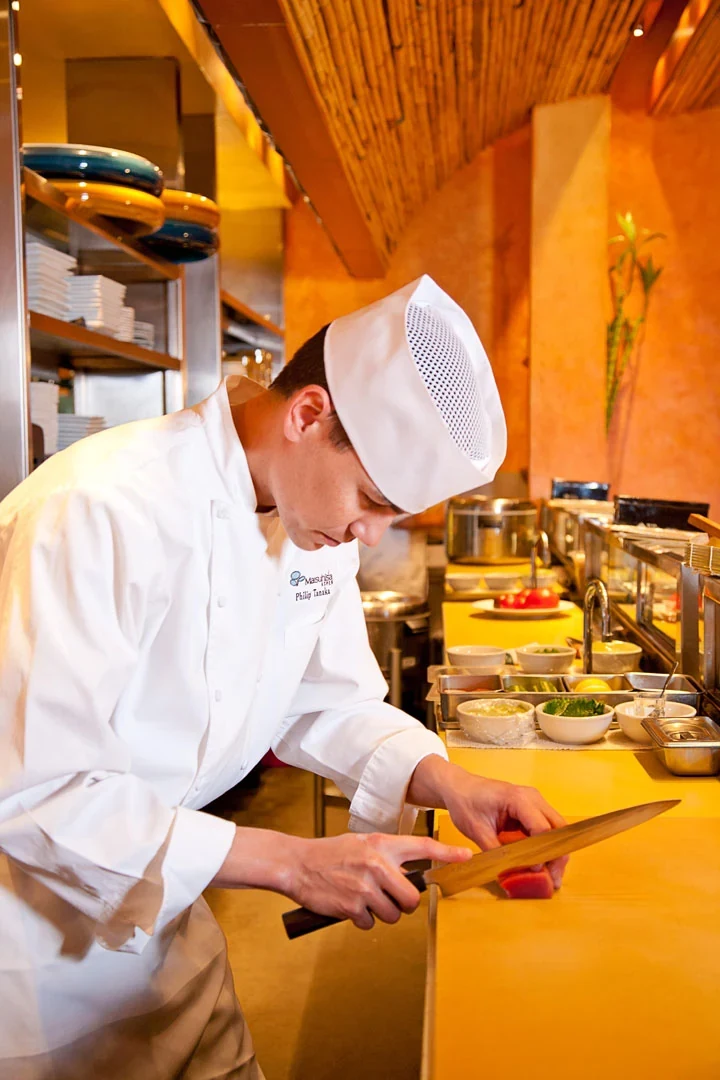
Philip Tanaka’s formation is visible through the house he leads: as executive sushi chef at Matsuhisa Aspen, United States, he works inside the Nobu-style Japanese tradition, where traditional Japanese technique meets South American-influenced preparation. The lineage is not presented as a list of schools or named masters, but as a living restaurant language carried through sushi, omakase, and a precise way of receiving the guest.
The Training Tanaka’s craft centers on sushi and Japanese cuisine, with the counter as both workplace and classroom. At the Aspen restaurant, his role as executive sushi chef places him at the point where technique becomes hospitality: fish, rice, seasoning, timing, and attention are brought together in front of diners rather than hidden behind the door of a kitchen. The clearest view of that training-in-practice comes from the omakase experience associated with him in 2013. Guests began by answering preliminary questions about their taste, then handed the meal over to the head sushi chef. That structure says a great deal about the discipline required: the chef listens first, then composes. In that exchange, personal preference does not weaken the form. It becomes part of the form. Omakase, in Tanaka’s hands at the restaurant, is described less as a fixed procession than as a relationship built in real time, guided by the guest’s answers and the chef’s judgment.
The Lineage The house style under Tanaka is Nobu-style Japanese cuisine, a lineage defined here by the blending of traditional Japanese technique with South American-influenced preparation. That phrasing names two forces at once: the restraint and exactness of Japanese craft, and the brightness, acidity, and cross-cultural movement associated with the broader Nobu culinary vocabulary. Rather than separating those influences, Tanaka’s work at the Aspen restaurant joins them in a single service language. The sushi chef’s task is not only to cut and season, but to keep a tradition intelligible as it travels across places and palates. The restaurant itself carries that lineage in Aspen, where a global culinary grammar is interpreted through a local dining room. Tanaka’s position gives the house style a human face at the counter: the person who receives the guest, reads the appetite, and turns a tradition into a sequence of bites.
The Table One dish gives the page a sharp point of focus: Tuna with Heirloom Tomatoes and Kinome Vinaigrette, credited to Chef Philip Tanaka of Matsuhisa Aspen, was listed in 2018 among featured dishes from the World of Nobu cookbook. The title alone shows the crossing of registers in his work: tuna, Heirloom Tomatoes, kinome, vinaigrette. It is a composed idea rather than a broad claim. Tuna brings the sushi chef’s field of attention; Heirloom Tomatoes introduce sweetness and acidity; kinome, a Japanese aromatic leaf, signals a specific register of seasoning; vinaigrette points to the South American-influenced preparation associated with the house style. That dish and the omakase experience belong to the same table. One can be named from a cookbook feature; the other unfolds through questions before the first course arrives. Together, they show a chef working through lineage not as nostalgia, but as service: tradition made responsive, technical, and personal.
FAQ Who has Philip Tanaka mentored? Specific mentees are not publicly identified; the clearest teaching relationship associated with his work is the omakase exchange with diners. Who did Philip Tanaka train under? His training lineage is documented through Matsuhisa Aspen’s Nobu-style Japanese cuisine rather than through an individual instructor.