i. Biography
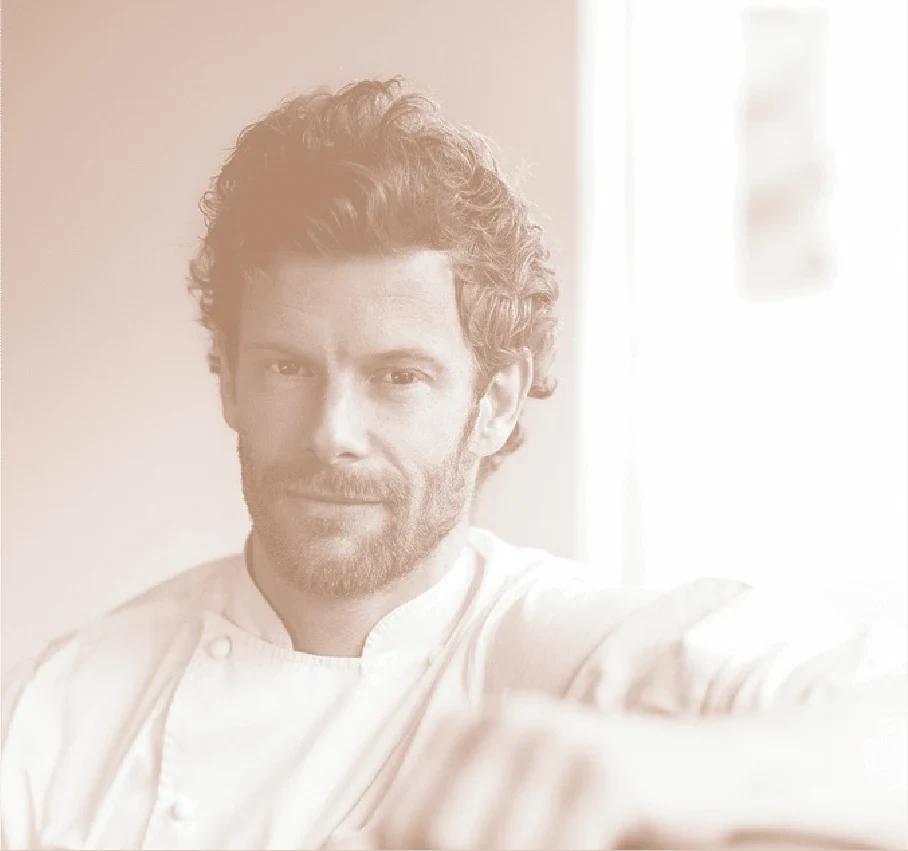
Modern British fine dining has few early benchmarks as plain as Two Michelin stars awarded to Pied à Terre in London in 1997, when Tom Aikens became the Youngest British chef ever to receive that distinction. The mark came from a kitchen culture built on pressure, repetition and exacting finish, and it set the terms for a career that has moved through the capital’s restaurants, hotel operations, international projects and self-named ventures without leaving the fine-dining problem behind: how to make personal cooking hold its shape under service.
Formation
Fine-dining discipline was the first register. Early work as chef at La Tante Claire in London placed Tom Aikens inside a kitchen language where timing, restraint and technical control carried the service. The move to sous-chef at Pied à Terre in Charlotte Street (from 1993) put that training into one of the capital’s more focused rooms, before the Joël Robuchon restaurant in Paris added contact with a grand European mode of polish and rigour. The decisive Charlotte Street period came on his return there (1996–1999). As head chef, then chef patron and co-owner, Aikens became attached to cooking measured by control, pace and intensity. The Two Michelin stars awarded in 1997 under Aikens’s leadership made him the Youngest British chef ever to receive the honour. After that chapter, the role as chef at La Tante Claire at The Berkeley hotel kept him in the high-discipline hotel-restaurant frame, while private chef work for Private clients in Gloucestershire and other locations shifted the work toward closer, more tailored service. Self-named and branded restaurants tested a different part of the craft: how a chef’s cooking changes when it must also carry identity, scale and repetition. Chef-owner roles at Tom Aikens in Chelsea (2003–2014) and Tom's Kitchen in Chelsea (2006–2020) set two different public expressions alongside each other. Operator at Tom's Place (2008–2008), followed by chef-owner at Tom's Kitchen in Canary Wharf (2013–2019), and chef-owner at Tom's Kitchen in Mailbox Birmingham (2016–2019), extended that question beyond one dining room and one neighbourhood. Current work has widened the geography while keeping the stated centre on memory, place and experience. Tom Aikens is chef of Muse by Tom Aikens (since 2020), chef and operator of The Abu Dhabi Edition hotel eateries (since 2020), chef and operator of ALICE at The Langham Jakarta, and chef and operator of Tom's at The Langham Jakarta. The craft problem is no longer only refinement on the plate; it is also how a restaurant format can carry narrative without losing clarity.
Present Day
“Story-led dining is important to me… because food has always been deeply connected to memory, emotion and a sense of place.” Story-led dining, as Aikens describes it, treats food as a sequence of associations rather than a display of technique alone. Memory, emotion and place are not garnish to the work; they are the organising materials. For a working kitchen, the useful point is structural: narrative has to be made serviceable, course by course, without loosening the discipline of flavour, pacing and presentation.
Honors
Formal recognition has tracked both early fine-dining performance and later peer acknowledgement. Tom's honors include First Michelin star for Tom Aikens (2004), Two Michelin stars for Pied à Terre under Aikens's tenure (1997), AA Chefs’ Chef of the Year (2024), New 5 Rosette Award (2007), Four rosettes for Tom Aikens (2004), and Newcomer of the Year (2004). The sequence runs from the 1997 Pied à Terre benchmark, through the 2004 recognition around Tom Aikens, to AA Chefs’ Chef of the Year (2024).
Profile updated July 2026
FAQ
Asked of Tom
What is Tom Aikens's current role?
Tom Aikens is chef at Muse by Tom Aikens.
Where did Tom Aikens work before?
Earlier in their career, Tom Aikens worked at La Tante Claire, Pied à Terre, and Joël Robuchon restaurant.
What recognition has Tom Aikens received?
First Michelin star for Tom Aikens (2004).