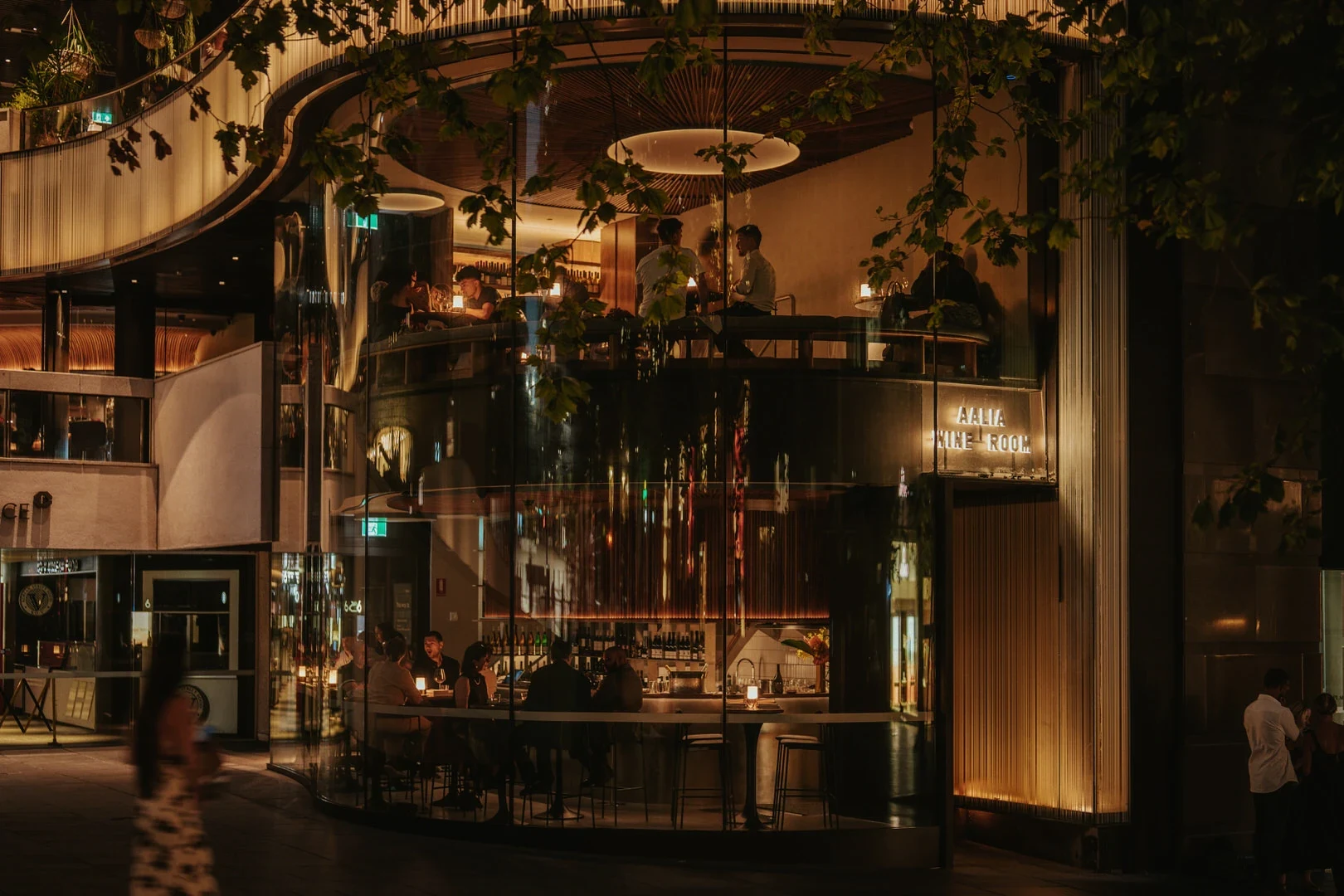
At 4.45pm, the full menu at Aalia Wine Room stayed shut for another fifteen minutes. The Martin Place bar, opened in late January, trades as a walk-in companion to two-hat Aalia, with Paul Farag opened the room but his final service was 28 March 2026; he has left Aalia and ESCA. The plates and glasses have intent. The floor still needs more give.
The bar comes from ESCA, the hospitality group behind Nour, Henrietta, Ito, Joji and Besa. Aalia, its parent restaurant, has held Farag at the kitchen since it opened in 2022; he is also a former Good Food Guide Chef of the Year winner. Here, the promise shifts from restaurant ceremony to direct access: bar snacks in the $$ band, no booking required, and a menu built to sit between a snack and a meal.
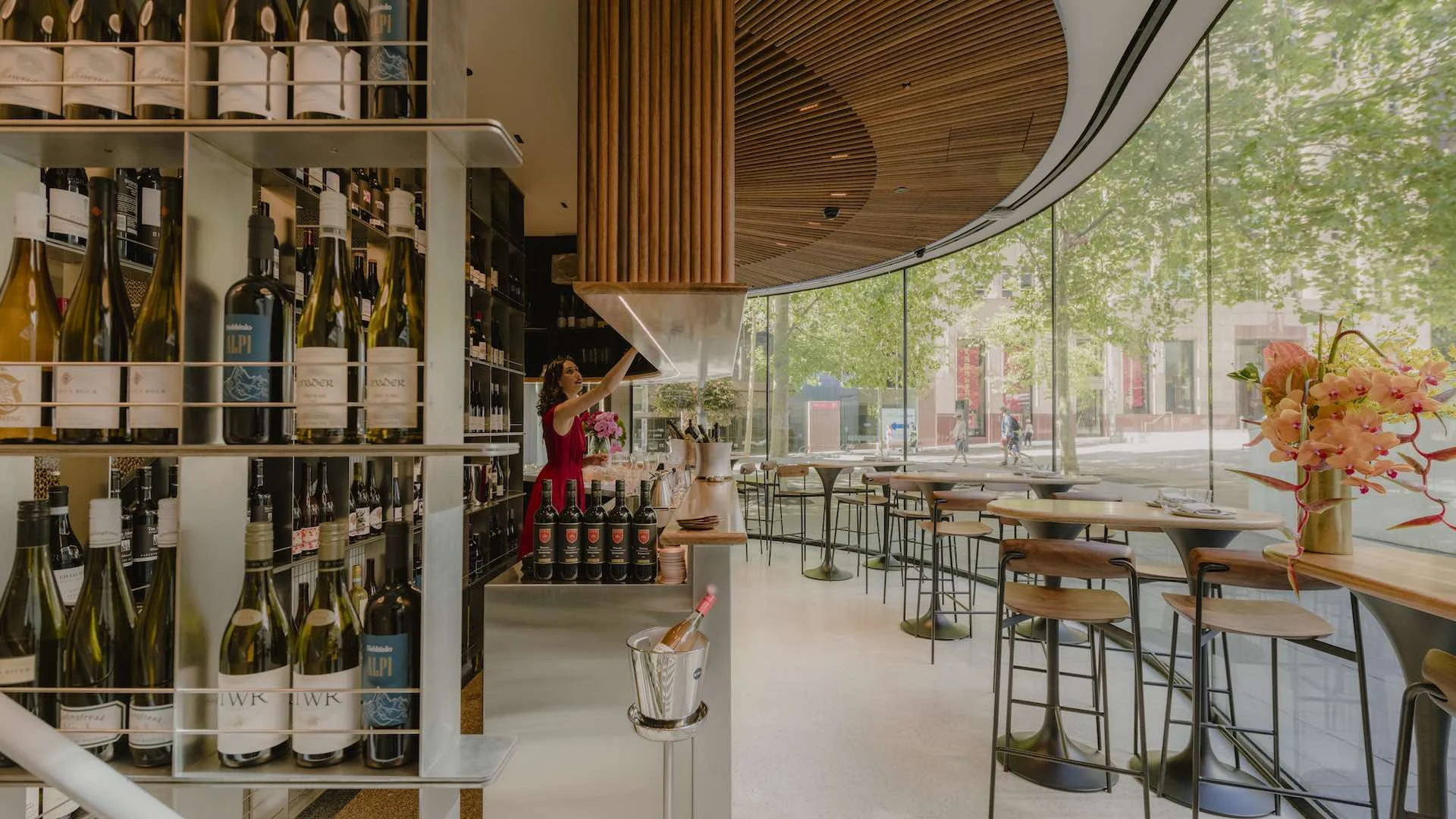
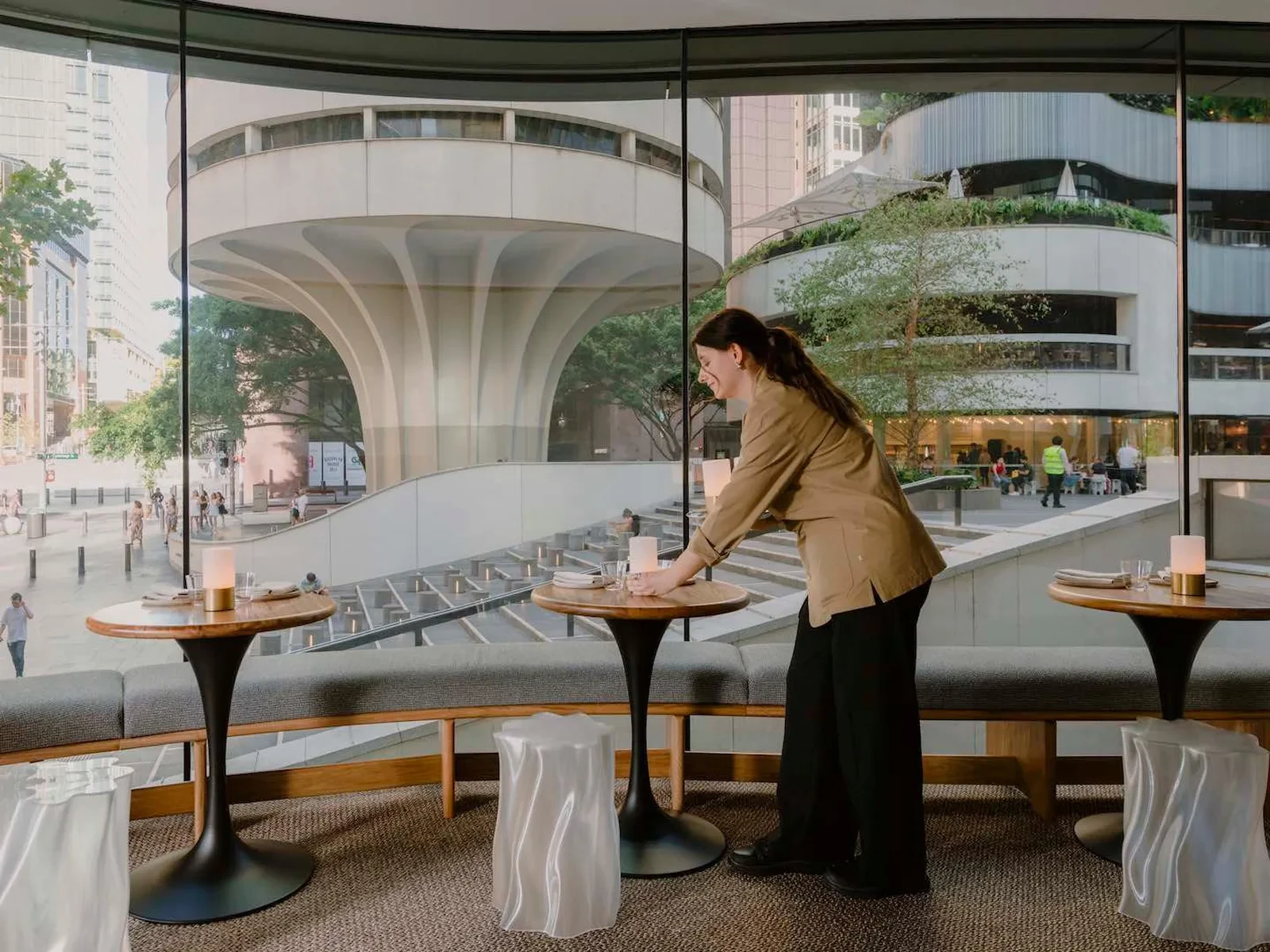
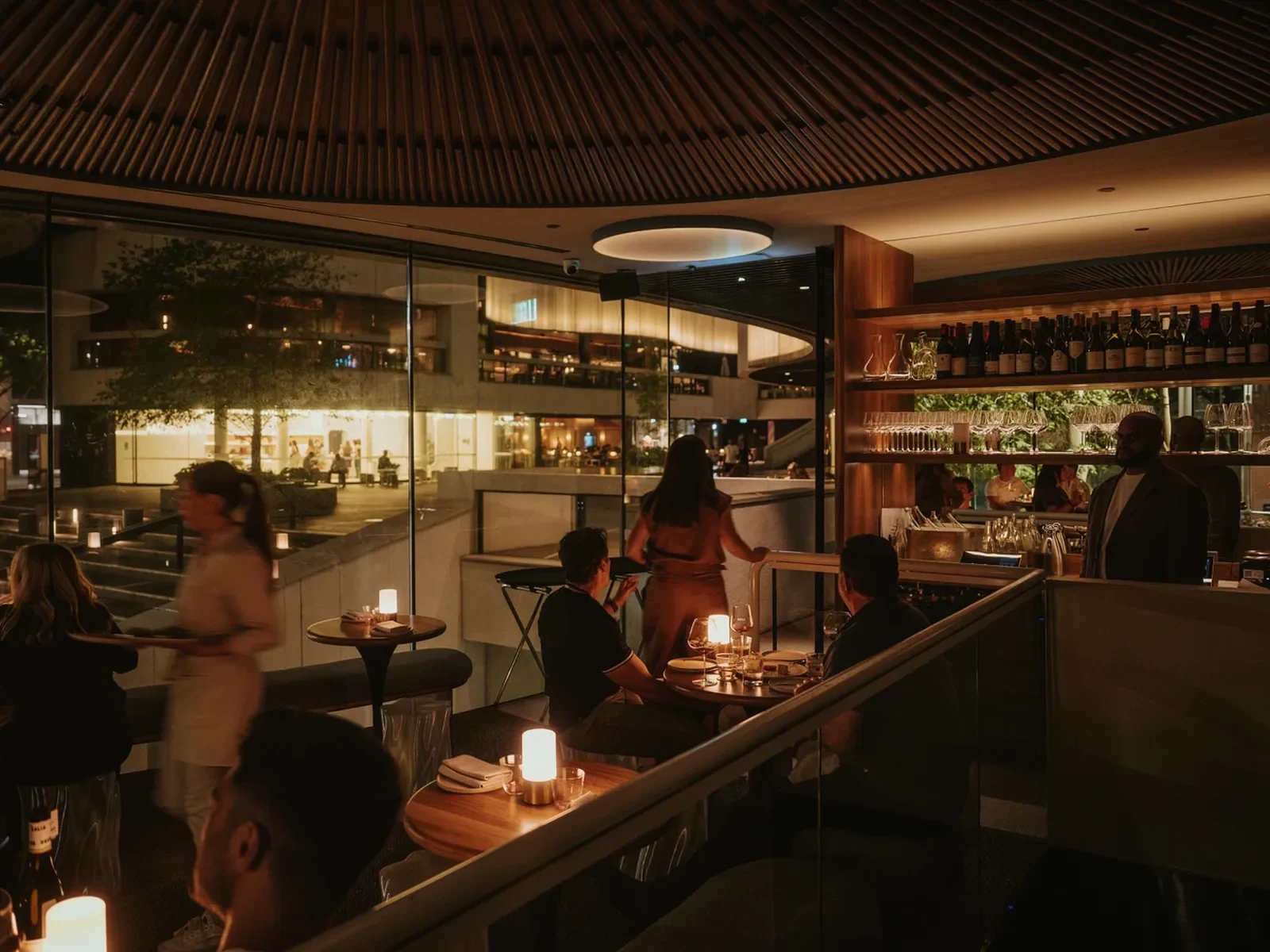
Martin Place does its own mise en place outside the glass. Sydney-based architect Matt Darwon has drawn the 42-seat room across two levels: downstairs in stainless steel, timber and iron; upstairs softer, grey-toned, with low tables around banquettes. The windows take in office workers, shoppers and tourists moving past. Inside, the room has to match that movement with the oldest discipline in hospitality: seeing the guest before the guest has to ask.
Inside Aalia Wine Room’s Martin Place Opening
Aalia Wine Room is not Aalia with the formality loosened by lighting. It changes the route in. The guest can walk in from the street, take a glass, and meet Farag’s cooking without booking a full restaurant sitting.
That access gives the room its work. A two-hat restaurant has pacing built into its bones: reservations, courses, a floor team moving to a known clock. A wine bar has a rougher rhythm. One person wants a quick plate before leaving; another arrives for one glass and stays. The room must read both without making either feel like an interruption.
Darwon’s plan separates the tempos. Downstairs suits the short stop: light, hard surfaces, a plate and a glass. Upstairs invites a longer dwell, with lower seating and a more intimate palette. Neither level can carry the whole idea alone. The bar needs both: speed without brusqueness, ease without drift.
The site helps. Martin Place supplies the passing theatre, and the floor-to-ceiling windows let the street enter without decoration. But the stronger proposition is practical rather than scenic: Aalia’s kitchen language and O’Dwyer’s cellar thinking, made available in a room that does not require the diner to plan a week around it.
What Adam Wolfers Brings From Aalia’s Bench
Farag works the menu into the narrow band a food-focused wine bar needs: enough structure to stand beside serious drinking, not so much weight that the bar becomes a restaurant by stealth. The cooking draws on Middle Eastern and North African references, but the useful detail is in the handling of acid, bread, pastry, dairy and deep savour.
Raw kingfish arrives on crisp bread, lifted by finger lime caviar. Globe artichokes are fried and finished with tahini. Pita made with khorasan flour comes puffed and scorched, with labneh holding caramelised onions under sumac. Egyptian-style eggplant is cooked down in tomato sauce until it moves toward a paste. Lamb hawashi folds shredded lamb into fine golden pastry, with black garlic sauce and lemon for the final cut.
These are not filler plates built to justify another pour. The kitchen thinks in friction: cool fish against citrus; fried artichoke against sesame; bread against dairy; lamb and pastry against the dark concentration of black garlic. Each dish gives the glass something to work against.
The 5pm rule is the stiff joint in the service. A quarter-hour is a small measurement on paper. In a bar, after the guest has sat down, it becomes a test of whether rules are carried with grace or simply enforced. A room built around “wine without rules” still needs the floor to explain the ones that remain.
Sarah O’Dwyer’s Drinks Program, From Flights to Funk
Sommelier Sarah O’Dwyer gives the bar its second craft line. The build-your-own flight starts at $69 for the standard offering, with rarer drops available for more. That format suits a room trying to loosen the grip of the single bottle: the drinker can move by curiosity, not by obligation.
The named pours sketch the range. Torchbearer, from Tasmania, brings a crisp, citrusy new-style sauvignon blanc. MMAD, from Blewitt Springs, contributes a fruit-forward field blend rosé. Fiegl, from Oslavia, appears through a dry, oaky, slightly funky ribolla/friulano. The list moves from local brightness to a more oxidative edge without pretending those registers belong to the same mood.
“Wine without rules” works only if the person holding the list can make freedom legible. O’Dwyer’s task is not just buying bottles; it is building a path through them, keeping the edges intact while giving the guest enough footing to choose well.
The bar also makes a potent Manhattan. In a wine-focused room, that matters. It gives the non-wine drinker a serious way in, and it keeps the drinks program from narrowing into one language.
The Rule Aalia Wine Room Still Needs to Get Right
The weakness is not on the plate or in the glass. It is at the point of contact. Water glasses were not filled when guests sat down, and one floor member seemed surprised by the arrival. Those are small actions only if service is treated as a checklist. In a bar, they are the first measure of care.
Hospitality is not mood. It is method. A host notices the body at the door. A floor member brings water before the guest has to begin the transaction. Someone explains when the full menu starts, what can be ordered now, and how the wine flight might be approached. None of that requires performance. It requires attention.
The two-level room raises the stakes. Downstairs needs quick recognition; upstairs needs slower tending. The same service rhythm will not suit both. Darwon has given the bar two distinct paces, and the floor has to learn the footwork.
The names attached to the project bring real craft weight: Farag at the menu, O’Dwyer at the drinks, Darwon at the architecture, ESCA behind the operation. The floor does not need to add theatre to those credentials. It needs to make them usable.
How to Use the Room Now
Go for Adam Wolfers’ food and O’Dwyer’s list without booking into Aalia proper. The strongest use of the room is direct: walk in, take the measure of the menu, and let the bar sit somewhere between a glass and dinner.
Drinkers should start with the flight if they want to understand the cellar quickly. The standard version begins at $69, and the list has enough spread to move from Tasmanian sauvignon blanc to Blewitt Springs rosé to Oslavia ribolla/friulano. If wine is not the answer, order the Manhattan.
The room already has the hard materials: a serious kitchen mind, a sommelier’s structure, a central site and a design that separates quick drinking from longer staying. What it needs now is the simplest craft and the hardest to fake: a welcome that arrives on time.