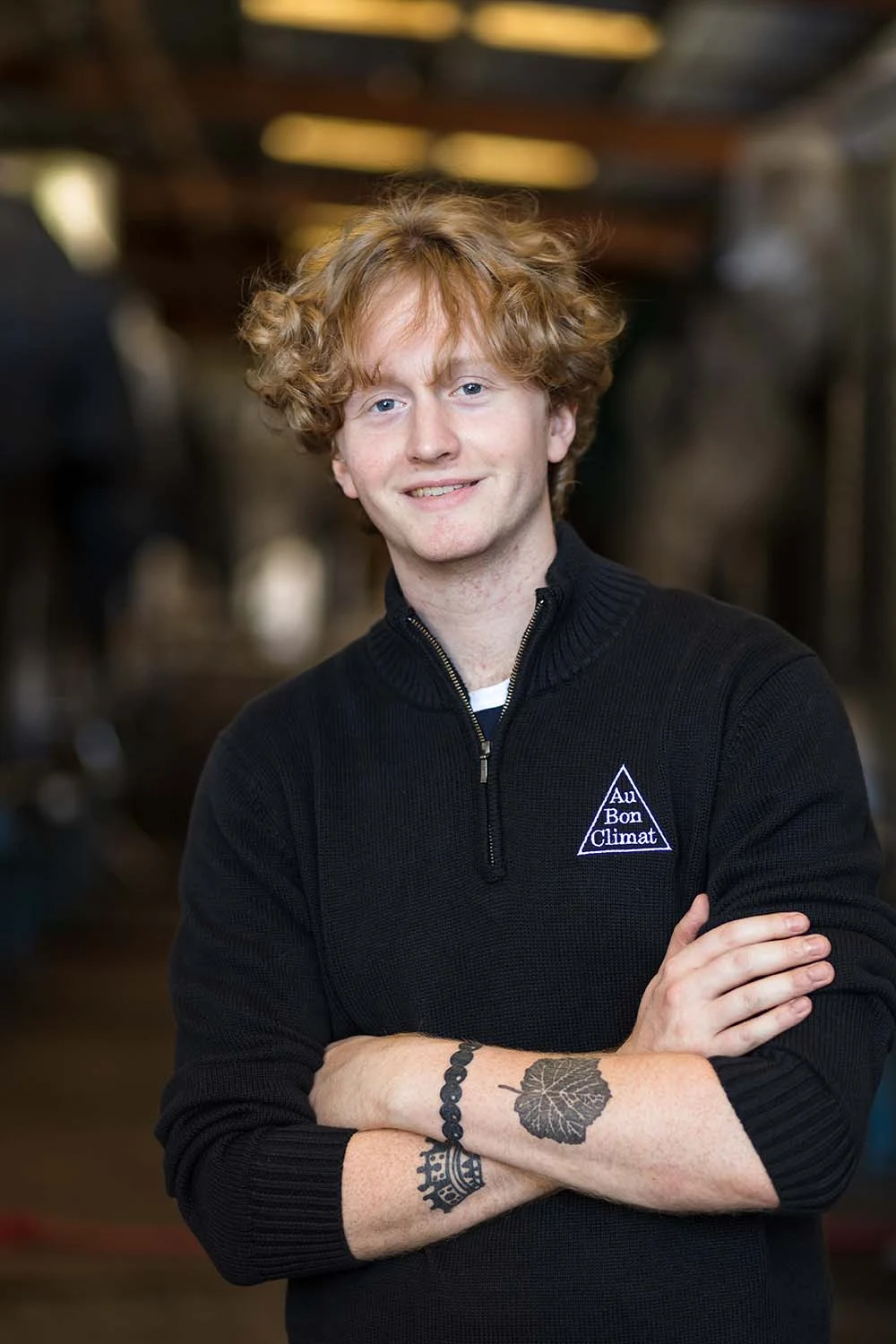
Knox Alexander returned to the cellar for his first harvest in 2022, one year after Jim Clendenen died during Knox’s junior year at Temple University; Isabelle Clendenen had already joined Au Bon Climat full time in 2018, working the export relationships their father once carried on the road for as many as 200 days a year. Au Bon Climat winery is now led by Jim Clendenen’s second generation, with Knox Alexander working in production alongside Marc Piro and Sarah Atwood, and Isabelle Clendenen shaping the house’s international markets, especially Japan.
The inheritance is technical before it is sentimental. Barrel fermentation for whites. French oak for the barrels. Pinot Noir and Chardonnay from Santa Barbara County treated as wines for food, acidity, and travel, rather than as local curiosities. Jim Clendenen built Au Bon Climat, often shortened to ABC by the people who bought and poured it, into one of the names that helped make Santa Barbara County legible as a serious place for cool-climate Pinot Noir and Chardonnay. His children now have to decide what stays on the bench and what moves.
They have not answered that question with one voice. Isabelle moves outward, through language, dinners, distributors, and markets where a bottle of California Pinot Noir may sit beside duck bao, matsutake gohan, or tom kha gai. Knox moves inward, through the station work of harvest, cellar decisions, and continuity with Piro and Atwood. The house remains the house. The hands are different.
The 1982 Beginning of the Au Bon Climat Winery Lineage
Jim Clendenen founded Au Bon Climat in 1982 with Adam Tolmach, after returning from Bordeaux and after a harvest in Burgundy’s Chassagne-Montrachet had fixed his attention on Pinot Noir and Chardonnay. That sequence explains the house’s grammar. Jim had worked close enough to Burgundy to understand the pull of its method, and far enough from it, in Santa Barbara County, to build without asking permission from the old bench (Advinetures3).
In 1990, Tolmach left to create The Ojai Vineyard. That split placed Au Bon Climat more fully under Jim’s hand, while keeping it inside a community of winemakers who shared facilities, fruit conversations, and meals. Bob Lindquist, formerly of Qupé, also makes his wines in the same facility as Au Bon Climat. In a cellar, proximity is never theoretical; hoses cross, barrels sit in rows, people taste and disagree within earshot (Advinetures3).
Bien Nacido remains the biggest source of fruit for Au Bon Climat. That gives the house a fixed point inside the broader Santa Barbara County story. ABC’s reputation rests on cool-climate Pinot Noir and Chardonnay, but the phrase gains weight only when tied to vineyard supply, cellar method, and the long work of selling those wines outside California. Jim did that work with a frequency his daughter still remembers. Isabelle has said her father could be away travelling as many as 200 days a year, returning with stories and souvenirs from the places where he introduced Au Bon Climat to drinkers abroad.
The road was part of the method. International sales are not an afterthought at ABC; around 45% of Au Bon Climat’s sales are exports, with Japan the largest international market and the UK next. For a California winery known for Burgundian varieties, that is not a decorative statistic. It explains why succession at the house cannot be measured only by what happens at fermentation. The next generation inherited distributors, private labels, and table habits in China, Japan, Denmark, the UK, and elsewhere. A barrel choice in Santa Barbara can become a pairing in Tokyo.
Jim’s way of gathering people also ran through food. One account describes him as chef for a group of 16 that included fellow winemakers Bob Lindquist, Frank Ostini, and Mark Piro. Another remembered line, addressed to Jim, cuts through the hindsight that gathers around a founder: “well Jim, none of us really saw the potential in you, but you were a lot of fun back then too”. The sentence holds the pre-fame texture of the place, before Au Bon Climat became shorthand for a certain California reading of Burgundy, before the children had to carry the name.
Jim Clendenen’s Method: What the Children Inherited
Lineage becomes visible in constraints. Au Bon Climat remains committed to freshness and acidity in its wines, to barrel fermentation for its whites, and to French oak for the barrels. Those are production choices that shape texture, tempo, and the range of foods the wines can sit beside. A white wine fermented in barrel asks for a different sequence of labor than a stainless-steel program; the cooperage is part of the sentence.
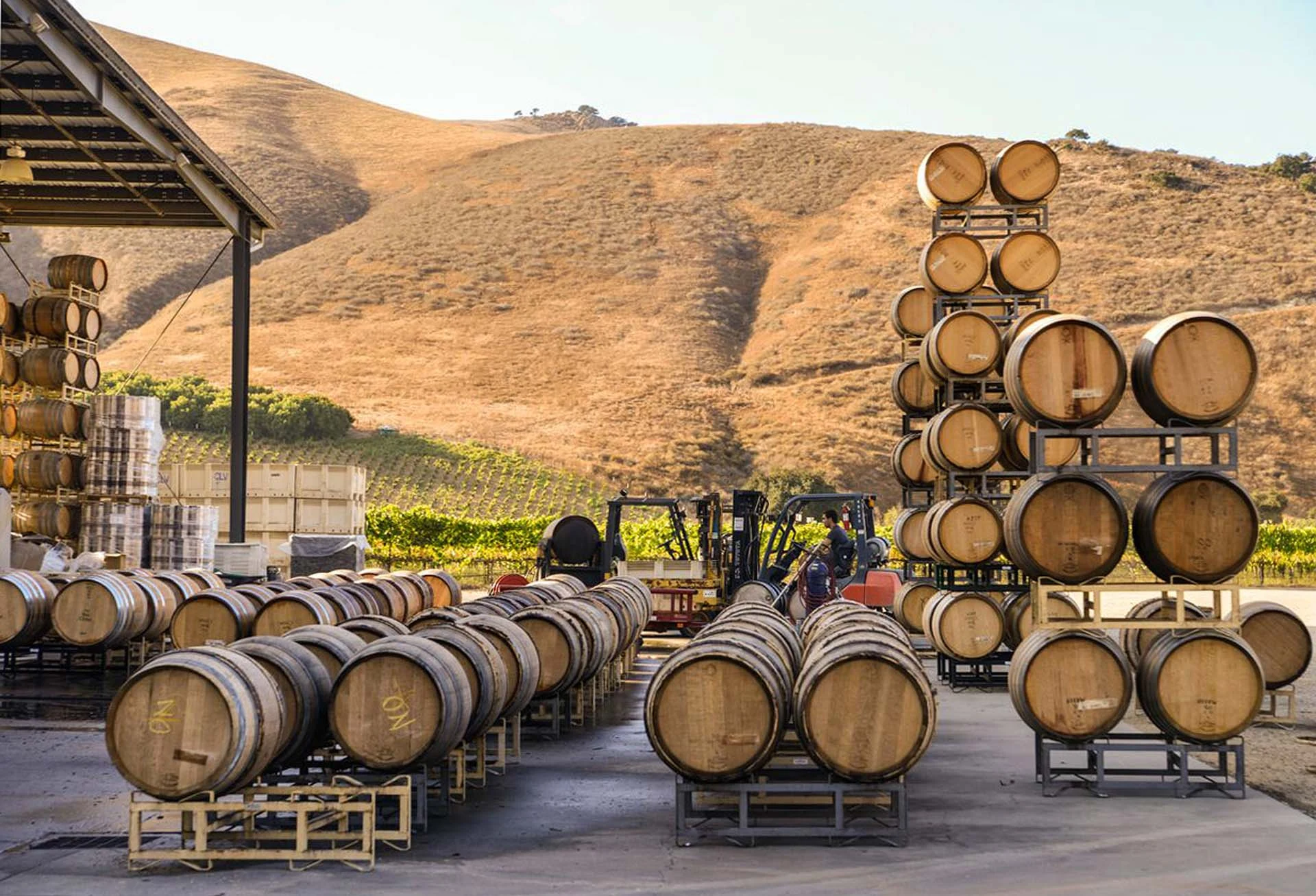
That continuity matters because Jim Clendenen built Au Bon Climat at a moment when Burgundy stood as the benchmark for Pinot Noir, and when critical fashion gave French fine wine a particular force in the market. The first vintage of Isabelle, the barrel-selection Pinot Noir named for his daughter, came in 1995. The name was familial, but the wine also belonged to a broader argument about California Pinot Noir: that Santa Barbara County could produce cool-climate wines with enough acidity and food sense to matter beyond the state.
For the second generation, the question is not whether the wines should become something else in order to prove that the children have arrived. Knox Alexander has been explicit about resisting that reflex. He returned to production after graduation and works alongside Marc Piro and Sarah Atwood. The phrasing matters. He did not arrive as a solitary heir descending into a silent cellar. He entered a working program with named winemakers already holding the line.
"We aren't rushing to mechanise our production. We aren't straying away from our utilisation of French oak"1
Knox Alexander, co-owner, Decanter
That quote places Knox’s role clearly. The younger Clendenen is not presenting mechanisation as the sign of adulthood. He is tying his work to the tools already in place, the barrels, the cellar rhythm, the accumulated decisions around freshness and acidity. Continuity can be a harder discipline than disruption, because it leaves less room for theatrical gestures. It asks the maker to repeat a method until repetition becomes judgment.
Au Bon Climat winery carries that discipline in its most basic public identity. Pinot Noir and Chardonnay come first in the conversation, but the house is also shaped by its ability to keep those varieties in motion across markets and cuisines. A wine built for food has to survive translation. It has to make sense with the winery lunch in Santa Barbara and with a distributor dinner in Japan. Jim’s gift was to see that early. His children now work the same idea from two stations.
Isabelle Clendenen’s Japan Bench
Isabelle Clendenen’s route into the family work began with objects small enough for a child’s hand. Jim brought back figurines from Japan, and the trips became part of the atmosphere around her. When she eventually traveled there with him, she met people who wanted to speak with her and found that she could barely answer. She came home to California with a task. Learn the language.
That decision became an apprenticeship outside the cellar. Isabelle majored in Japanese and spent a semester in Japan working with one of ABC’s distributors. By the time she began traveling to Japan around 2007, Japanese wine drinkers were looking beyond Burgundy for more affordable expressions of cool-climate Pinot Noir. Au Bon Climat had a position in that opening. The wines carried the Burgundy conversation, but they came from Santa Barbara County and from a founder who had spent decades putting those bottles in front of drinkers abroad.
"I wouldn't speak Japanese without wine, and I wouldn't be in the wine industry without Japanese"2
Isabelle Clendenen, co-owner, Decanter
There is a clean division inside that sentence. Wine gave her the language; Japanese gave her a place in wine. Isabelle joined Au Bon Climat full time in 2018, and she is now one of the principal faces of ABC in Japan, strengthening distributor relationships and hosting dinners and events. She says Japan’s share of the winery’s sales has roughly doubled, from 7% to 15%. That is the kind of number that reveals labor usually hidden behind the glamour of export markets: emails, flights, tastings, greetings in the correct register, pairings built for the room rather than for a sales sheet.
The food details show how she works. In China, Isabelle has paired her namesake Pinot Noir with crispy duck bao, steamed buns built around skin, fat, and sweetness. In Japan, Hildegard has appeared with matsutake gohan, seasoned rice with wild mushrooms and dashi. In Thailand, Los Alamos Chardonnay has gone beside tom kha gai, coconut milk chicken soup. These are not generic pairings for a global brand dinner. They show Isabelle taking the house style, freshness, acidity, and the Burgundian-variety frame, into cuisines where texture, broth, mushroom, coconut, and spice ask different questions of the glass.
Her work also changes the meaning of the Isabelle wine itself. Jim released the first vintage of Isabelle in 1995 as a barrel-selection Pinot Noir named for his daughter. Decades later, Isabelle Clendenen is the one carrying that name into rooms where she speaks Japanese and explains the wine without relying on her father’s presence. The bottle began as a parental gesture. It now belongs to her own station in the family business.
Knox Alexander in Production with Marc Piro and Sarah Atwood
Knox Alexander’s path back to Au Bon Climat started away from wine. He grew up in Santa Barbara wine country, surrounded by people who made wine or worked near it, and he became numb to the idea. He worked security at a concert venue. He studied journalism at Temple University’s campus in Japan. While there, he picked up voice-acting work for commercials and a video game. Then Jim died in 2021, during Knox’s junior year, and the question of succession stopped being abstract.
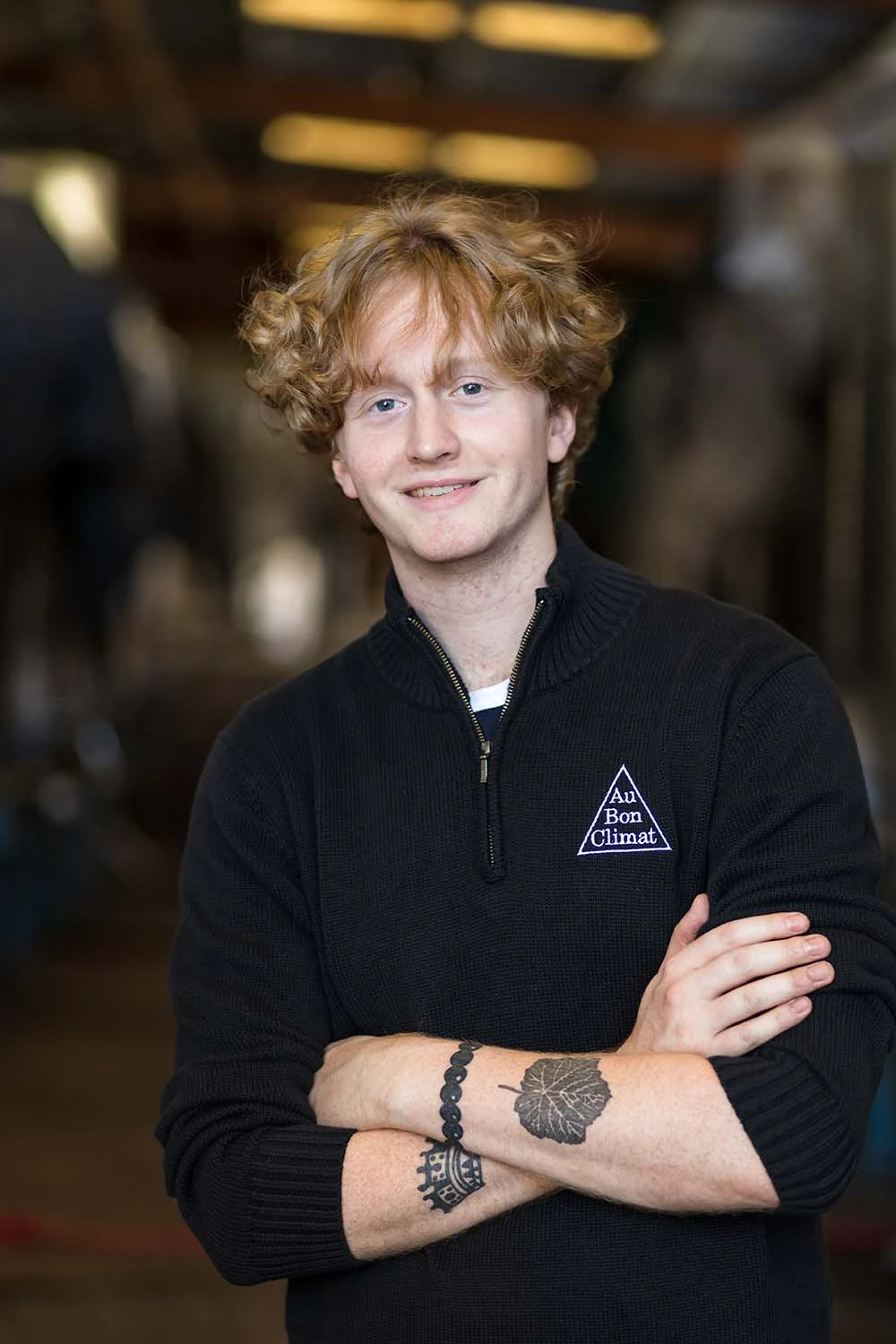
After graduating, Knox returned for his first harvest in 2022. That timing gives the current Au Bon Climat winery story its pressure. Isabelle had been full time since 2018, already deepening the international side. Knox arrived into harvest after the founder’s death, with the practical work of fruit, fermentations, barrels, and team trust in front of him. He now works alongside winemakers Marc Piro and Sarah Atwood in production.
For a second-generation maker, the first harvest is less a ceremonial entry than a test of attention. A cellar does not care about biography. Fruit comes in when it comes in. Whites destined for barrel fermentation demand preparation before any public story can be told about them. French oak barrels must be managed as vessels, costs, and flavor instruments. He returned to a working cellar with a dead father’s method still active around him.
Knox’s stated preference for continuity places Marc Piro and Sarah Atwood near the center of the succession. They are not background names. They are the winemakers with whom the heir works. At a family winery, the named non-family hands often determine whether inheritance becomes practice or image. Piro and Atwood hold institutional memory in the cellar; Knox brings the family obligation; the wines have to move through all three.
This is where Au Bon Climat differs from a succession story built around a public makeover. Knox has said he hopes ABC will be the same in 10 or 20 years, just with a few more grey hairs. The line fits the cellar better than the market. A barrel program can age without changing its grammar. A house style can survive because people refuse easy renovation. The discipline is not freezing the wines in the past; it is keeping enough of the method intact that the next bottle still belongs to the same lineage.
Exports, Private Labels, and the Table Abroad
Au Bon Climat’s international work did not begin with Isabelle, but she has given it a second-generation shape. Around 45% of sales are exports, with Japan the largest international market and the UK following. ABC also produces private labels for distributors in China, Japan, Denmark, and the UK. Those private labels place the winery inside relationships that are usually invisible to a domestic drinker, where a distributor’s market knowledge meets a producer’s cellar and brand discipline.
Jim Clendenen’s version of international work was physical: as many as 200 days a year away, carrying bottles and stories from place to place. Isabelle’s version still depends on travel and dinners, but it adds language as a tool. Japanese fluency changes the room. It lets the maker’s daughter speak without waiting for translation to do all the work. It also gives her a way to listen, which matters in a market where wine can be framed through cuisine, season, and gift culture as much as through scores or grape variety.
The pairings named around ABC’s current export work are worth reading closely because they carry the winery’s food logic across borders. Hildegard with matsutake gohan is a precise kind of placement: seasoned rice, wild mushrooms, dashi, and a wine from a Santa Barbara house rooted in freshness and acidity. Los Alamos Chardonnay with tom kha gai asks Chardonnay to meet coconut milk and chicken soup, a different test from the butter and shellfish pairings often attached to the grape. Isabelle Pinot Noir with crispy duck bao takes Pinot into a structure of steamed bun, duck, and rendered fat.
That export work also pushes against the idea that preserving a founder’s wine must mean preserving a founder’s exact audience. Jim established the markets. Isabelle extends the grammar of presentation. She can bring the same bottle to a new table and change the frame without changing the wine. That is succession as translation, not reinvention.
For collectors and drinkers who follow Au Bon Climat winery across vintages, the international side also explains why certain bottles may feel present in one market and scarce in another. The house has export commitments, distributor relationships, and private-label work that draw wine outward from California. The domestic shelf tells only part of the allocation story. Japan’s growth from 7% to 15% of sales under Isabelle’s efforts gives that story a number.
What Has Stayed Since 2021
Jim Clendenen’s death in 2021 created the kind of break every family house eventually faces. The question after such a break is often phrased as change versus preservation, but the real work is more specific. Which vessel stays? Which market needs attention? Which person knows the history of a blend, a distributor, a barrel choice, a lunch tradition? Which younger hand is ready to hold the method without turning it into a museum piece?
At ABC, the stated continuities are clear: freshness and acidity, barrel fermentation for whites, French oak for the barrels, and a food-friendly style associated with Jim’s reputation. The house still stands on Pinot Noir and Chardonnay from Santa Barbara County. Bien Nacido remains the biggest source of fruit. The facility still includes Bob Lindquist’s wines, keeping the shared-cellar texture around the Clendenen story. Marc Piro and Sarah Atwood work production with Knox.
What has changed is the distribution of attention. Jim concentrated the founder’s force in one figure: cellar instinct, public appetite, travel, food, argument, and hospitality. The second generation separates that force into roles. Isabelle makes the export work more linguistically and culturally specific, especially in Japan. Knox keeps the cellar from being remade for the sake of a generational announcement. This is the sibling pattern now visible at Au Bon Climat winery.
For visitors and collectors, the post-2021 period deserves attention for that reason. The wines are not being presented as a clean break from Jim Clendenen’s style. The current generation has said the opposite through its choices: no rush to mechanise, no retreat from French oak, no abandonment of barrel-fermented whites. The shift sits around the wines, in who pours them, who explains them, who works beside the winemakers, and which tables abroad receive them.
Au Bon Climat helped establish Santa Barbara County as a serious source of cool-climate Pinot Noir and Chardonnay. That achievement belongs to Jim Clendenen and to the wider circle of growers and winemakers who made the region’s case over decades, but ABC remains one of the names through which many drinkers first understood the argument. The wines traveled. The founder traveled. The export numbers show the work went well beyond a local following.
Watch the next releases from ABC with that split in mind. The signal will be in the wines that keep their acidity and barrel grammar, and in the dinners where Isabelle places those wines beside dishes Jim did not need to imagine when he founded Au Bon Climat with Adam Tolmach in 1982. A family house survives when the method remains useful in new rooms; the Clendenens are testing that now, one cellar decision and one export table at a time.