Chocolatier Tommaso Grollero Wins World Chocolate Masters 2026
Tommaso Grollero won World Chocolate Masters 2026 for Italy, taking Design for an octopus sculpture and Best Taste in Antwerp.
HM
Director of Editorial Standards
Hugo Marchetti
Filed October 30, 2026
12 min read
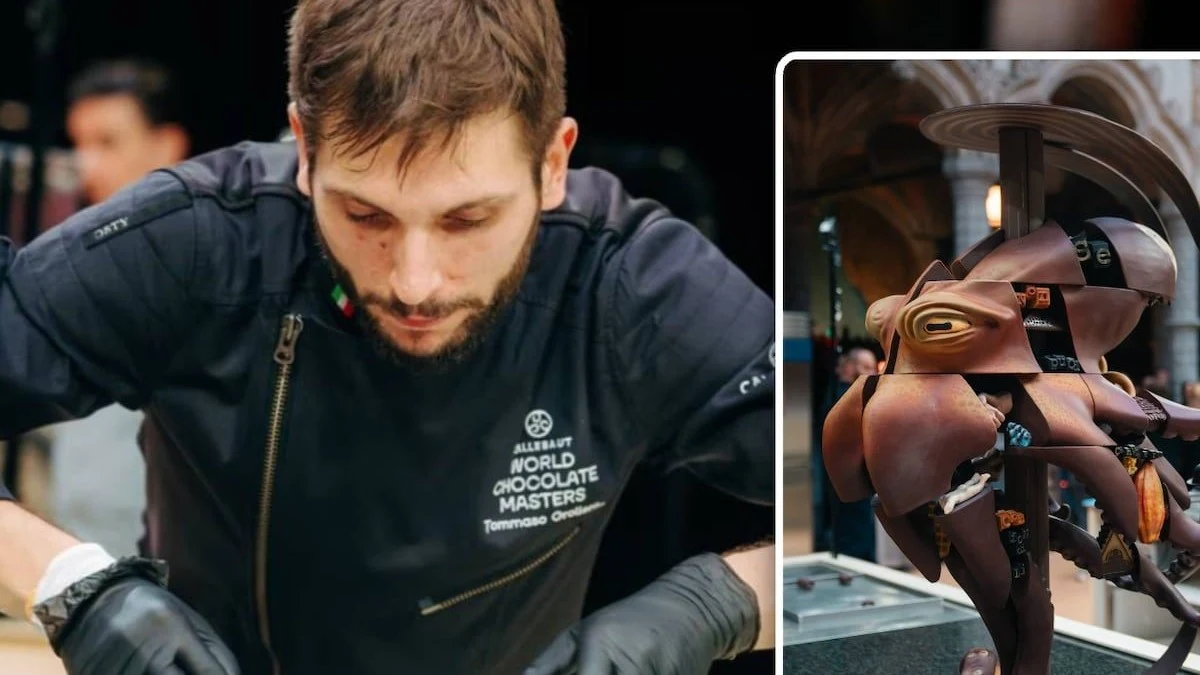
Tommaso Grollero put an octopus on the chocolate design bench and left Antwerp with the title. Representing Italy, Grollero won the World Chocolate Masters 2026 at Handelsbeurs on 26-27 October 2026, taking the overall prize in the ninth edition of the Barry Callebaut competition, which is held every three years. His winning week also carried two category marks: Design, for a chocolate sculpture of an octopus, and Best Taste, for a fresh chocolate pastry built around transformation in taste, texture or temperature.
The competition's theme, Play & Taste, asked finalists to treat chocolate as an interactive, emotional and sensory medium. That brief can expose thin thinking quickly. A pastry can eat cleanly and still say little about the theme. Grollero had to satisfy a jury headed by US pastry chef and chocolatier Amaury Guichon, with Spanish pastry chef Jordi Roca leading sensory evaluation and Australian pastry chef Kirsten Tibballs leading technical evaluation. The prize went to a maker who answered the room on more than one register.
The Sunday email
Get new Made By stories every Sunday.
Every Sunday we send a lead story and up to four more about the chefs, winemakers, sommeliers and hoteliers behind the restaurants, bars, wineries and hotels we cover.
Free. One email a week, and you can unsubscribe from any issue.
World Chocolate Masters 2026: Grollero Takes the Title
The World Chocolate Masters 2026 final gathered 15 national winners in Antwerp. Barry Callebaut organised the contest, now in its ninth edition, across two days at Handelsbeurs, a building with its own commercial memory and enough scale for a chocolate competition built around height, fragility and timed service. The format tightened after the first day: eight competitors advanced as superfinalists to contest the second day's Taste and Share challenges (Thecaterer2).
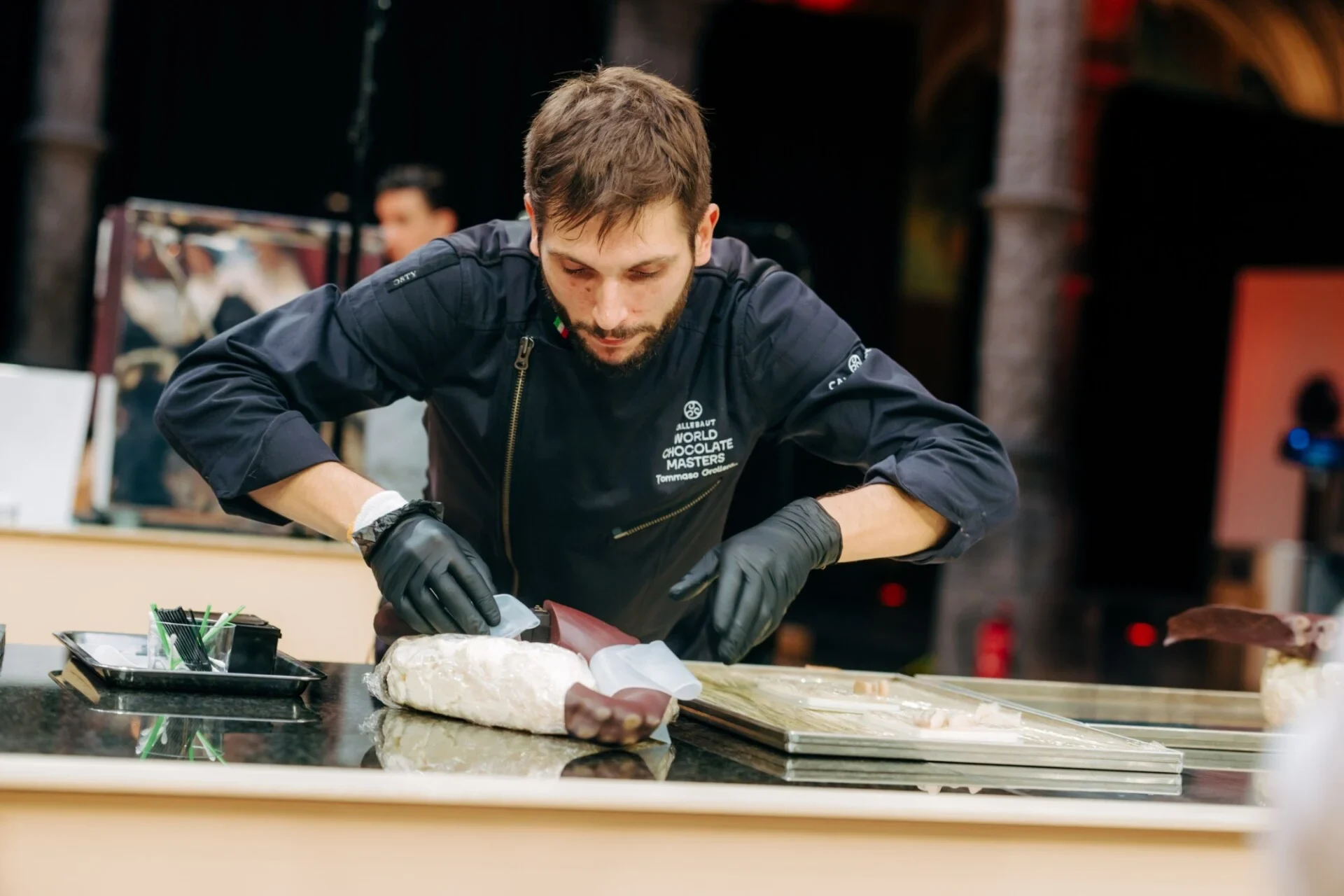
A chocolatier in black chef's jacket with 'World Chocolate Masters' branding works at a competition station.
Grollero, competing for Italy, finished first overall. Lyu Haoran, representing China, finished runner-up. Keita Koshimizu, representing Japan, took third place. The superfinalists also included Canada's Jérémy Monsel, South Korea's Sanghwa Lee, France's Samuel Fremaux, Sweden's Kasper Kleihs and Poland's Łukasz Roguski. Each had already won a national route into the world final.
Grollero took the overall title, the Design category and the Best Taste Award. Haoran took the Best Share Award, attached to a brief that asked competitors to rethink the chocolate gift of tomorrow, and also won the Best Bonbon Award. Monsel won the You Assignment Award, which recognised the competitor who best told the story behind his creativity. Lee received the Jury Standout Award. Monsel won the You Assignment Award, and Lee received the Jury Standout Award.
Guichon said this year's contestants "raised the bar" and added: "This competition is designed to bring new techniques to the industry to inspire the next generation of chocolatiers, and they did just that." The jury table included Guichon, Roca and Tibballs. Design had to survive the eye; sensory work had to survive Roca's side of the table; construction and finish had to pass Tibballs and the technical evaluation.
The Octopus, the Pastry and the Play & Taste Brief
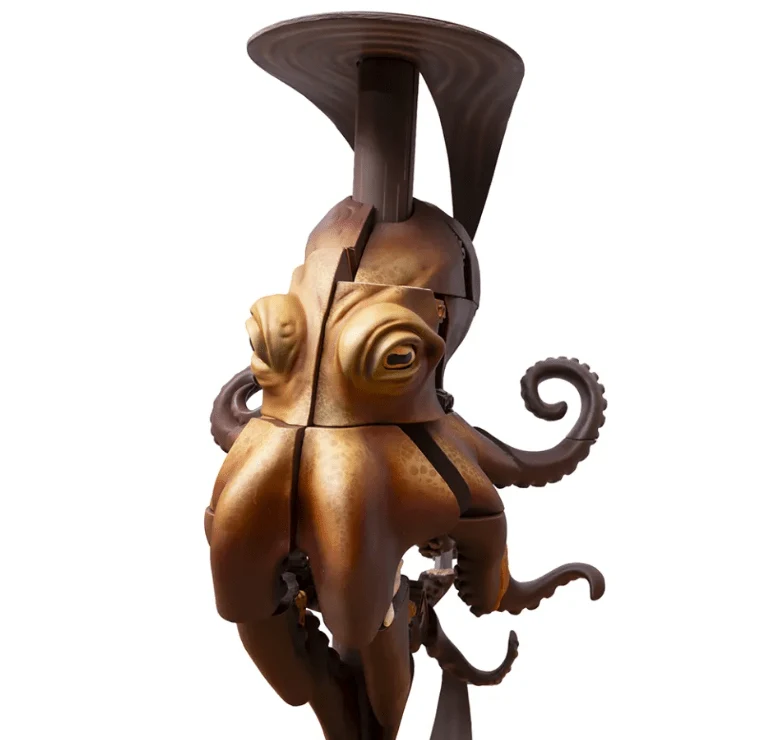
Grollero's octopus was the winning design object: chocolate made into a creature whose form carries its own risks. Tentacles demand repeated curves, points of contact and clean transitions. An octopus form gives little cover to clumsy joins. The octopus surface must read as a single organism, even when the maker has built it from worked pieces, supports, tempered components and assembled parts.
A chocolate sculpture of an octopus with a golden-bronze metallic body.
The Play & Taste brief gave that sculpture a role beyond display. The final asked competitors to reimagine chocolate as interactive, emotional and sensory. Grollero also won the Best Taste Award for his interpretation of a fresh chocolate pastry that comes alive through transformation in taste, texture or temperature. The pastry had to change as it was eaten, warmed, cut or otherwise encountered. A static flavour line would not meet the Play & Taste assignment.
there was a spanish galleon that was loaded up with treasures that left antwerp to go to the uk but it never actually reached us it sunk and has never been found so i said i m going to go treasure hunting after this now i know a1
Ian Mark, Raf Chef and Uk Representative
Chocolate competitions have long split the bench between showpiece and eating work. One hand builds height and clean geometry; another builds ganache, biscuit, cream, glaze, shell and snap. Antwerp asked competitors to cross that split. The Design category rewarded Grollero's octopus sculpture. Best Taste rewarded his fresh pastry. The overall title came after both kinds of labour met the theme, one in form and one in the mouth.
A fresh chocolate pastry that changes in taste, texture or temperature asks a chocolatier to think in sequence: first touch, first cut, first aroma release, first bite, temperature shift, finish. Each stage can help or expose the one before it. Grollero's Best Taste Award says the jury found his answer strongest in that field.
Grollero's octopus gave the room an image to remember. Grollero's Best Taste Award gave the title weight at the tasting bench.
How Fifteen National Winners Became Eight Superfinalists
The first day brought all 15 national winners to Antwerp for the design assignment. That round put each competitor's visual language, construction method and capacity for time control in public view. Chocolate design at this level depends on temper, surface finish, support strategy, mould work, carving and airbrushing. If one element slips, the bench shows it before the tasting starts.
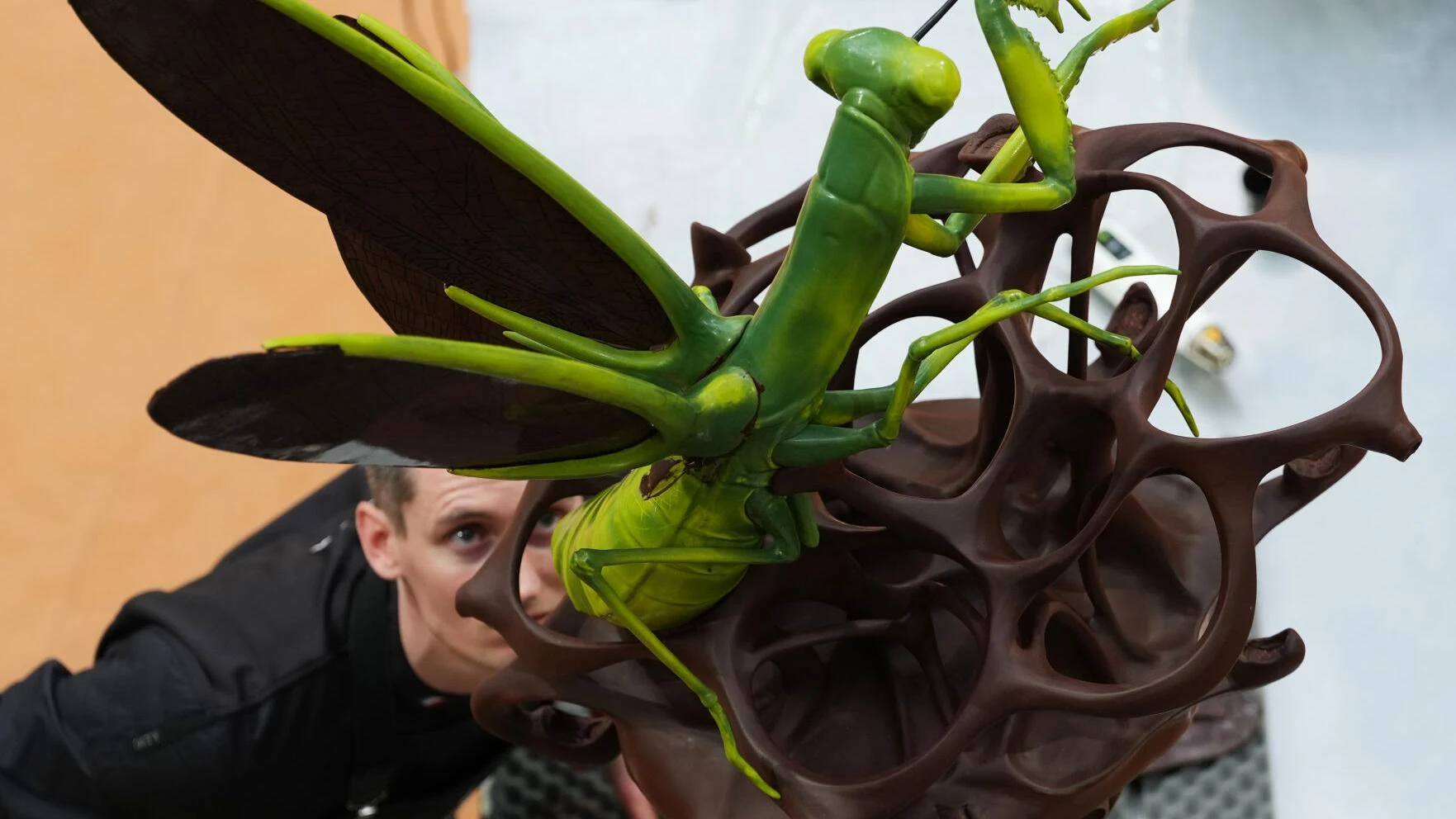
A competitor at the World Chocolate Masters competition holds an elaborate chocolate sculpture depicting.
The reduction from 15 to eight changed the temperature of the contest. A national title had brought each maker to Antwerp; the superfinal asked them to work in the smaller room where category awards and the overall title were still alive.
The Taste challenge placed the mouth at the centre. Grollero won there, through the fresh pastry brief built around transformation. Grollero won that award, while Haoran also took Best Bonbon. Haoran finished second overall while taking two categories.
Koshimizu's third place put Japan on the overall podium. The podium required both the design day and the final day's eating assignments (Thecaterer2).
The national round opens the door, the design day tests the object, and the superfinal tests taste and sharing. The winner has to keep the method intact through each cut.
Ian Mark's Last Contest and the UK Bench
Ian Mark represented the UK as its national winner. He is an RAF chef and won Bake Off the Professionals in 2018. At the World Chocolate Masters 2026, his design looked to Antwerp itself and to the city's role as a gateway into Europe for the spice trade in the 16th century.
Mark's piece included Antwerp's lion symbol, a ship, crashing waves, a flower and a butterfly. The butterfly carried a family line: it was a dedication to his grandmother, who collected porcelain butterflies. He told The Caterer there was another story inside the work: "There was also a second meaning. There was a Spanish galleon that was loaded up with treasures that left Antwerp to go to the UK, but it never actually reached us. It sunk and has never been found, so I said I'm going to go treasure hunting after this, now I know about it!"
The flavour route followed the same port logic. Mark incorporated spices that would have travelled through Antwerp: star anise, cinnamon, vanilla and nutmeg, with mandarin. Spice, citrus, ship, waves, lion and butterfly all came from the story he chose to work through in chocolate.
The technique carried several hands. Mark hand-sculpted and airbrushed the waves. The flowers were tempered chocolate. Alistair Birt from Harrods helped him create the ship using a modern waterjet technique. John Costello, senior confectioner at Nestlé Product Technology, assisted with the lion design, which marked Mark's first use of a mould. Mark said: "We created it from a CAD drawing and then 3D printed it, then I hand carved the intricate hairs into the lion."
Hand carving and CAD can sit in the same piece. A mould can begin on screen and still demand a knife, a needle, a file or a modelling tool in the maker's hand. Mark did not make the superfinal after 21 years of chef competitions. He called the contest "the biggest learning curve" because he had not had a team behind him, then added that the skills were transferable.
Representing his country, he said, "meant everything" and he had given the world final "absolutely everything". He then named the cost in family time: "I've sacrificed a lot of time with my family competing, not seeing my boys grow up. It's time I sacrificed this to go spend time with them while everyone's still young enough." Mark framed Antwerp as his last contest after 21 years of chef competitions.
The Jury Table: Guichon, Roca and Tibballs
The World Chocolate Masters 2026 jury structure gave the final three visible axes of judgment. Amaury Guichon, the US pastry chef and chocolatier, headed the expert jury. Jordi Roca, the Spanish pastry chef, served as head of sensory evaluation. Kirsten Tibballs, the Australian pastry chef and television personality, served as head of technical evaluation.
Those roles matter because chocolate competition work can seduce the wrong eye. A high sculpture can distract from poor finish. A clever story can cover a weak bite until the tasting spoon reaches the plate. A pastry that eats well can still miss the discipline of temper, assembly and structural control. By separating sensory and technical leadership, the Antwerp panel made clear that the winning work had to satisfy both the mouth and the method.
Guichon's comment about technique reaching the next generation places the contest inside a wider apprenticeship chain. World Chocolate Masters creates reference points for school demonstrations, hotel pastry teams, confectionery development kitchens and national selection benches. A design that wins in Antwerp will be studied for construction choices. A fresh pastry that wins Best Taste will be discussed for sequence and transformation. A Share award or Bonbon award will travel quickly into conversations about gifting, shell thickness, filling logic and finish.
Barry Callebaut chief executive Hein Schumacher also tied the competition to the market around the craft. He said: "The craftsmanship of everyone was truly unbelievable and I'm so impressed at how much time and effort has gone into the preparation for each chef." He added: "Together all of us need to lift the chocolate market and find inspiration to grow the market for everyone, and that's why this competition matters." The commercial frame shows why a supplier-backed contest puts so much pressure on technique that others can study, adapt and teach.
The octopus earned Design. The fresh pastry earned Best Taste. The overall result passed through a jury led by Guichon, with Roca and Tibballs carrying sensory and technical authority. That is the architecture of the decision.
What Grollero's Win Leaves for the Next Cycle
Grollero's World Chocolate Masters 2026 title gives Italy the name at the top of this three-year cycle. The octopus will draw the first look, because chocolate showpieces do that. The Best Taste Award went to his fresh pastry, because taste is where the competition's title earns its last word.
The Share brief asked for a rethink of the chocolate gift of tomorrow, and the Bonbon award sits close to the most repeatable unit in the chocolatier's case. If Grollero's win stretched from creature to fresh pastry, Haoran's category wins point toward exchange, gifting and the small finished piece.
Monsel's You Assignment Award puts storytelling under its own light. Lee's Jury Standout Award gives South Korea a named place in the final results.
The next World Chocolate Masters cycle will begin again at national benches before returning to a world final.
Frequently Asked Questions
The Sunday email
Get new Made By stories every Sunday.
Every Sunday we send a lead story and up to four more about the chefs, winemakers, sommeliers and hoteliers behind the restaurants, bars, wineries and hotels we cover.