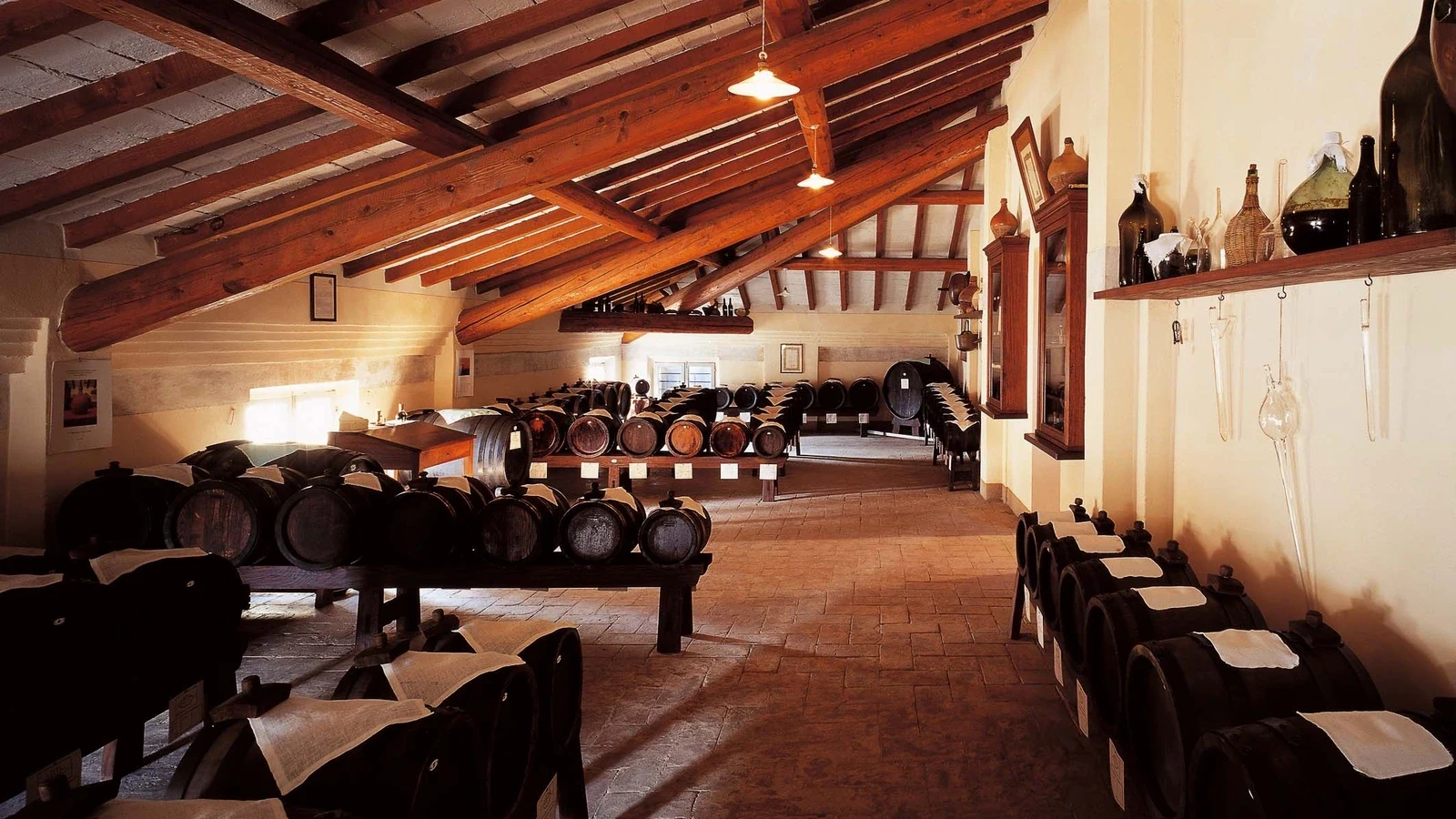
The producers who make traditional balsamic vinegar in Modena will receive you in their attics, and for most of the historic families the route is a direct email or phone call. The difficulty is not a velvet rope; it is geography, language, and the fact that most acetaie are working family farms where the producers' primary business is the vinegar itself, not hospitality. The best route for most readers is a pre-arranged appointment with one of the Consorteria-affiliated producers who formally receive guests, confirmed weeks in advance and conducted in the attic where the producers' barrels actually age.
The gesture that orients everything here: a producer lifts the smallest barrel in a battery of seven, tips it slightly, and draws off perhaps a teaspoon of liquid with a glass pipette. The color is the color of old mahogany. She holds it to the light before she lets you taste. That battery of barrels, each a different wood, each a different size, has been moving through the same attic for longer than most visitors have been alive, tended by the producer, her parents before her, and her grandparents before them. That is who you are coming to meet.
Why the Producers Cannot Simply Open Their Doors to the Public
Aceto Balsamico Tradizionale di Modena (ABTM) is a protected designation of origin product made exclusively from cooked grape must, aged in a battery of progressively smaller barrels made from different woods, with a minimum aging period set by the designation's rules.
The two recognized grades require distinct minimum times in the battery; the extra vecchio grade carries the longer minimum. The producers who make it are, almost without exception, family operations whose primary business is the vinegar itself, not hospitality.
Many of these families work inside private farmhouses or attached to working agricultural estates in the hills around Modena and Reggio Emilia.
The Consorteria dell'Aceto Balsamico Tradizionale di Spilamberto, the civic body that has organized the annual Palio and the sensory evaluation of ABTM, maintains a museum and tasting facility in Spilamberto that functions as the most accessible single point of entry for visitors who have not yet established a relationship with a specific producer. The Consorteria's museum, the Museo del Balsamico Tradizionale, is the one place where you can arrive with a reasonable expectation of a structured experience without a personal introduction.
The scarcity is real but different in character from a restaurant reservation problem. There are no algorithms, no bots, no secondary markets. The constraint is that the producers have limited hours, limited staff willing to host, and a product so slow to make that the economics of tourism are genuinely secondary to the economics of the vinegar. A battery started by a grandmother in the 1970s is still being tended by her grandchildren today. Visitors are guests in a working household, not customers in a tasting room.
When the Producers Actually Become Available for Visits
The Consorteria does not publish a fixed reservation-release calendar in the way a restaurant does. The Museo del Balsamico Tradizionale in Spilamberto, where the Consorteria staff conduct structured tours, is the most reliably bookable experience; the museum's opening hours and visit availability should be confirmed directly with the Consorteria before travel, as seasonal hours vary and the museum has operated on reduced schedules outside peak season.
For visits to private acetaie, the producers who receive guests do so by appointment arranged directly, and lead times vary by producer and season. The harvest period in autumn (roughly October through November) is when producers are most occupied with the grape must that starts every new battery; visits during this window are possible but require earlier contact. Spring and early summer are, by most accounts, the more relaxed period for the producers who host visits.
The annual Palio di San Giovanni, the sensory competition organized by the Consorteria each June in Spilamberto, draws producers and serious enthusiasts together and represents one of the few moments when access to multiple producers in a single day is practically achievable. The 60th Palio took place on June 28, 2026; dates are set annually, so check the Consorteria for future editions.
How to Reach the Producers Who Will Host You
Direct contact with the producer is the primary channel and the one that yields the most substantive visit. Producers affiliated with the Consorteria and the two official consortia (the Consorzio Produttori Antiche Acetaie for Modena and the equivalent body for Reggio Emilia) are the most likely to have some infrastructure for receiving guests. A written inquiry in Italian, or at minimum a polite email in English with a clear statement of purpose and proposed dates, is the standard approach.
Among producers with more developed visitor programs: the Malpighi family at Acetaia Malpighi, located at Via Vignolese in the San Donnino area of Modena, offers guided tours free of charge,1 available every day year-round upon reservation by phone at +39 059 467725 or by email at tour@acetaiamalpighi.it.1 The Malpighi family recommends booking at least 48 hours in advance, and tours are officially confirmed only upon receiving a written or telephonic response from staff.1 Tour duration with the Malpighi team ranges from 30 to 60 minutes.1
The Marchi family at Acetaia Marchi offers structured ticketed experiences: the Classic Experience costs €18.00 per person for a one-hour visit with tasting of both Balsamic Vinegar of Modena PGI and Traditional Balsamic Vinegar,2 while the Prestige Experience costs €25.00 per person (from two people) for a one-and-a-half-hour visit with an expanded tasting.2 Group and company tours require contacting the Marchi family directly for availability and a custom quote.2
The Consorteria staff at the museum in Spilamberto are the channel for visitors who want a guaranteed, structured experience without a personal introduction. The museum staff conduct guided tastings and hold a collection of historic batteries. Confirm current opening hours and contact details via the Consorteria's website before travel.
Specialist food and wine tour operators based in Emilia-Romagna offer pre-arranged acetaia visits as part of broader itineraries. These operators carry existing relationships with producers and can secure access that a cold inquiry might not. The tradeoff is cost: pricing for these tours is not standardized and should be confirmed with operators directly. For a reader with limited time in the region and no Italian, the operator route is the practical one. For a reader who can spend a few weeks planning and is comfortable with direct correspondence, the producer route is the more honest experience.
How to Improve Your Odds That a Producer Will Host You
Write to producers in Italian if you can, or have your inquiry translated. A message that demonstrates some knowledge of the production process, the wood sequence of the battery, or the distinction between ABTM and commercial balsamic vinegar signals to the producer that you are worth their time. Producers who host visitors are not running a tourist operation; they are sharing something they have spent decades building, and they respond to curiosity that is grounded in the work.
Propose a specific date range rather than asking for availability in the abstract. Offer flexibility. If you are traveling with a small group, say so; most producers prefer small groups for a working visit, and a larger party requires a different kind of arrangement. The Malpighi family, for instance, can arrange a paid aperitivo for groups of 10 to 20 participants,1 which gives a sense of the scale producers are equipped to handle.
If you are planning around the Palio in June, book accommodation in or near Spilamberto well in advance. The town is small and the event draws visitors from across Italy and beyond. Use the Palio as an anchor and arrange producer visits for the days immediately before or after, when producers are present in the area and the atmosphere around the vinegar is at its most concentrated.
Consider arriving at the Consorteria museum first, even if your primary goal is a private acetaia visit. The Consorteria staff conduct guided tastings that calibrate your palate and your vocabulary before you sit across from a producer. You will ask better questions. The producer will notice.
Who Else Can Host You When the Private Producers Are Unavailable
Acetaia Access: Who Can Host You, How to Reach Them
| Route | Difficulty | Typical Cost | Lead Time | How to Book |
|---|---|---|---|---|
| Direct producer visit (e.g., Malpighi family, Marchi family) | Moderate (requires direct contact; Italian helpful) | Free to €25.00 per person depending on producer and format | At least 48 hours; weeks recommended in busy seasons | Direct email or phone to producer |
| Acetaia Comunale staff, Modena | Low; reservation required | €5.00; free for children under 12 and people with disabilities3 | Short; accepted until spots are filled3 | Online, phone +39 059 2032660, or email info@visitmodena.it3 |
| Consorteria staff, Spilamberto museum | Low | N/A (confirm with Consorteria) | Short; confirm hours in advance | Consorteria website |
| Specialist food tour operator | Low (operator handles logistics) | Higher; confirm with operator | Days to weeks depending on operator | Via operator's booking system |
| Palio di San Giovanni, June | Low to moderate (public event; travel planning required) | N/A (confirm with Consorteria) | Annual; confirm 2026 date with Consorteria | Consorteria website; accommodation booked independently |
If a private acetaia visit with a producer proves impossible to arrange on your timeline, the Consorteria staff at the museum in Spilamberto remain the most honest substitute: the batteries are real, the tasting is structured, and the staff can often point you toward producers who are currently receiving guests. The Acetaia Comunale of Modena is accessible only with a guided tour and by prior reservation,3 with tours led by Acetaia Comunale staff on Fridays at 3:30 PM and 4:30 PM, and on Saturdays, Sundays, and public holidays at 10:30 AM, 11:30 AM, 3:30 PM, and additional slots;3 access is limited to groups of up to 20 people.3 It is a practical entry point for visitors who want a municipal, publicly organized experience rather than a private farm visit with a family producer.
Inside the Attic: What Happens When a Producer Receives You
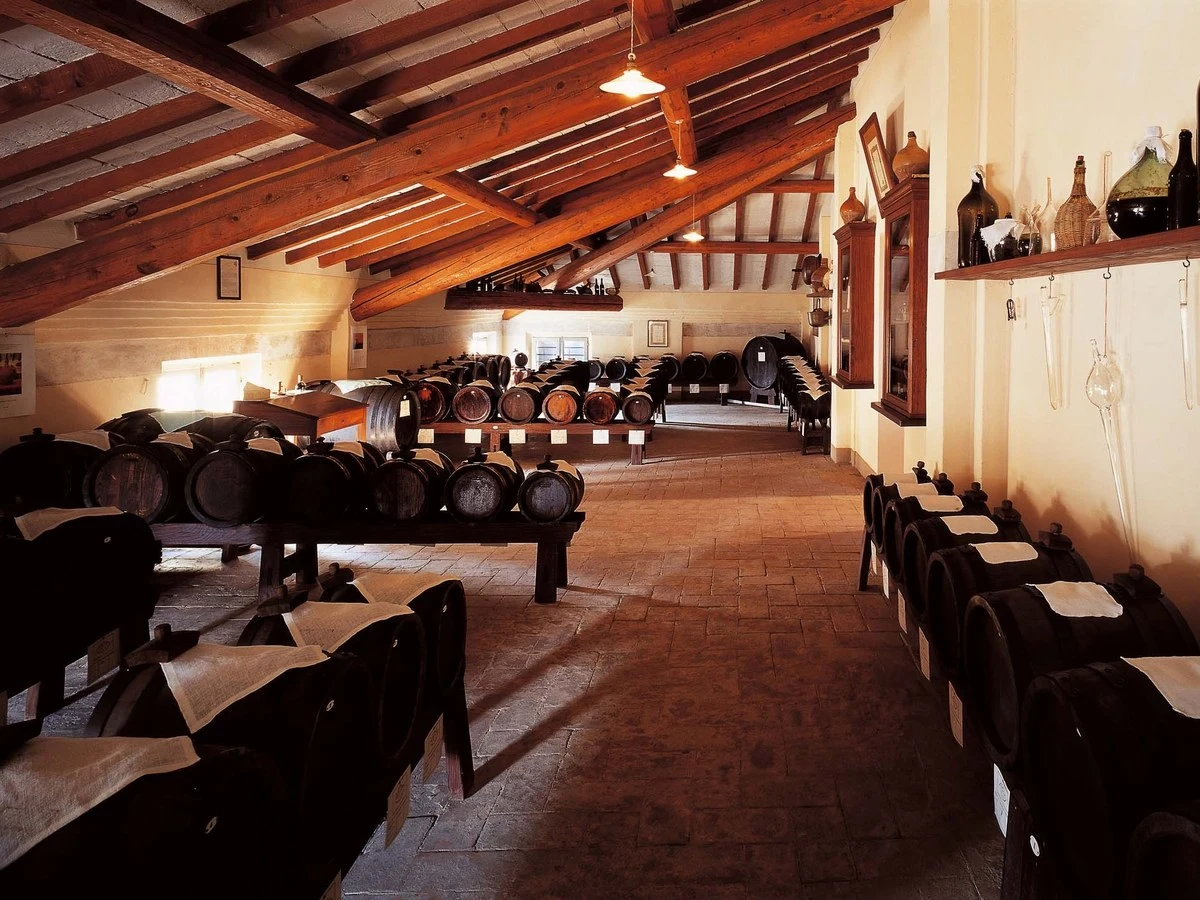
The visit begins, almost always, in the attic. The producer leads you up because traditional balsamic vinegar ages in the roof space of the farmhouse; the temperature swings between summer heat and winter cold are part of the process. The contraction and expansion of the liquid through the seasons drives the slow concentration that no climate-controlled cellar can replicate. The attic is low-ceilinged, warm in summer, and smells of wood and something between vinegar and dried fruit and old furniture.
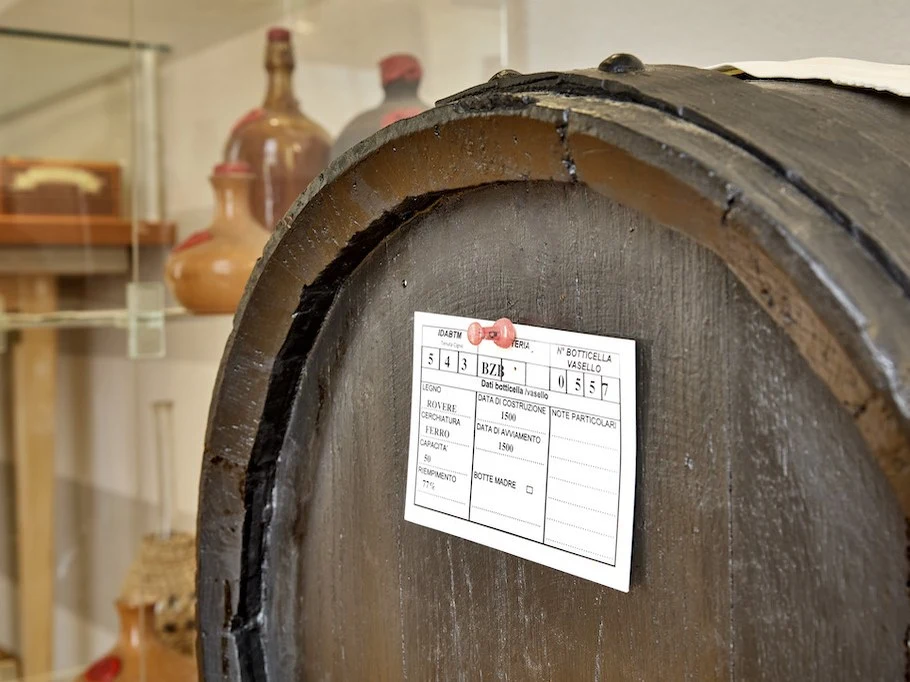
The battery itself is a set of barrels arranged in descending size, typically five to seven vessels, each made from a different wood: oak, chestnut, cherry, mulberry, juniper, ash. The sequence of woods is a family decision, passed down or argued over across generations. Each year, the producer draws off a small amount from the oldest, smallest barrel as the finished product; she then tops that barrel from the next largest, and so on up the battery, with fresh cooked grape must added to the largest barrel at the top.
A tasting at a working acetaia typically involves two or three samples: a younger vinegar, one meeting the minimum aging requirement, and where available an extra vecchio at the longer minimum or beyond. The producer draws the samples directly from the barrel with a pipette or a small ladle. You taste from a small white ceramic spoon, the same spoon used in the official Consorteria evaluation. The difference between the two grades is not subtle; it is the difference between a sharp, complex condiment and something that moves more slowly across the palate, with a sweetness that is not sugar but time.
Visit duration varies by producer and by how the conversation develops. At Acetaia Malpighi, for instance, tours run from 30 to 60 minutes.1 The longer visits tend to happen when the producer senses genuine curiosity and the conversation opens up into the history of the battery, the family's choices about wood sequence, the years when the harvest was difficult. These are the visits worth planning for.
Who Should Make the Effort, and When
This visit rewards people who cook seriously and want to understand a primary ingredient at the source. It rewards wine people who are already comfortable with the language of aging, wood influence, and the way time changes a liquid. It rewards anyone who has ever bought a bottle labeled "balsamic vinegar of Modena" and wondered what the traditional product actually is; the answer is not a better version of the same thing but a categorically different object.
It is not the right visit for someone who wants a polished hospitality experience with a gift shop and a tasting menu. The acetaia is a working farm, and the producer conducts the visit on her own terms. If you are not comfortable with some ambiguity in the schedule, some language friction, and the possibility that the producer's attention will be pulled away by the actual work of the farm, this is not the right format.
The best occasion is a dedicated food-focused trip to Emilia-Romagna, ideally one that also includes time in Parma for the prosciutto and Parmigiano-Reggiano producers, where the same logic of protected designation, long aging, and family continuity applies. The acetaia visit sits naturally in that itinerary as the third pillar of a region whose food culture is built on patience and specificity.
Worth the Planning?
Yes, with the caveat that the planning is the access. There is no app, no release window, no waitlist to join. The route that reliably works is a direct, respectful inquiry to a producer affiliated with the Consorteria, sent several weeks before your travel dates, in Italian where possible. The Consorteria staff at the museum in Spilamberto are the fallback that is genuinely worth taking; they are not a consolation prize but a well-organized introduction to the product and the people who make it.
The visit itself, when it happens, is one of the more grounding food experiences available in Italy, not because of ceremony but because of the absence of it. A producer drawing vinegar from a barrel that her grandmother started is not performing for you. She is doing the work. You are watching.
The extra vecchio grade, the longer-aged category, is the thing to taste if you taste nothing else. Buy a small bottle directly from the producer if she offers it; the price will be higher than the retail equivalent, and the provenance will be exact. That is the transaction the visit is built around.
The producers of Modena are among the clearest examples of what it means to tend a craft across generations, and the families still drawing from batteries their grandparents built are the reason the discipline endures. A visit, arranged with care and patience, is the most direct way to understand why.
Frequently Asked Questions
Do the traditional balsamic producers of Modena charge an entry fee for visits?It depends on the producer and the format. The Malpighi family's guided tours are free of charge.1 The Marchi family's Classic Experience costs €18.00 per person.2 The Acetaia Comunale of Modena charges €5.00, with free admission for children under 12 and people with disabilities.3 Confirm pricing directly with each producer before your visit, as structures vary.
How far in advance should you contact the Malpighi or Marchi families to arrange a visit?The Malpighi family recommends booking at least 48 hours in advance.1 For other producers, lead times are not published; contact each producer directly to confirm availability. During the autumn harvest period (October through November), producers are occupied with the grape must and may require more notice or may not be available at all. Spring and early summer are generally more accommodating.
Can you visit the Acetaia Comunale of Modena without a prior appointment?The Acetaia Comunale of Modena is accessible only with a guided tour and by prior reservation.3 It can be booked online, by phone at +39 059 2032660, or by email at info@visitmodena.it.3 Tickets are paid on the day of the visit at the Tourist Information Office.3
What is the difference between Aceto Balsamico Tradizionale di Modena and the balsamic vinegar sold in supermarkets?Aceto Balsamico Tradizionale di Modena (ABTM) is a protected designation of origin product made exclusively from cooked grape must, aged in a battery of progressively smaller barrels made from different woods, with minimum aging periods set by the designation's rules. The commercial product sold in most supermarkets under the name "balsamic vinegar of Modena" is a different product category, typically a blend of wine vinegar and grape must with a much shorter production timeline. The two are not interchangeable in flavor, texture, or price.
Is the annual Palio di San Giovanni in Spilamberto open to the public, and how do you confirm the 2026 date?The Palio di San Giovanni, organized by the Consorteria dell'Aceto Balsamico Tradizionale di Spilamberto, is a public event held annually in June. It is one of the few occasions when multiple producers and serious enthusiasts gather in one place. The 2026 Palio took place on June 28; check the Consorteria's website for future annual dates. Accommodation in Spilamberto and the surrounding area should be booked well in advance once the date is confirmed.