A single wheel of Parmigiano Reggiano weighs roughly 40 kilograms and takes a minimum of twelve months in the aging cave before it is graded, though most serious producers hold their wheels for twenty-four or thirty-six months before release.
That number is the entry point to understanding why these visits matter: the work is slow, the infrastructure is large, and the people who do it are not, by default, in the hospitality business.
Getting inside a working dairy in the Emilia-Romagna production zone, or into a jamón bodega in Extremadura or Andalucía, requires advance planning, a direct approach, and some patience. Neither experience is impossible to arrange; neither is a walk-in.
The most reliable route for both is direct contact with the producer, well ahead of your travel dates, with a clear statement of purpose.
Why the Dairy Floor and the Bodega Cave Stay Closed to Casual Visitors
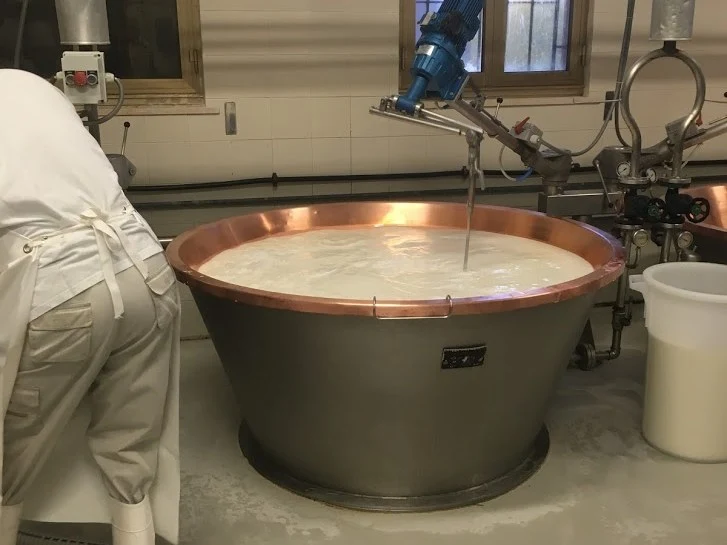
Parmigiano Reggiano production is governed by a protected designation of origin (PDO) consortium, the Consorzio del Formaggio Parmigiano Reggiano,1 which sets strict hygiene and production protocols across every affiliated dairy. The caseifici (dairies) are working food-production facilities. Milk arrives before dawn from local farms,2 and the cheesemakers, often a team of two or three, begin the coagulation process immediately. Visitors on the production floor during active cheesemaking must wear protective clothing and cannot touch surfaces or equipment. Most small dairies run a single daily production cycle; a poorly timed or unannounced visit disrupts the work in ways that cannot be recovered.
The jamón bodega presents a different but parallel constraint. A traditional Ibérico bodega in the Dehesa region ages legs for periods that vary by grade and producer; the bodega does not publish a standardized aging schedule, so confirm the specific program directly with the producer before planning your visit.
The bodega itself, a long, cool, ventilated hall lined with thousands of hanging legs, is a controlled environment. Temperature and humidity are managed carefully across the seasons. Unscheduled foot traffic introduces variables the maestro jamonero, the person responsible for the aging program, cannot account for.
Access is a matter of production integrity, not exclusivity for its own sake.
When Visits to Dairies and Bodegas Actually Open Up
Neither the Consorzio del Formaggio Parmigiano Reggiano nor individual jamón producers publish a standardized booking calendar with drop times or release windows in the way a restaurant reservation system does. The Consorzio does operate a visitor program and maintains a list of dairies open to the public. To reserve a guided tour of a Parmigiano Reggiano dairy near Modena, you can contact the Tourist Information and Services Office or make a reservation through the visitmodena.it portal.3 Individual dairies affiliated with the program set their own visit schedules, and availability is not aggregated on a single platform. The Consorzio does not publish a centralized booking calendar; confirm directly with the individual dairy before planning around a specific date.
For jamón bodegas, the situation is similar. Some larger producers, including those in the Denominación de Origen Protegida zones of Jabugo (Huelva) and Guijuelo (Salamanca), have formalized visitor programs with scheduled group tours. Smaller family operations, particularly in Extremadura's Dehesa, arrange visits by direct request only. No centralized booking platform covers the full range of producers; the visit is arranged by email or phone, in Spanish where possible, with a lead time of several weeks at minimum during peak travel months.
The Best Channels for Booking Both Visits
For Parmigiano Reggiano dairies, the Consorzio del Parmigiano Reggiano has a dedicated portal where you can find dairies open to the public in the Modena area and book your visit.4 From there, direct email to the dairy is the most effective channel. Visits typically take place early in the morning, between 7:00 and 9:00, while production is under way,4 so a request that specifies your preferred date, group size, and language needs will move faster than a generic inquiry.
For jamón bodegas, the approach is producer-direct. Larger operations with established tourism programs, such as those in the Jabugo appellation, often have a dedicated contact for visits on their producer websites.
Smaller bodegas respond best to a direct email in Spanish that explains your interest in the production process specifically, not just a tasting.
Mentioning the breed (Ibérico puro or Ibérico cruzado), the feeding regime (bellota, cebo de campo, or cebo), and the aging duration you are interested in signals that you are there for the craft, not the photo opportunity, and tends to open doors that a generic tourist inquiry does not.
There is no single aggregator platform that covers both visit types reliably. Agritourism booking platforms such as Agriturismo.it list some Emilian dairies, and regional tourism boards in Andalucía and Extremadura maintain producer directories.
Strategy: What Actually Improves Your Odds
The single most effective move for a Parmigiano dairy visit is to arrive during the production window. A visit request that specifies "we would like to observe the morning production" signals seriousness and aligns with the dairy's natural rhythm. Requests for afternoon visits, when the production floor is being cleaned and the cheesemakers are resting, are harder to accommodate and less interesting.
For the jamón bodega, the equivalent move is to ask specifically about the grading and selection process, the moment when the maestro jamonero assesses each leg by probing it with a thin bone needle (a cala) and reading the aroma. This is the technical heart of the bodega visit and is not always included in standard group tours. Asking for it by name, and explaining why you want to see it, changes the nature of the conversation.
Mistakes that cost people the visit:
- Arriving at a dairy without a confirmed appointment. Booking is required, at least a few days in advance;4 an unannounced arrival during production will result in a polite refusal at the gate.
- Booking a jamón bodega visit through a general tour operator without confirming that the visit includes the aging cave and not just a retail tasting room. Many "bodega tours" sold through travel platforms are retail experiences with a short walk through a display area.
- Requesting a visit during August in either region. Italian dairies often reduce production or close entirely in August; many Spanish bodegas operate on reduced staff. July and August are the hardest months to arrange a substantive visit.
- Sending a group inquiry without specifying group size. Both dairies and bodegas have limits on how many people can be on the production floor at once, and an unspecified group request is often deprioritized in favor of confirmed small groups.
What insiders do differently: Serious food professionals and buyers who visit these producers regularly tend to arrive with a specific technical question prepared, something about the milk sourcing, the rennet type, or the aging humidity. This shifts the visit from tourism to peer conversation, and producers respond to it. For jamón, asking about the montanera, the autumn and winter period when Ibérico pigs graze on acorns in the Dehesa, and how the current year's acorn crop affected the fat composition of the legs currently in the cave, is the kind of question that earns a longer, more open visit. Insiders also follow producers on social media and reach out after a notable post about a new vintage or a grading day, timing their inquiry to a moment when the producer is already thinking about the work.
Seasonal access calendar: For Parmigiano dairies, the window from October through May is the most productive for visits. Spring milk, from cows grazing on fresh pasture, produces wheels with a different fat profile than winter milk, and visiting in April or May allows you to observe this distinction in real time. For jamón bodegas, the period from November through February aligns with the matanza (slaughter) season for freshly cured legs and with the end of the montanera for bellota pigs. Visiting in late autumn gives you the chance to see both the incoming fresh legs and the mature legs in the final stages of aging simultaneously.
Comparable Visits Worth Considering
Parmigiano Dairy and Jamón Bodega: Visit Options Compared
| Visit Type | Access Difficulty | Booking Channel | Best Season | Production Observation |
|---|---|---|---|---|
| Parmigiano Reggiano dairy (Consorzio-affiliated) | Moderate; advance booking required | Direct via Consorzio directory or producer email | Oct, May | Full morning production cycle possible |
| Jamón Ibérico bodega (large DOP producer, e.g. Jabugo) | Moderate; formalized tour programs exist | Producer website or direct email | Nov, Feb | Aging cave and cala demonstration possible |
| Jamón bodega (small family, Extremadura) | Higher; direct contact in Spanish required | Direct email or phone only | Nov, Feb | Most access; least structured |
| Grana Padano dairy (Po Valley) | Lower; more visitor infrastructure | Consorzio Grana Padano visitor program | Year-round | Production observation available |
| Prosciutto di Parma producer (Langhirano) | Moderate; Consorzio del Prosciutto di Parma runs tours | Consorzio del Prosciutto di Parma website | Year-round | Curing and aging halls accessible |
On the Dairy Floor and in the Cave: What the Visit Actually Involves
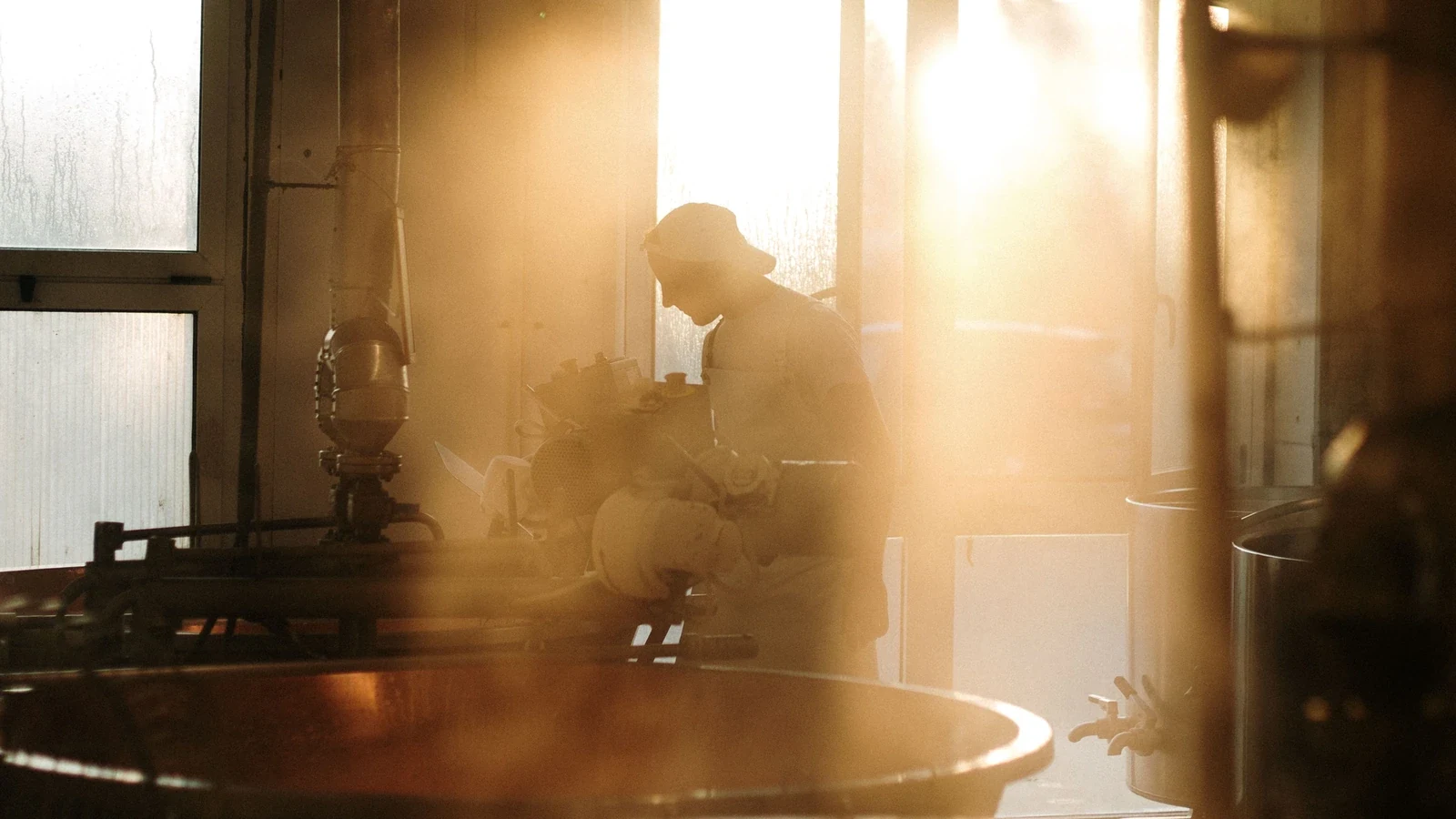
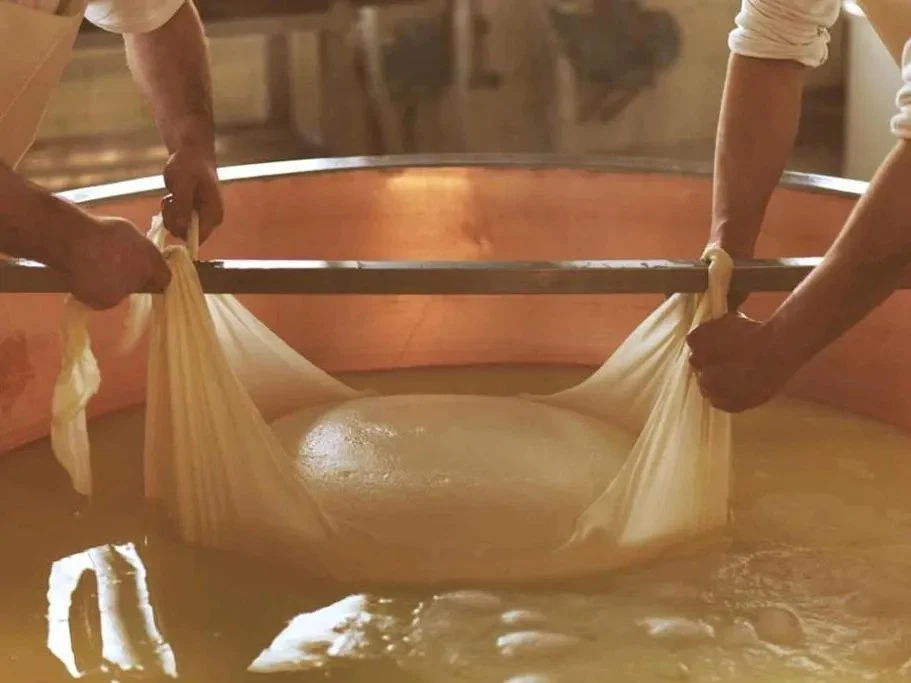
At a working Parmigiano Reggiano caseificio, the morning begins with the arrival of fresh milk from local farms.2 The cheesemaker, often working with one or two colleagues, combines the previous evening's partially skimmed milk with the fresh whole milk from the morning milking in large copper vats. The coagulation process, using natural whey starter and calf rennet, takes roughly eight to ten minutes. What follows is the breaking of the curd with a tool called a spino, a wire whisk on a long handle, which the cheesemaker works by hand and by feel, reducing the curd to granules roughly the size of rice. The vat is then heated to around 55 degrees Celsius. A dairy visit lasts approximately one to one and a half hours,4 and a visitor who arrives at the start of production can watch the full arc of it.
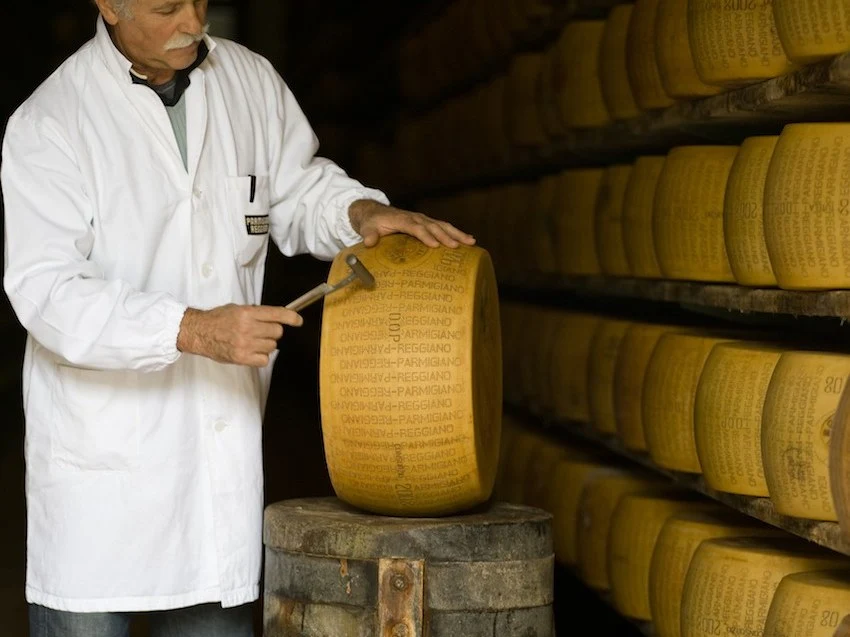
The visit includes touring the ageing warehouses,4 where wheels are stacked on wooden shelves in rows that can extend for hundreds of meters in a large operation. The smell is specific: a dry, mineral, slightly ammoniated air that carries the faint sweetness of aged fat. The wheels are turned and brushed regularly by hand or by automated brushing machines in larger facilities. At the grading stage, a Consorzio inspector taps each wheel with a small hammer, reading the resonance for internal voids or cracks, before branding passing wheels with the Consorzio's fire-mark.
In a jamón bodega, the experience is slower and more olfactory. The bodega hall is cool and dim, the legs hanging in rows from iron hooks, each one tagged with its entry date and breed classification.
The maestro jamonero moves through the hall with the cala needle, a thin probe made from the shin bone of a horse or cow, pressing it briefly into the leg at three specific points and reading the aroma released.
The difference in aroma between a leg at an early stage of aging and one approaching full maturity is immediately legible once you have been shown the comparison. A good visit includes this demonstration and a tasting of legs at different stages of aging, cut to order from the leg with a long, flexible jamón knife.
Who Should Make the Effort, and When
These visits reward people who already cook with these ingredients and want to understand why an extended-aged Parmigiano behaves differently in a risotto than a younger wheel, or why a bellota leg has a fat that melts at a lower temperature than a cebo leg. They are not well suited to large groups with mixed levels of interest, or to travelers who want a passive tasting experience without the production context. The visits are working-facility tours, not hospitality experiences, and the best ones feel like a conversation between practitioners rather than a guided tour.
For food professionals, buyers, and serious home cooks, both visits are worth the planning effort. The cost of a dairy visit varies, generally about EUR 18-22 per person, with a wider range of roughly EUR 15 to EUR 55 depending on the dairy and tour format,4 which makes the Parmigiano caseificio one of the more accessible production visits in European food travel. For a first-time visitor to either region who wants a more structured introduction, the Consorzio del Prosciutto di Parma runs a formalized visitor program in Langhirano that provides a good foundation before approaching a smaller, less structured producer directly.
Worth the Planning?
Yes, but only if you approach both visits as a practitioner rather than a tourist. The Parmigiano dairy visit is the more accessible of the two: the Consorzio's visitor infrastructure is well developed, the production cycle is predictable, and a morning visit to a working caseificio in the Emilia-Romagna zone is one of the clearest illustrations available of how a single ingredient is made, aged, and graded over years. Most factory tours include guided tastings of Parmigiano Reggiano at different aging stages, often paired with regional products,2 which gives the visit a sensory arc that reinforces what you have just watched on the production floor. The jamón bodega visit requires more initiative, more Spanish, and more specificity in your request, but the payoff, standing in a cave with a maestro jamonero who has spent decades reading legs by smell, is proportionate to the effort.
The direct email is the route here, not any aggregator or allocation list. Write to the producer, name what you want to see, and give them enough lead time to fit you into the production schedule. Avoid August for both. Arrive early at the dairy. Ask about the cala at the bodega.
For most travelers, the Consorzio-affiliated dairy and a larger DOP bodega with a formalized program are the smarter first choice; the small family operations in Extremadura reward the second or third visit, when you already know what questions to ask. The access, in both cases, runs through the people doing the work, and that is precisely where it should begin.
Frequently Asked Questions
Can you walk into a Parmigiano Reggiano dairy without a booking?
No. Working caseifici are active food-production facilities operating under PDO hygiene protocols. An unannounced arrival during production will typically result in a refusal at the gate. Book in advance through the Consorzio del Formaggio Parmigiano Reggiano's visitor directory or by direct contact with the dairy.
How far ahead should you contact a jamón bodega in Extremadura to arrange a visit?
For larger DOP producers with formalized programs, two to four weeks is generally sufficient outside peak summer months. For smaller family bodegas in Extremadura, allow several weeks and write in Spanish where possible. The bodega does not publish a booking calendar; confirm availability directly with the producer.
What is the best time of year to visit a Parmigiano Reggiano dairy to see active production?
October through May is the most productive window. Spring milk, from cows on fresh pasture, produces wheels with a distinct fat profile, and production activity is at its highest. August is the hardest month: many dairies reduce production or close entirely during this period.
Does a jamón bodega visit in Jabugo or Guijuelo include the aging cave, or just a tasting room?
This depends on the producer and the program. Some larger operations include the aging cave as part of a structured tour; others offer only a retail tasting experience. When booking, ask specifically whether the visit includes the bodega cave and a demonstration of the cala grading process. If the answer is no, consider contacting a smaller producer directly for a more substantive visit.
Is there a single platform that books both Parmigiano Reggiano dairy visits and jamón bodega tours?
No centralized platform covers both. The Consorzio del Formaggio Parmigiano Reggiano maintains a dairy finder at parmigianoreggiano.com. For jamón bodegas, regional tourism boards in Andalucía and Extremadura maintain producer directories, but direct contact with the producer remains the most reliable booking channel for both visit types.