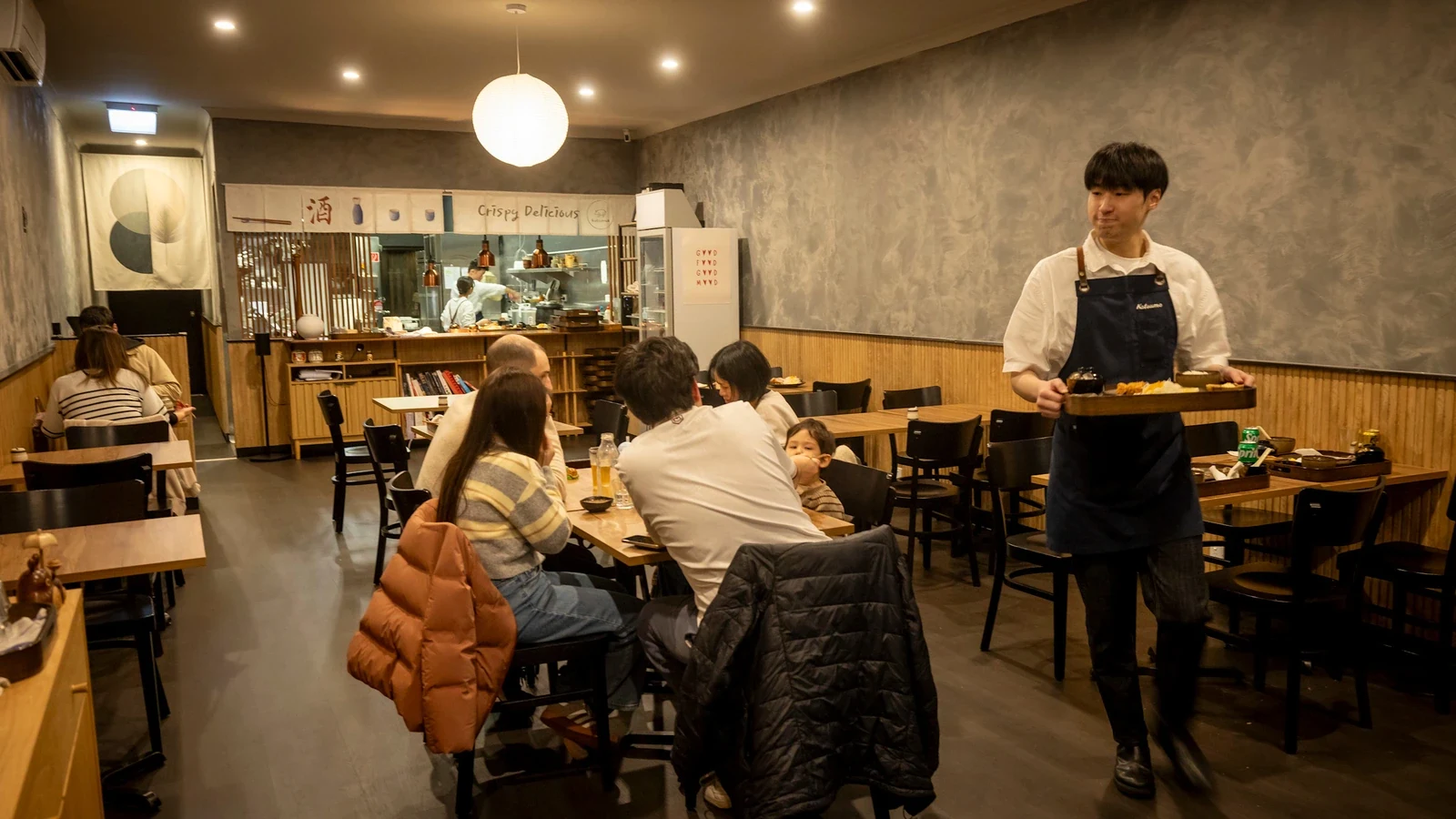
Jaejun Kim buys whole pork loins for Katsumo Glen Huntly, then sorts tenderness before any crumb reaches the bench. The 25-seat Japanese eatery he opened in Glen Huntly last August is a narrow answer to a long craving: tonkatsu made with the attention Kim carried from fine-dining kitchens.
As a child in Korea, Kim found comfort in Japanese-style crumbed pork fillet; later he travelled through Japan seeking it out. In Melbourne, he saw room for a more exacting version, and built Katsumo around that belief.
The format is lean. Kim does not take bookings, the limited tonkatsu supply often sells out, and early arrival matters. The restaurant sits about 10 kilometres south-east of the city, with a moderate price point and a kitchen that treats one dish as a full discipline. For the reader, the practical instruction is simple: go early, expect a small room, and order with the understanding that the pork supply is finite.
Why Katsumo Glen Huntly Starts With the Pork Loin
A whole loin asks more of the cook than a pre-portioned cut. Kim reads shape, tenderness and yield before dividing the pork: "premium" cuts come from the front end; "signature" cuts sit nearer the rump, where the meat is slightly less tender. That distinction gives Katsumo its first layer of craft: butchery before frying.
The finished pork is sliced and set on a wire rack with mustard, citrusy yuzu-kosho, wasabi and house-made tonkatsu sauce that moves between sweet and tart. The condiments sit beside the cutlet, not over it, so each bite can be adjusted without burying the crust. If you want to read the method clearly, taste the cutlet first without sauce, then work through the mustard, yuzu-kosho, wasabi and house sauce bite by bite.
Build the cutlet into a meal and the tray adds cabbage shredded into fine strands with cooked carrot sauce, plus rice, miso soup and potato salad. The supporting pieces stay close to the central task: relief from the fry, warmth from the soup, enough starch to turn the cutlet into a complete plate.
From Rosetta and Kazuki's to a Tonkatsu Station
Kim moved to Australia in 2014, spent five years working up to sous chef at Neil Perry's since-closed Rosetta, then became head chef at two-hatted Kazuki's in Carlton. His fine-dining experience crosses French, Italian and Japanese cooking, but Katsumo compresses that range into one station.
Tonkatsu gives the cook little cover. The surface shows whether Kim handled the oil with care; the slice shows whether the meat was given time; the finish shows whether the crust can stay crisp without turning heavy. Repetition does not make the work smaller. It makes the margin for error easier to read. Sit with the plate long enough to notice those tests: colour, slice, crust, then heat.
The French lineage is already inside tonkatsu itself: a 19th-century Japanese interpretation of veal schnitzel, remade through flaky panko and deep-frying rather than pan-cooking. Kim works within that exchange, but his measure is practical, not nostalgic.
How Kim Builds the Cutlet at Katsumo
Two breadcrumbs, used in a specific ratio, give the crust its balance: fragile enough to break cleanly, dense enough to protect the pork. Kim monitors hot oil closely to reach a golden, crisp finish, then rests the cutlet so the fibres can relax. A short oven finish warms the pork through and clears away greasiness.

Each movement has a job. Crumbing builds structure. Frying creates colour and crispness. Resting protects the meat. The oven brings the plate back to temperature. A crumbed cutlet can become ordinary quickly when those stages collapse into speed.
Kim also offers beef, chicken or prawn in place of pork, and a pork loin version stuffed with mozzarella. Pork trim becomes menchi, then goes into a slow-braised Japanese curry with spice and tomato-driven umami. If pork is not the order, the same station still gives you a choice: beef, chicken, prawn, or the mozzarella-stuffed loin.
Why Kim Built a Small Room With No Bookings
No bookings changes how the meal begins. You arrive in person, accept the scale of the place, and understand that the kitchen is not built for endless supply. For a restaurant this focused, restraint protects the work as much as it creates demand. The useful move is to treat Katsumo as an early-arrival meal, not a late backup plan.
The drinks list follows the same line. Sake and beer are the core accompaniments, with a 90-millilitre masu sake serve poured into a small glass set inside a square box. The gesture has generosity in it, but it suits the casual room: enough ritual to notice, not enough to pull attention away from the cutlet.
What Kim Adds to Melbourne's Japanese Dining
Melbourne already has Japanese dining in many registers. Kim adds a specialist's pressure. He does not place tonkatsu among many options and hope the diner notices; he makes the cutlet the reason for the room. For diners tracking Japanese food in Melbourne, Katsumo Glen Huntly is the place to study tonkatsu as the main event, not a side note.
Familiar food often loses its technique in plain sight. A crumbed pork fillet can read as comfort before it reads as craft. Kim reverses that order. The pleasure is direct, but it comes through decisions made at the bench.
Specialisation is visible elsewhere in Melbourne. Cha Tra Mue, the Thai tea brand brewing since 1945, now serves strong milk tea at 236 Swanston Street, Melbourne, with iced and hot versions and creaminess shaped by "pulling" the tea from vessel to vessel.
At 7 Alfred Place, Melbourne, 7 Alfred serves only steak frites: grass-fed scotch fillet, beef-tallow fries, and a choice of peppercorn, chimichurri, veal jus or umami butter.
At 250 Russell Street, Melbourne, Sagye, from the team behind Little Lonsdale Street's Ondo, centres gomtang, a slow-cooked Korean beef soup served in traditional bronze bowls that keep the broth hot and preserve a clean flavour.
Kim belongs to that narrower kind of ambition. He has not built a large room to prove range. He has built a small one around crumb craftsmanship.