Sommelier Pascaline Lepeltier Builds on Best Sommelier World 2023
Pascaline Lepeltier reached the final three, caught a corked wine before service, and left elite wine service with a harder question.
HM
Director of Editorial Standards
Hugo Marchetti
Filed October 21, 2026
11 min read
The Association de la Sommellerie Internationale holds the Best Sommelier of the World competition every four years. The final stage requires candidates to pour the wine, decant the port, identify the glass blind, speak to the guest, and keep the line of service intact. Sixty-six candidates had already been cut to 20 after practical tastings and written exams. Then three remained: Lepeltier for France, Svorte for Norway, and Iwata for Japan (Grubstreet1).
Svorte won. Iwata earned third place. Lepeltier, one of the few women to compete at this level of sommelier competition, left without the title. Since the ASI began naming a best sommelier in the world in 1969, no woman has won it. That fact sat under the room before ASI president William Wouters opened the envelope; it stayed there after he read the result (Grubstreet1).
The Sunday letter
Get our new stories in your inbox every Sunday.
One email with our newest profiles and guides. See a sample before you subscribe.
The stage was arranged as a dining room. Wine professionals and judges filled the seats, and the finalists worked as if the table were alive with guests. That choice is the discipline in miniature. A sommelier can know the producer, grape, region, and service temperature; if a flawed wine reaches the diner, the knowledge has failed at the pass.
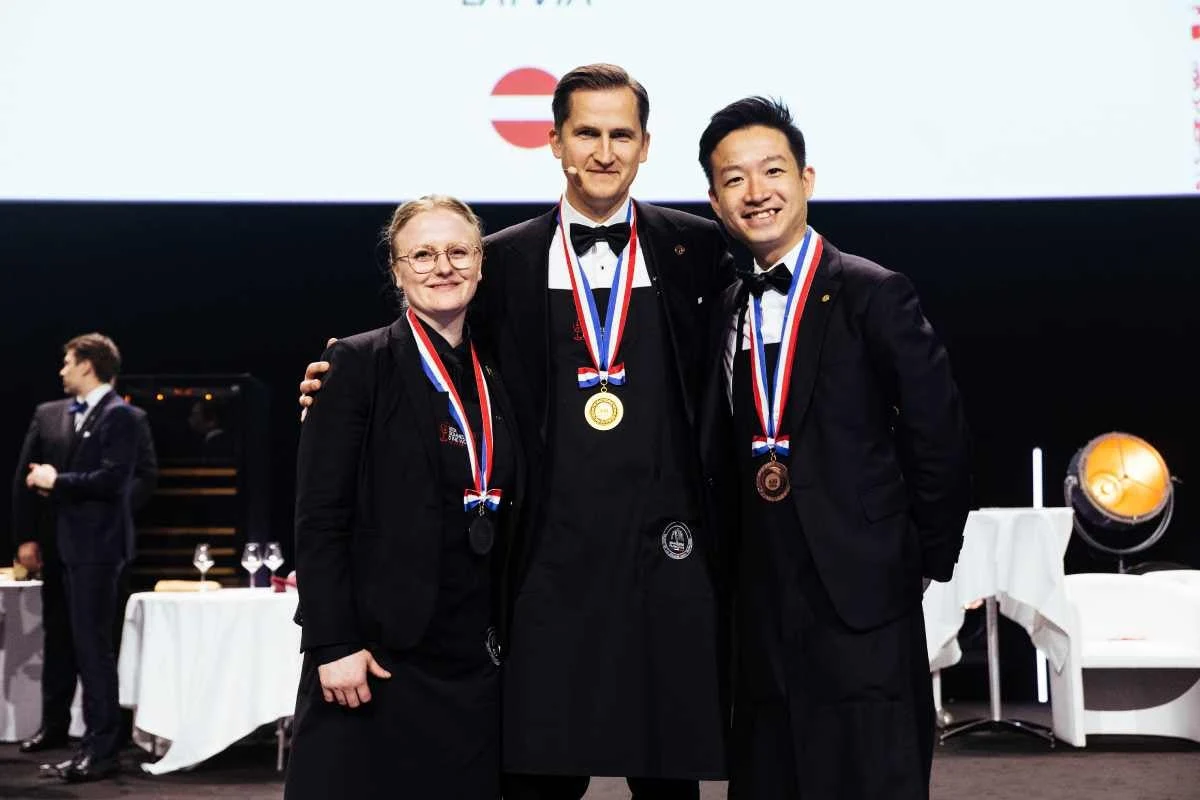
Three sommeliers in formal attire wearing medals on ribbons stand on a competition stage with white-clothed.
Svorte’s mistake came through a bottle under screw cap. A diner identified the wine he had served as corked. “I am so sorry,” Svorte said. “It was under a screw cap, so I didn’t check.” Cork is the usual culprit for TCA, but a screw cap does not release a sommelier from smelling the wine. In competition, the closure can become misdirection. The method has to survive the misdirection.
Lepeltier worked second. The master of ceremonies introduced her with the line, “Make him feel welcome,” although Lepeltier was the woman on the stage. The introduction was awkward because the room already carried decades of results without a woman’s name at the top. Lepeltier worked second, checked the wine, found the fault, and kept it away from the judges’ table.
That is service technique at its plainest. The bottle moves from hand to eye to nose before it moves to the guest. The assessment takes seconds, and the habit takes years. In a dining room, that habit protects a table from an off bottle. In a world final, it tells the room whose hands stay steady under lights, noise, and consequence.
How Best Sommelier World 2023 made the room louder
Best Sommelier World 2023 had already made Lepeltier a public measure of what had not yet happened in the competition. At Paris La Défense Arena, before more than 4,000 people, she finished fourth. One place short of the final. As she left the stage, the crowd called her name (Grubstreet1).
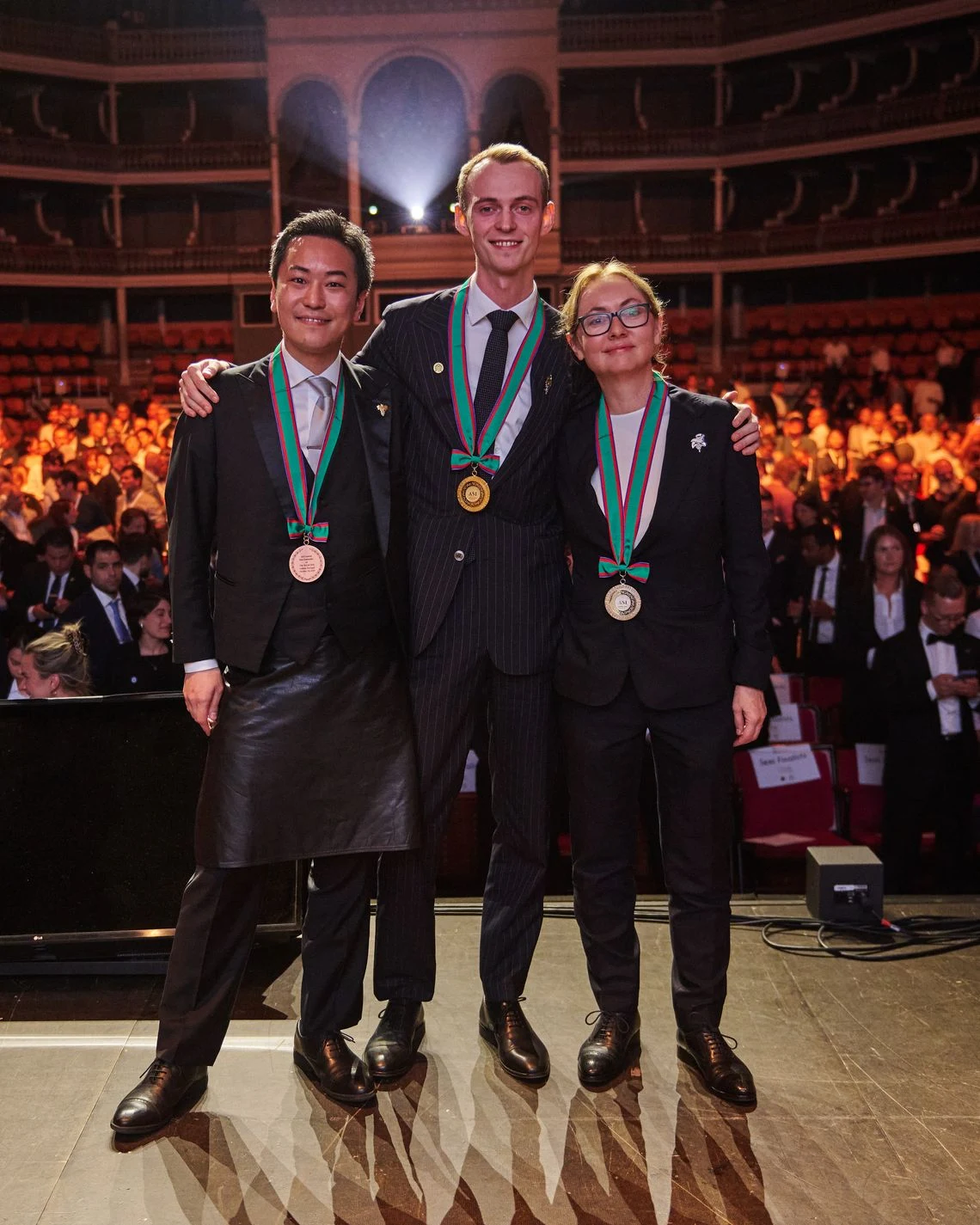
Three sommeliers in formal attire standing on stage at an awards ceremony, wearing medals (gold center.
The scale matters because sommelier work usually happens at table height, in a voice low enough not to disturb the next two seats. In Paris, the discipline moved into an arena. The same actions remained: the grip on the bottle, the reading of the glass, the decision to speak or wait. The noise around them changed.
After that fourth-place finish, Lepeltier returned to training. The work named around her preparation included meditation, theater exercises, study, travel, and blind tasting. Meditation steadies the breath before a service task. Theater exercises train the body to project without hardening. Travel puts more wines into memory with place attached. Blind tasting keeps the taster honest.
During the later rounds that brought her back to the final three, one red wine gave her four minutes for an organoleptic description and a conclusion. Lepeltier leaned toward the glass and called, “Syrah from Santa Barbara.” The wine was a Tablas Creek Syrah, made about an hour from where she placed it. That answer joined grape, region, and sensory evidence under the clock.
In Paris, Lepeltier was fourth before thousands. In the following world stage, she reached the final three and caught the corked wine before service. The title still went elsewhere.
The lineage behind Lepeltier’s service
Lepeltier was born in Anjou, France, on January 9, 1981, and grew up in the Loire Valley. She earned a master’s degree in philosophy from Nantes University in 2001, then completed sommelier and hospitality master’s degrees at the CFA in Angers in 2005. The sequence still shows in her public work: service, agriculture, argument, and memory held in the same frame (Wikipedia2).
Her early wine work passed through L’Auberge Bretonne in La Roche-Bernard, where she worked as an assistant sommelier. She began her obsession with wine at the two-Michelin-starred L’Auberge Bretonne under chef Jacques Thorel. Within a year, she had been named Best Loire Valley Young Sommelier and Best Brittany Sommelier. Those titles mark the move from student to cellar hand with enough command to stand in judged rooms (Pascalinelepeltier3).
At Rouge Tomate in Brussels, where she worked as beverage director, Lepeltier interned at the George V in Paris under Eric Beaumard, described as Best European Sommelier and a Best World Sommelier runner-up. Later, she started at Rouge Tomate’s New York operation on a temporary assignment and became wine director. The World of Fine Wine awarded Rouge Tomate’s list Best Long Wine List in the World 2017 and Wine List of the Year 2017. Lepeltier left Rouge Tomate in 2017 after the restaurant decided to reduce its wine program (Wikipedia2).
Racines NY and Chambers followed in New York. Lepeltier has worked at L’Auberge Bretonne, Rouge Tomate, Racines NY, and Chambers; she is currently co-owner and wine adviser at Chambers in New York City, and the competition account identifies her as beverage director at Chambers in Tribeca. Chambers is a farm-to-table, wine-focused restaurant, which gives her a daily station for the same questions that appear under harsher light in competition: what does the wine need, what does the guest need, and what does service owe both?
In 2014, Lepeltier passed the Master Sommelier Diploma. In 2018, she became the first woman to win both the Meilleur Ouvrier de France title in the sommelier category and the Best Sommelier of France competition. In January 2019, La Revue du Vin de France named her Personality of the Year 2019, the first woman to receive that recognition from the magazine. In 2024, she authored One Thousand Vines, the English version of Mille Vignes, Penser le vin de demain. The book work sits beside the floor work, and both explain why her competition appearances carry more than a score (Wikipedia2).
The tests that separate the finalists
The final three gave the ASI competition its cleanest form: Pascaline Lepeltier for France, Nikolai Haram Svorte for Norway, and Wataru Iwata for Japan. Each had survived a field of 66 candidates, then the cut to 20, then the final reduction. By the time they reached the stage, every candidate had already passed through written questions, practical tasting, and service work that would exhaust a normal restaurant shift before service even began (Grubstreet1).
The final tasks named in the room were direct: pour wine, decant port, taste blind. Each one carries its own failure points. Pouring wine tests equal measure, label position, glass awareness, and table pace. Decanting port asks for control over sediment and timing. Blind tasting requires a candidate to translate smell, texture, color, acid, tannin, and alcohol into a place and grape without letting reputation interfere.
Written exams sit behind the final spectacle, and they matter because the competition is as much memory as service. A sommelier at this level may face a question on an esoteric grape, a region rarely ordered by the glass, or a cultural reference that has moved a wine into public conversation. One written question asked which wine Taylor Swift had made famous. The answer was Sancerre.
The tasting bench asks for another discipline. Before the final show, three glasses sat on a table, two sparkling and one still. Candidates had to identify how they were made. Then came the red wine that Lepeltier placed as Santa Barbara Syrah from Tablas Creek. Four minutes gave a trained taster enough time to build and test a conclusion about the wine.
Svorte’s winning run included the corked-wine episode under screw cap, a mistake that made the result hard for some in the room to receive. Wouters announced Iwata in third place. Then he announced Svorte as the winner. A Decanter editor nearby responded, “How?” The question stayed in the air because the visible service had given the room one set of impressions; the envelope gave it another.
The gender line running through the podium
The ASI has named a best sommelier in the world since 1969, and no woman has won the title. Every woman who trains for that stage carries the normal demands of the exam plus the accumulated history of who has been rewarded there.
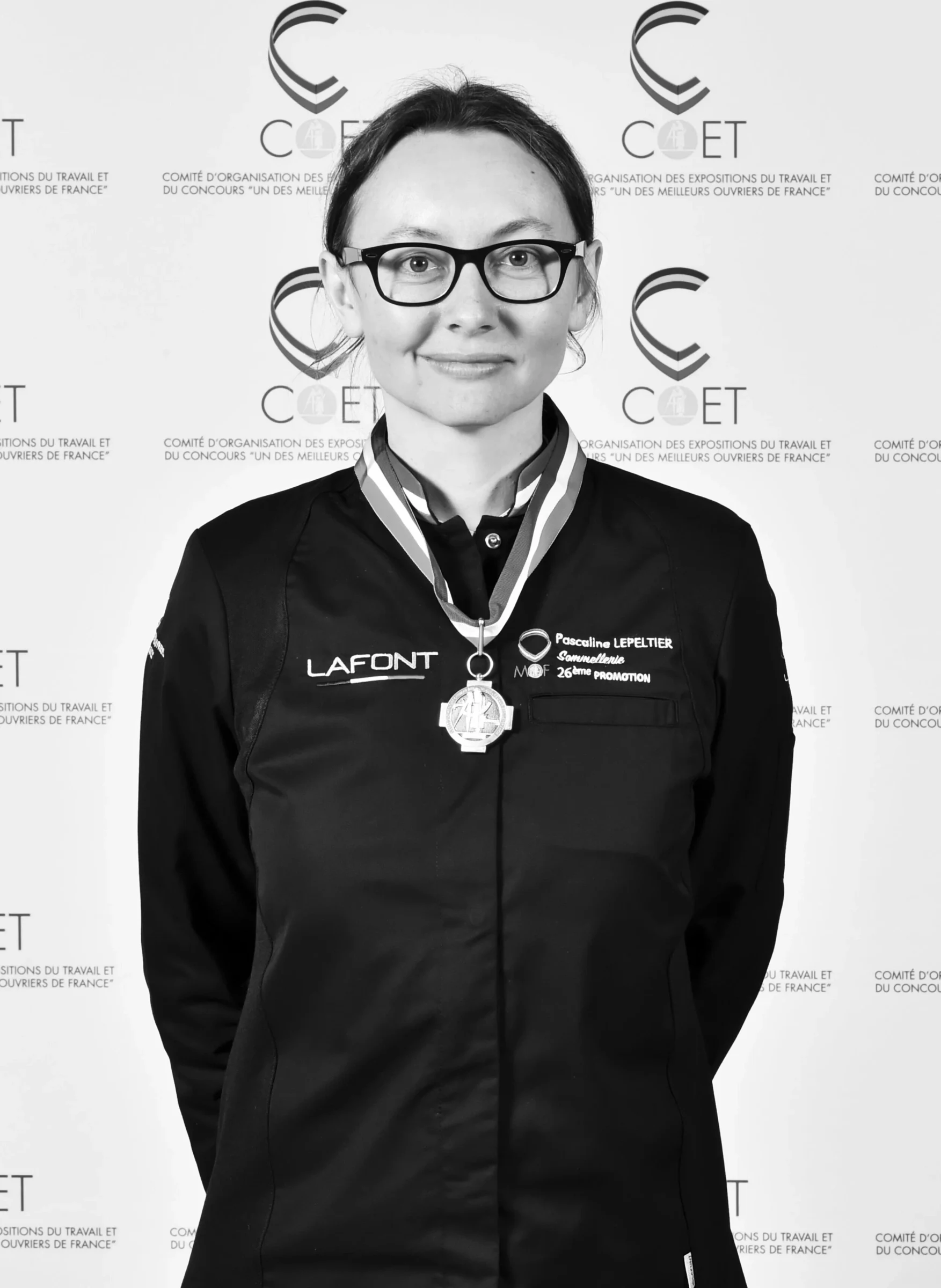
A woman wearing glasses and a black chef's jacket with 'LAFONT' branding and 'Pascaline LEPELTIER'.
In an early attempt to become France’s top sommelier, she was the only woman. At a 2010 contest, one task required serving a magnum of Champagne. Lepeltier served it with the bottle nestled into her elbow, while the male competitors used two hands. She passed the test. She did not win the top award. The feedback that followed did not address a missed temperature or a flawed pour. A judge told her she was too enthusiastic, suggested that being a sommelier might not be her thing, and advised “un petit talon” and makeup if she insisted on the career.
Eight years later, she returned and became the first woman named France’s best sommelier. She also became the first woman to win both the Meilleur Ouvrier de France title in sommellerie and the Best Sommelier of France competition in the same year. The old advice about heels and makeup did not survive contact with the work.
Laure Gasparotto, who writes about wine for Le Monde, named the stakes after the world final. “Had Pascaline won this competition, it would have offered a real sense of hope to women,” Gasparotto said. “Through her, the presence of all the women working in this deeply macho field would have been elevated to the podium.” The line comes from inside wine culture, where the cellar, the floor, the buying table, and the competition room have long sorted authority through habits that can look neutral until a woman reaches the same bench.
Lepeltier has said why she kept returning to formal competition. “I want to do it for women,” she said. Competition at this level can feel distant from the pleasure of drinking wine; it favors blind tasting, formal service, and the grammar of three-star dining. Lepeltier still chose the format because the podium remains one of the places where the profession decides whom it calls master.
Later, she pointed to a sentence she had seen from Swiss winemaker Marie-Thérèse Chappaz: “To be feminist is not to follow the example of men’s success.” Then she took a sip of Champagne. The gesture fits her wider work: Chambers, One Thousand Vines, Chenin blanc, chëpìka in the Finger Lakes, and the long return to the competition table.
What to watch from Chambers and the next ASI cycle
A sommelier who catches TCA before the wine reaches the table changes the night. A beverage director who can place a Santa Barbara Syrah blind, while also building a wine program around farming and region, changes how a restaurant buys and serves. At Chambers in Tribeca, Lepeltier’s work is visible through the program and the table-side method.
Elite sommelier competition uses skills that also matter when a wine list moves beyond obvious labels. The taster who understands Chenin blanc across sweetness, oxidation, and age can make a Loire section useful. The buyer who has worked through organic and biodynamic farming with producers can explain why two bottles from the same grape do not behave the same way. The service professional who can separate a flawed bottle from a difficult one protects the cellar from false judgments.
The ASI competition will return on its four-year cycle. The next field will bring another set of candidates through written exams, practical tastings, service tasks, and a final table where one small gesture can become decisive. Best Sommelier World 2023 gave Lepeltier the public near-miss; the later final gave the profession the image of her hand stopping the corked wine. Before the podium, candidates study after service, mentors drill blind tasting grids, and women on the floor understood what that hand on the bottle meant.
Frequently Asked Questions
Who won best sommelier world 2023?
The competition takes place every four years and tests sommeliers on practical service, blind tasting, and wine knowledge under intense pressure.
Has a woman ever won the Best Sommelier of the World competition?
Pascaline Lepeltier reached the final three in the best sommelier world 2023 competition and finished without the title.
What does the Best Sommelier of the World final test involve?
The final stage transforms restaurant service into public examination, requiring candidates to pour wine, decant port, identify glasses blind, speak to guests, and maintain flawless service. Competitors must also detect wine faults within seconds and make split-second decisions about whether to serve a bottle.
How often does the Best Sommelier of the World competition happen?
Candidates go through multiple elimination rounds including practical tastings, written exams, and service demonstrations before three finalists compete for the title.
What happened with the corked wine in the 2023 final?
During the best sommelier world 2023 final, one finalist served a faulty wine under screw cap without checking it first, and Pascaline Lepeltier detected the cork taint in her bottle and refused to pass it to the judges' table. This demonstrated proper service technique under competition pressure.
The Sunday letter
Get the next Made By guide in your inbox.
We send one email every Sunday morning with the guides and profiles we published that week.