Café Imperial
- 01CuisineClassic Czech Brasserie
- 02CityPrague, Czech Republic
Brasserie classics under 1914 ceramics
- Michelin Plate · 2026
- Michelin Plate · 2025
- Opinionated About Dining Classical in Europe Ranked #196 · 2025
- Michelin Plate · 2024
A grand café line in New Town
The service proposition comes before the flourish at Café Imperial in Prague, where the kitchen's brief is plain: homemade dishes, untouched by fast-food habit, drawn from the best of Czech cooking and set beside international plates. That phrasing suits a room where the pass has to carry breakfast, coffee, cake, lunch and dinner without losing its footing, with breakfast alone offered in English, American, Continental and French forms.
This is a discipline rather than a signature. A grand café cannot be theatrical for its own sake, because the room keeps asking for another plate. Continuity is the method: a plate language sturdy enough for a room that has been feeding Prague since 1914, and in 2025 named by Taste Atlas as the world's best traditional restaurant, ahead of houses in Rome, Paris and Tokyo.
Classics held to a brasserie tempo
The menu works à la carte, with the confidence of a grand café rather than the sequencing of a tasting counter. French onion soup, beef Wellington and duck confit sit naturally beside Czech favourites; the house leans traditional, but not narrow. A goat's cheese salad with chicory, crisp lettuce and beetroot shows the lighter end of the same hand. Its craft is in the service rhythm, in dishes built to be ordered across the day and still arrive with the proper weight, and in a lunch list that stays good value against the rest of the carte.
Desserts have their own station in the imagination of the place: gateaux, cakes, ice creams and sorbets belong to the café grammar as much as the main courses, and they are rated among the best in the city. The wine list is curated rather than presented as a cellar cult, with Czech, Italian and French bottles supporting the kitchen. Coffee and tea carry equal importance in a room that still understands the civic function of a café. In 2006 the house even sold stale doughnuts for guests to throw, a joke about its shabbier years that also tells you how long the room has been in continuous public use.
Ceramic walls, high ceilings, a working room
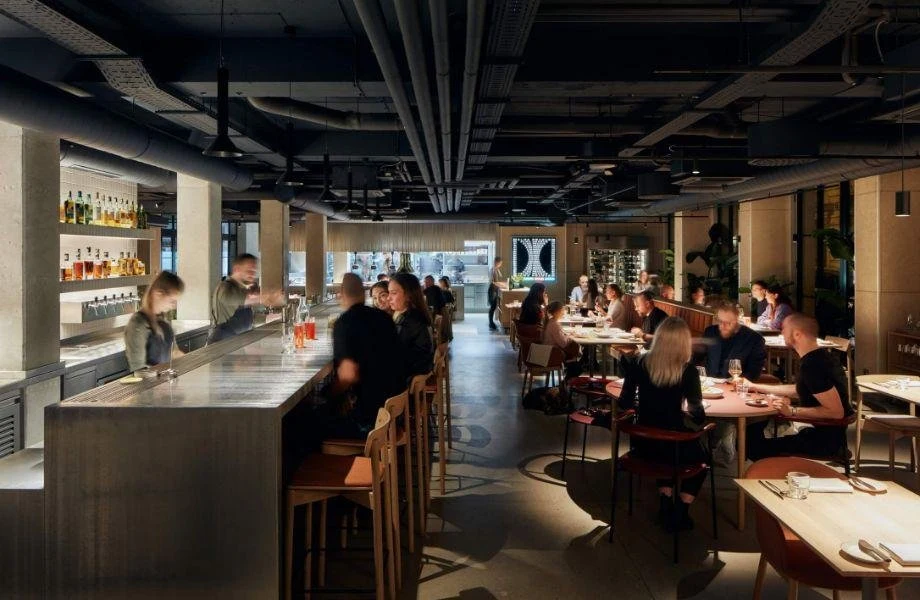
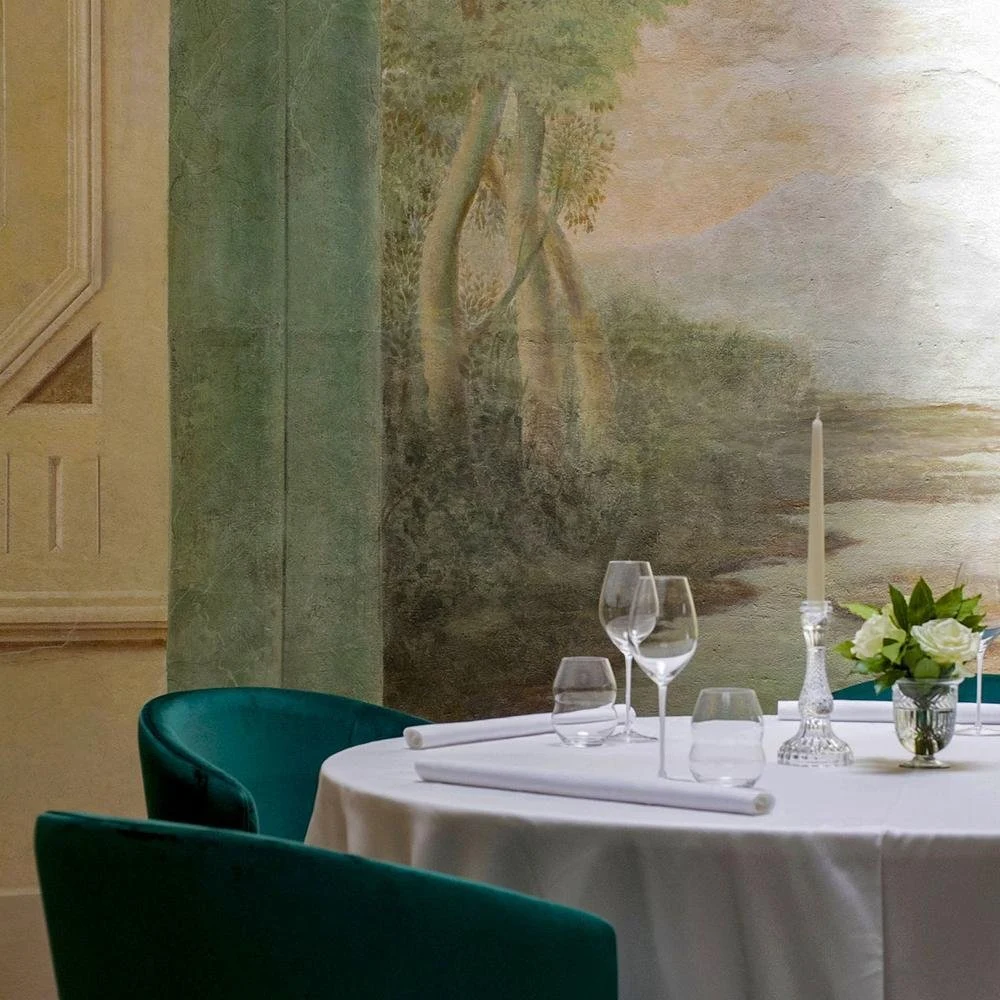
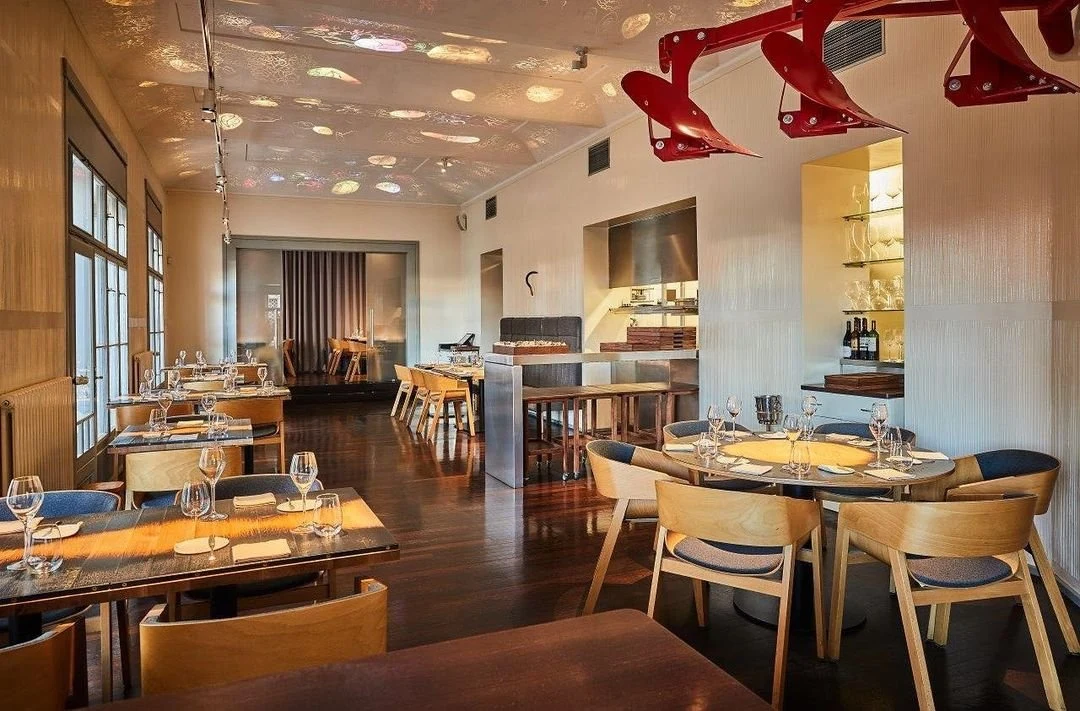
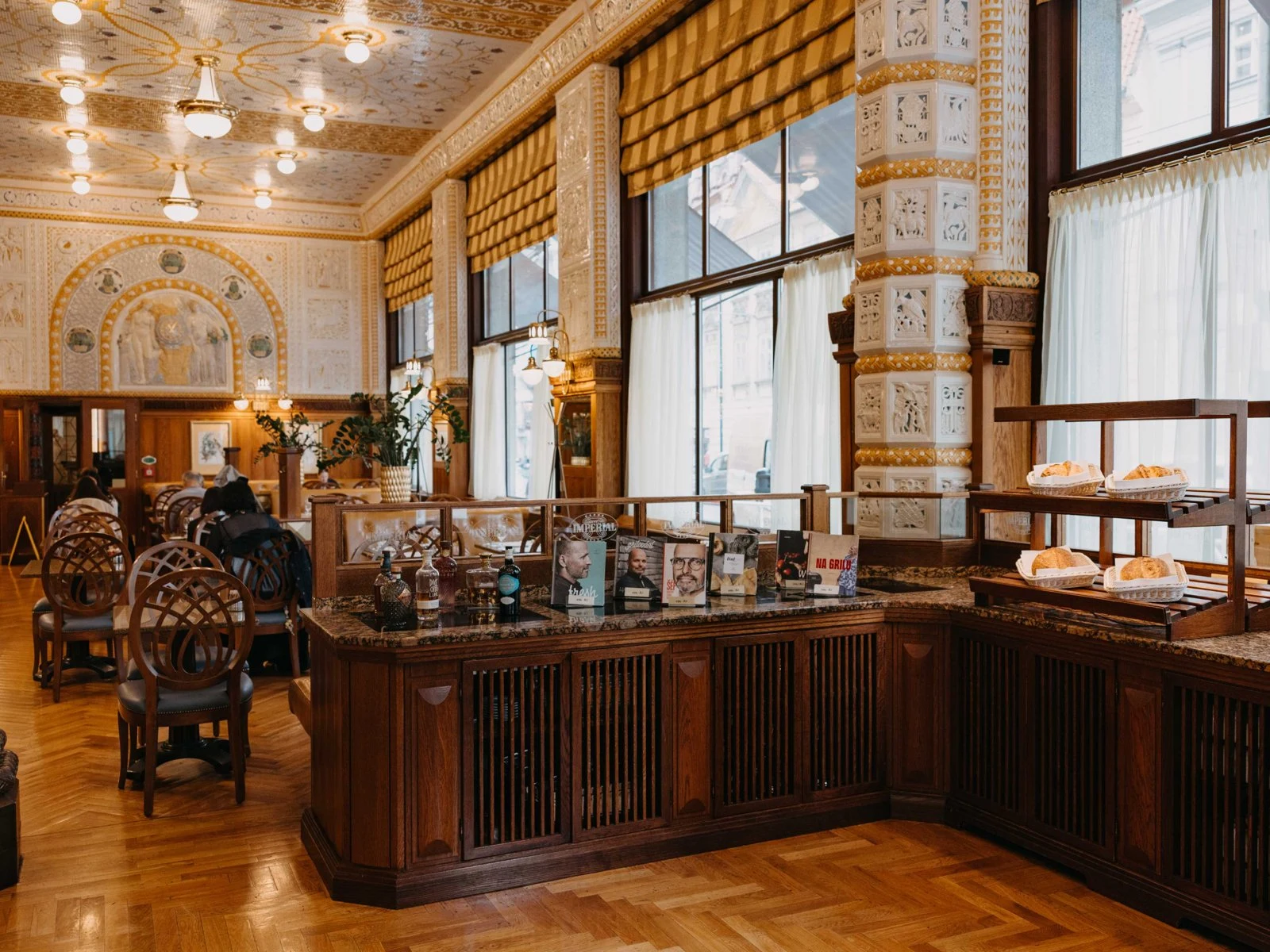
The room does not need to borrow atmosphere from the plate. Café Imperial occupies the ground floor of the Art Deco Imperial Hotel, with high ceilings, large street windows, ceramic wall tilings and mosaic ceilings that hold animal motifs, floral designs, stylised heads on pillars, hunters, stags, archers, ploughmen and cherubs. Architect Jaroslav Benedikt designed the hotel and café between 1913 and 1914; Jan Beneš made the mosaics, and Josef Drahoňovský contributed the sculpture, with archaeological borrowings from Egypt, Mesopotamia and Greece running through the ornament.
The material history is close to the tables, not sealed away. A waiter crosses the floor with soup, a coffee lands at the counter, a cake is cut, and the room keeps its composure. It is lively, but the noise remains conversational. The pass has to answer that scale without hardening into banquet cooking.
A house restored to its long use
The café's past is not decorative copy on the menu. The site reaches back through an inn called At the Black Eagle, which stood here from around 1730 on ground first documented in 1383; the brothers Kolář bought the later hotel and demolished it in 1913 for Prague's urban renewal. Between the wars the new café drew Tomáš Garrigue Masaryk, Franz Kafka and Leoš Janáček. It was nationalised in 1948 and run as a trade-union hotel into the 1980s, then reconstructed between 2005 and 2007 with its ceramic and mosaic character intact. The kitchen now works under Jan Beneš's ceiling, sending French onion soup into a room Prague has kept in use for more than a century.
Questions
Frequently asked
What kind of place is Café Imperial?
Café Imperial is a grand café and restaurant in New Town, Prague, serving Czech brasserie classics alongside international dishes. It works à la carte across breakfast, coffee, cake, lunch and dinner.
What is the room like?
The café occupies the ground floor of the Art Deco Imperial Hotel and is known for its high ceilings, large street windows, ceramic wall tilings and mosaic ceilings. The decor includes animal motifs, floral designs and sculptural details, and the room was reconstructed between 2005 and 2007 with its ceramic and mosaic character intact.
Which dishes are closely associated with the kitchen?
French onion soup, beef Wellington and duck confit are among the dishes that sit naturally on the menu. The kitchen also serves Czech favourites, and desserts such as gateaux, cakes, ice creams and sorbets are part of the café's offer.
Is booking recommended?
Reservations are essential, and bookings are taken direct. The dress code is smart casual.
Has Café Imperial received any recent recognition?
In 2025, Taste Atlas named Café Imperial the world's best traditional restaurant.
The field
How it compares
| Place | Cuisine | Notes | Awards |
|---|---|---|---|
| Café Imperial | Classic Czech Brasserie | Pelc Tyrolka, $$$ | · |
| Alma | Modern Czech | Prague | · |
| Dejvická 34 by Tomáš Černý | Modern Italian & Mediterranean | Prague | · |
| Field | Modern European Fine Dining | Prague | Michelin 1 Star |
| Na Kopci | Czech and French Classics | Prague | · |
| Štangl | Modern Czech Seasonal | Prague | Michelin 1 Star |
| Zén | Neo-Nordic with Japanese Influences | Singapore | Michelin 3 Stars, World's 50 Best |
Similar places
Modern Czech
Alma
Prague, Czech Republic
Modern Italian & Mediterranean
Dejvická 34 by Tomáš Černý
Prague, Czech Republic
Modern European Fine Dining
Field
Prague, Czech Republic
★
Czech and French Classics
Na Kopci
Prague, Czech Republic
Modern Czech Seasonal
Štangl
Prague, Czech Republic
★
Neo-Nordic with Japanese Influences
Zén
Singapore, Singapore
★★★ · 50 Best