- Falstaff Winery - 1 Stars · 2026
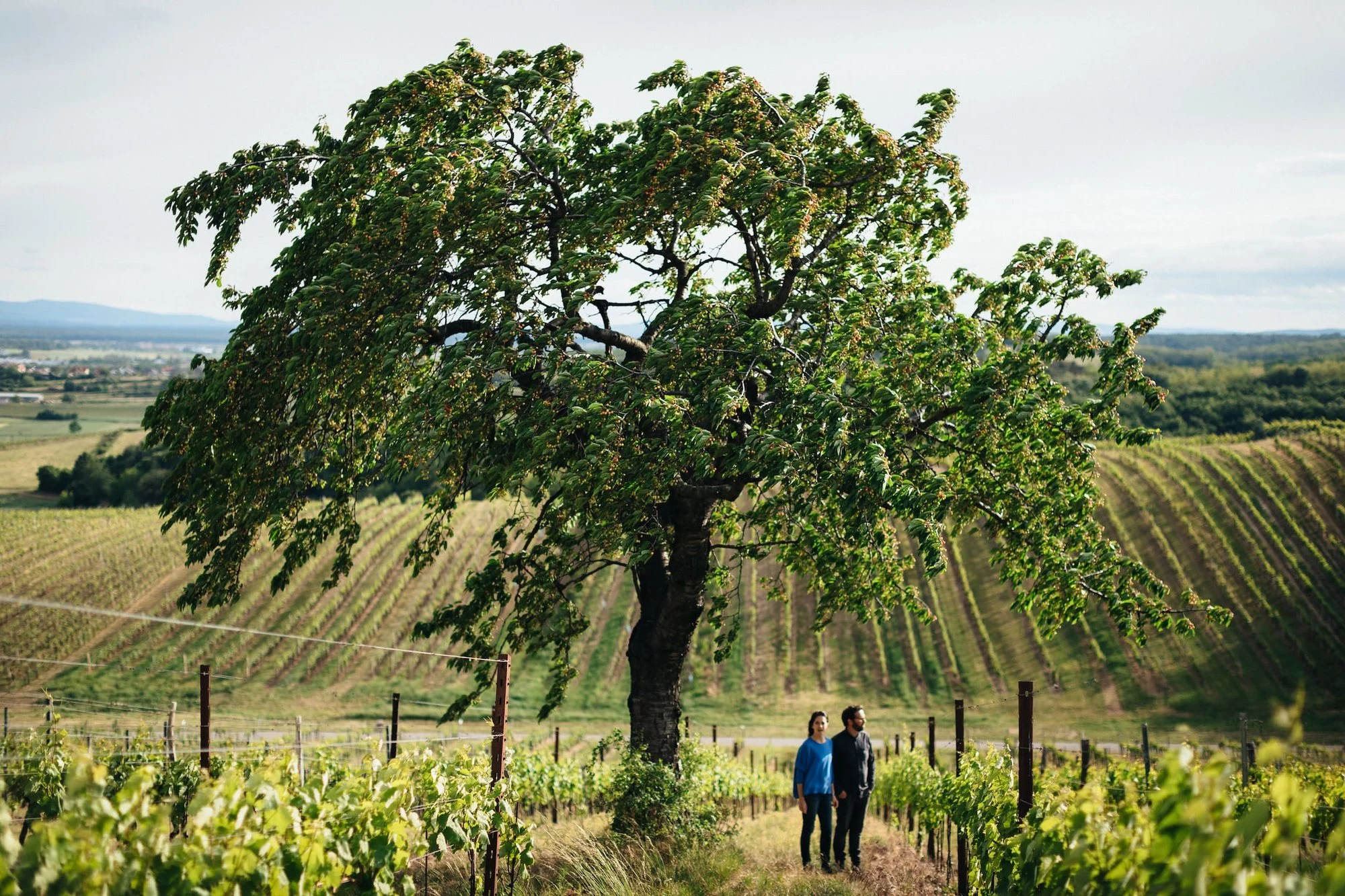
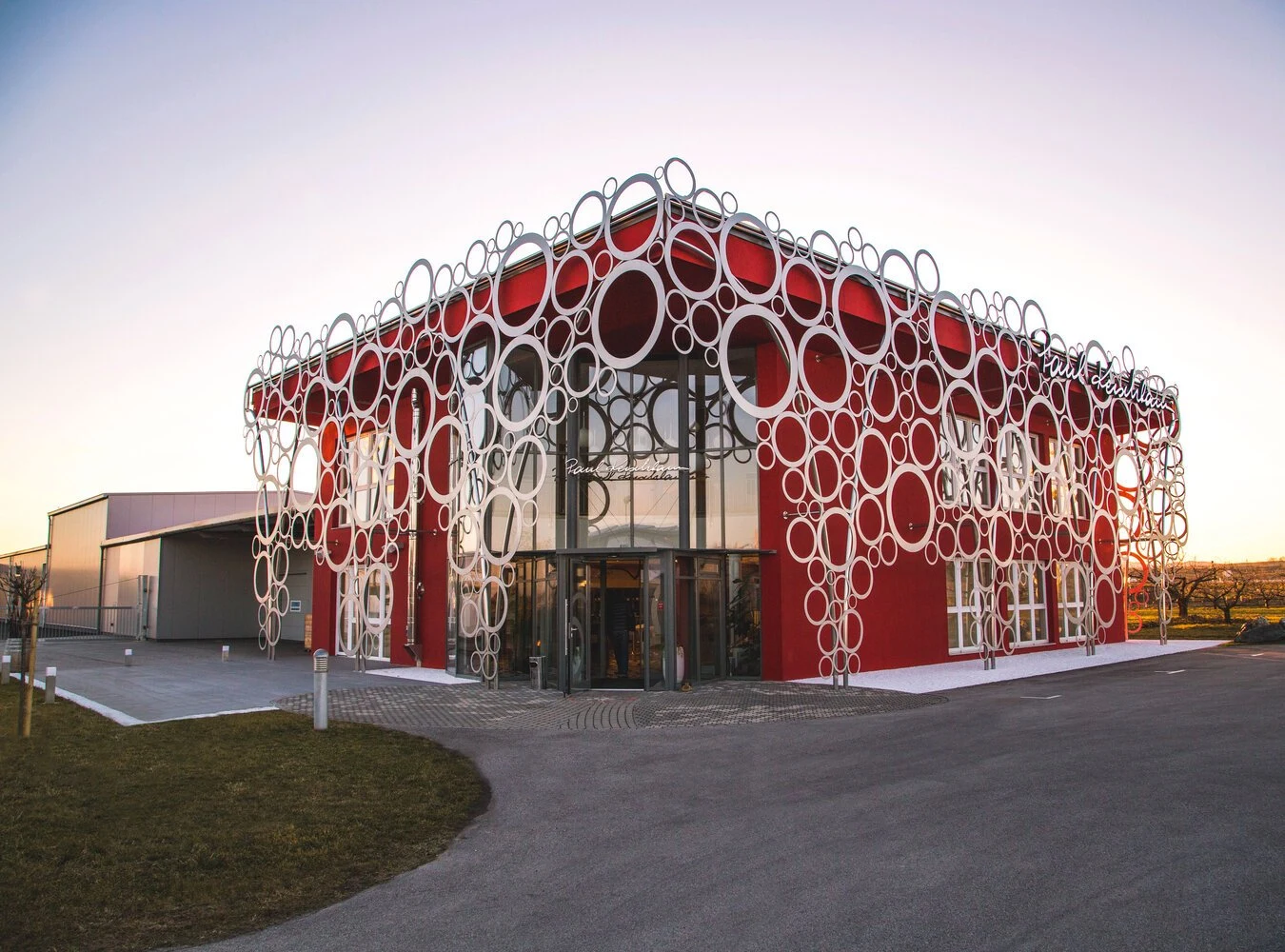
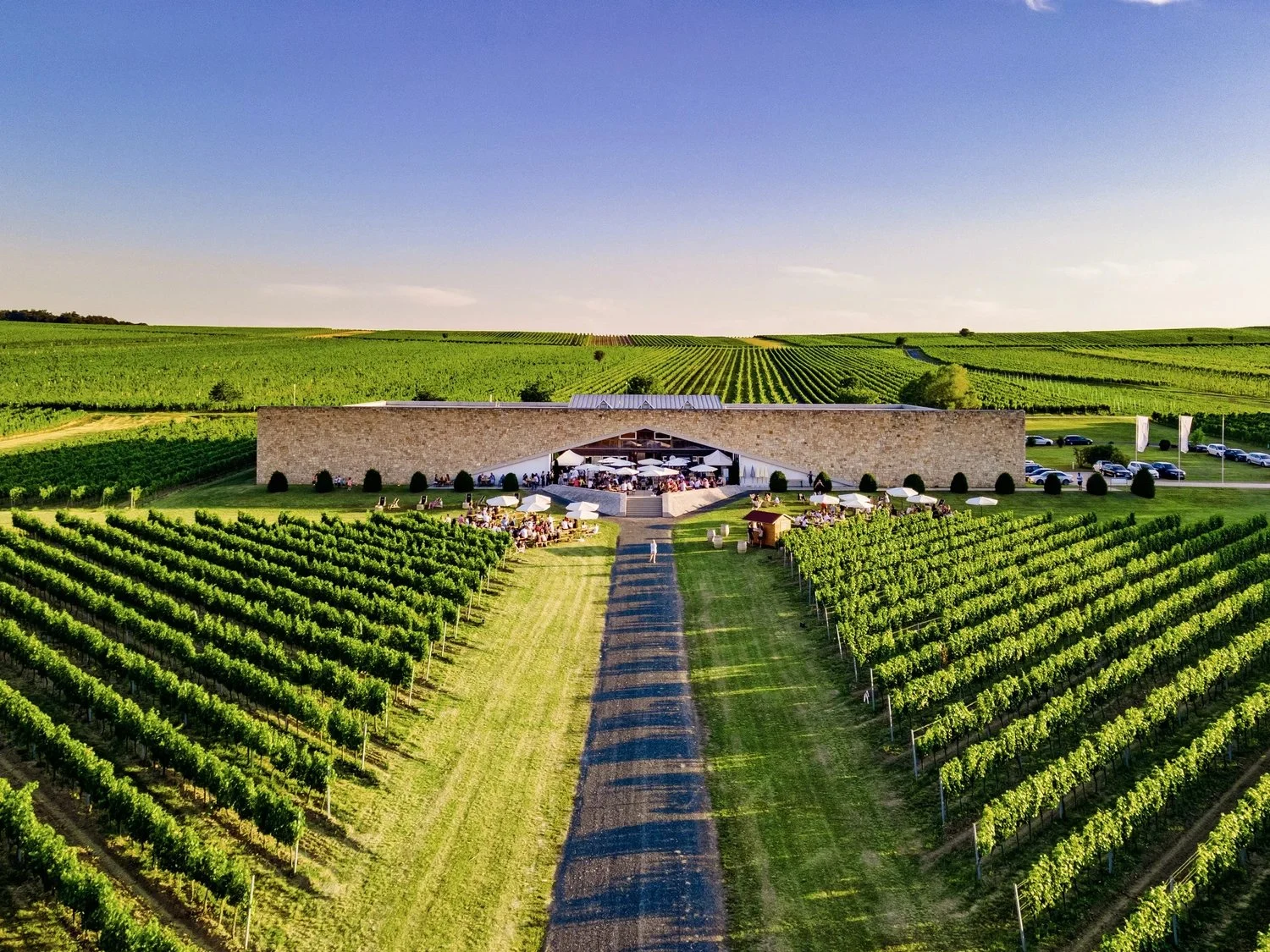
Approaching the Ried Gfanger vineyard area, the first signal is architectural rather than pastoral: a modern winery building set against one of Horitschon’s key Blaufränkisch sites. In Mittelburgenland, where red wine identity is built less on spectacle than on grape, site, and producer discipline, that setting matters. Eichenwald Weine belongs to the large-scale cooperative side of the region, not the tiny cellar-door romance often attached to Austrian wine tourism, and that distinction is central to understanding the experience.
Horitschon sits inside Austria’s Blaufränkisch belt, where the grape carries the cultural weight that Grüner Veltliner carries in parts of Lower Austria. The variety is late-ripening, structured, and strongly tied to place when handled with seriousness. Here, the numbers show the commitment: Blaufränkisch accounts for 60% of production, followed by Zweigelt at 20%, Merlot at 8%, Cabernet Sauvignon at 2%, and white varieties including Grüner Veltliner, Sauvignon Blanc, and Gelber Muskateller at 10%. That distribution is not decorative range; it is a regional thesis with Blaufränkisch at the center.
Ried Gfanger puts Blaufränkisch at the center of the argument
Mittelburgenland’s reputation rests on warm conditions suited to red varieties, and the DAC framework gives Blaufränkisch a formal regional language. Eichenwald Weine uses that language through Blaufränkisch DAC in its Premium and Reserve tiers, a regulatory designation rather than an award, but still a useful trust signal: it ties the wine to defined regional standards rather than loose varietal labeling.
The estate’s reach is broad by Austrian winery standards. Around 400 hectares of vineyard land span Horitschon, Unterpetersdorf, Raiding, Deutschkreutz, Haschendorf, Lutzmannsburg, Strebersdorf, and Großwarasdorf. Annual production is about 3 million liters, placing the operation in a high-capacity category. In practical drinking terms, that scale changes the reader’s expectation. This is not a micro-allocation producer built around scarcity; it is a regional house built around consistency, breadth, and the ability to present Mittelburgenland through several quality levels.
The portfolio is arranged in three tiers: Klassik, Premium, and Reserve. Klassik carries Grüner Veltliner, Sauvignon Blanc, Gelber Muskateller, Zweigelt, and Blaufränkisch, giving the line a broad entry point into local grapes and familiar Austrian whites. Premium narrows the frame toward Blaufränkisch DAC alongside Merlot and Cabernet Sauvignon, while Reserve returns to Zweigelt, Blaufränkisch DAC, and a cuvée. The structure is useful because it makes the house easy to read: regional accessibility first, then DAC-led red wine focus, then cellar-selection ambition.
A cooperative scale with a designed cellar-door experience
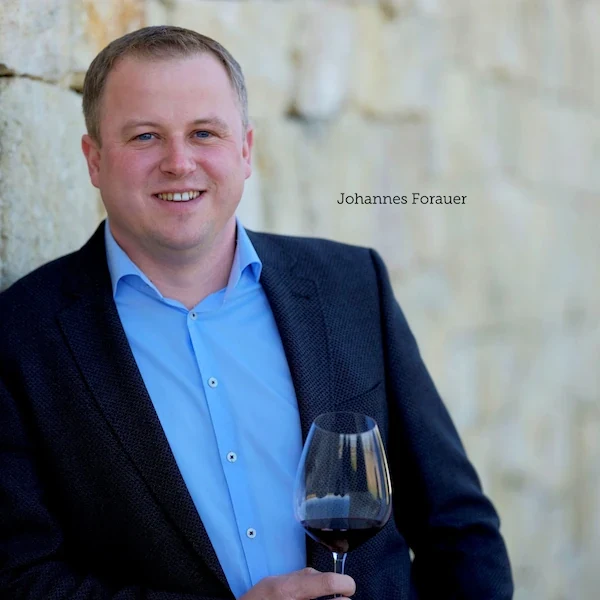
Cooperative form, signaled by Eichenwald Weine eGen, is part of the story. In wine regions built from many growers and small parcels, cooperatives can either dilute identity or concentrate it. Here, the defining editorial point is how a large grower base and multi-village vineyard reach are gathered into a clearly Blaufränkisch-led program. Johannes Forauer and Johannes Berger lead the team, but the more useful lens is collective production in a region where the grape itself remains the anchor.
Visitor format follows that controlled, regional-house model. Tastings are guided and arranged by appointment, with an on-site shop forming part of the experience. The setting is modern, quiet, and oriented toward groups, private tastings, and corporate events rather than casual drop-in tasting-room traffic. That format suits the producer’s scale: the value lies in seeing how a major Mittelburgenland cooperative organizes grape, site, and tier rather than in chasing a single cult bottling.
For travelers planning Horitschon around wine, the broader town context helps. The full local wine map is worth reading through Our full Horitschon wineries guide, while nearby editorial paths include Bioweingut Moritz, Der Bader, Domaine Mayrhofer, Emotion Wine, and IBY Rotweingut Bio. Those links are useful not as direct rankings, but as a way to understand how much Horitschon’s identity is tied to red wine production and estate culture.
How to read the visit in the wider Horitschon trip
Eichenwald Weine is priced at the approachable middle of the premium wine-travel spectrum, marked $$, and the dress code is casual. The mood is quiet rather than social, with a modern cellar complex and vineyard setting doing the heavy lifting. The absence of food pairing and outdoor seating shifts the focus back to guided tasting, shop browsing, and the question that matters in this part of Burgenland: how Blaufränkisch changes across tiers and production choices.
The strongest reason to come is not rarity. It is orientation. A large cooperative with 400 hectares under its umbrella gives a visitor a different view of Mittelburgenland than a small estate can. The experience explains the commercial and cultural backbone of the region: Blaufränkisch as majority grape, DAC as regional discipline, Zweigelt as important supporting red, and international varieties as controlled additions rather than the main plot.
For trip-building beyond the winery, Horitschon’s surrounding editorial rails are useful: Our full Horitschon restaurants guide, Our full Horitschon hotels guide, Our full Horitschon bars guide, and Our full Horitschon experiences guide. Broader wine reading can stretch farther afield through »der Steiner« Hans Steiner in Podersdorf am See, ®walzer in Gneixendorf Bei Krems, 1516 Brewing Company Distillery in Vienna, & Handwein in Mannheim, and 00 Wines in Carlton.
The editorial verdict is clear: this is the Horitschon address to read through scale, terroir, and regional structure. It is strongest for travelers who want Blaufränkisch explained through a major Mittelburgenland producer, not for those seeking a small, highly personal cellar visit built around scarcity.
Questions
Frequently asked
Who works at Eichenwald Weine?
Made By profiles Johannes Berger (Winemaker) and Johannes Forauer (Winemaker) at Eichenwald Weine.
How expensive is Eichenwald Weine?
Eichenwald Weine is listed at a price level of $$.
The field
How it compares
| Place | Notes |
|---|---|
| Eichenwald Weine | Horitschon, $$ |
| Bioweingut Moritz | Horitschon |
| Emotion Wine | Horitschon |
| IBY Rotweingut Bio | Horitschon |
| Weingut Anton und Gabriele Gober | Horitschon |
| Weingut Franz Weninger | Horitschon |
| Weingut Kerschbaum | Horitschon |