Guinness Storehouse
- 01CityDublin, Ireland
St. James's Gate and What It Represents
Guinness Storehouse is a bar and visitor attraction in Dublin, Ireland, located at St. James's Gate, with a Google rating of 4.4 from 24,451 reviews and an entry price of about $25 per person. The brewery district west of Dublin's city centre has been shaping the city's identity since the eighteenth century, and St. James's Gate remains its most legible landmark. Arthur Guinness signed his famous 9,000-year lease on the site in 1759, and the brewery that followed became one of the largest in the world by the early twentieth century. The Storehouse itself, a seven-storey Victorian cast-iron building constructed in 1904 as a fermentation plant, was repurposed as a visitor experience in 2000 and has since become Ireland's single most visited paid attraction, drawing well over a million people a year. It reflects a genuine convergence of brewing heritage, design investment, and cultural tourism.
Understanding what the Storehouse is requires separating it from a standard brewery tour. This is not a working-floor walkthrough with a sample at the end. It is a structured, multi-floor exhibition that moves through ingredient sourcing, brewing science, advertising history, and bar culture before arriving at the Gravity Bar on the seventh floor, where the complimentary pour awaits. The distinction matters for expectation-setting: visitors who arrive looking for an intimate craft brewing narrative may find the scale and visitor volume jarring. Those who arrive understanding the experience as a large-format cultural institution, closer in spirit to a design museum than a distillery tour, tend to leave more satisfied.
The Floor-by-Floor Structure and How the Experience Moves
The building's atrium is designed around a giant pint glass shape that rises through all seven floors, visible from the entrance. This architectural device does useful work: it orients visitors spatially while reinforcing the product logic. The lower floors address the raw materials of brewing, water, barley, hops, and yeast, in a way that functions as genuine education rather than promotional shorthand. The middle floors shift into advertising and cultural history, where the Storehouse's collection of original Guinness marketing material, spanning decades of print, television, and public art campaigns, earns attention on its own terms. The Guinness advertising archive is among the most documented in Irish commercial history, and the display gives it appropriate space.
The upper floors introduce several bar formats before the Gravity Bar. This progression from information to experience, from reading a process to participating in it, is one of the Storehouse's more considered structural decisions. It means visitors arrive at the pint pour after a reasonably thorough grounding in what they are drinking. Whether that context changes the taste is subjective, but it changes the conversation around the bar significantly.
The Gravity Bar and What the Pour Means Here
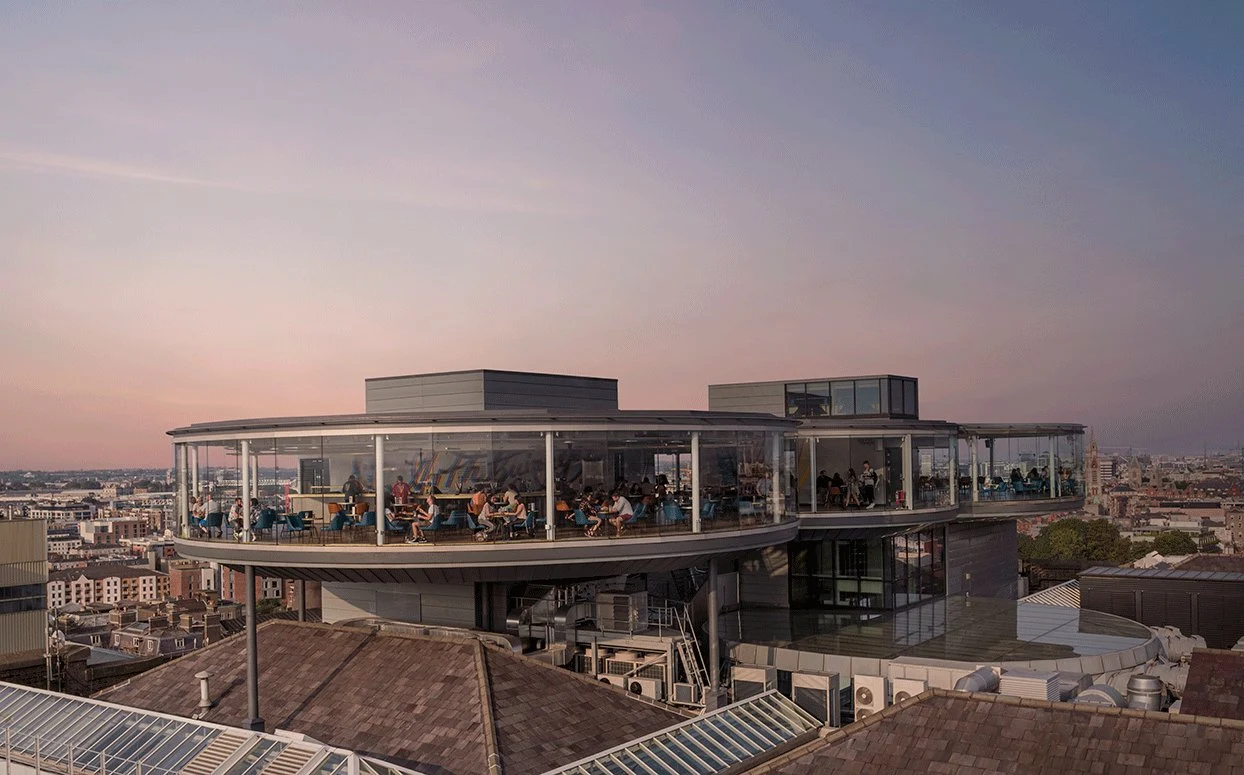
Gravity Bar on the seventh floor offers a 360-degree view across Dublin, stretching from the Wicklow Mountains in the south to the Dublin Bay coastline in the east. The complimentary pint of Guinness is included in the admission price, which makes the top-floor bar the logical and commercial endpoint of the visit. Pouring technique is given formal attention throughout the building, and the bar staff here are trained to standards that reflect the brand's global consistency criteria. A properly poured Guinness at the Gravity Bar, settled correctly with the characteristic two-part pour, is the product presented at its most deliberate.
Irish pub culture has long held that Guinness tastes different close to the source, and the Gravity Bar is where that claim gets its most considered test. The assertion involves variables that are difficult to isolate: freshness of keg, line length, ambient temperature, pour time, and the psychological weight of location. The Storehouse does not resist this mythology; it leans into it. Whether the pour is objectively different from what you would find at a well-run Dublin pub nearby is a question the experience deliberately leaves open.
Where This Sits in Dublin's Drinking and Hospitality Scene
Dublin's bar culture has evolved considerably over the past decade, with serious cocktail programs and wine-focused venues now operating alongside the traditional pub format. Venues such as Bar 1661 have built internationally recognised programs around Irish spirits and classic cocktail technique, while A Fianco and Bar Pez represent a more contemporary, ingredient-driven approach to drinking in the city. At the other end of the format spectrum, Bison Bar and BBQ has carved out a distinct identity around American whiskey and live music.
The Storehouse sits outside all of these competitive sets. It does not compete with neighbourhood bars or cocktail programs; it operates as a cultural institution with a specific product at its centre. Visitors using it as a reference point for Dublin's bar scene should treat it as a foundation rather than a destination within that scene. For the texture of what contemporary Dublin actually drinks, the city's independent bars, from the technically serious programs at Bar 1661 to the wine-led rooms at 64 Wine in Glasthule, offer a more current picture.
Across Ireland more broadly, drinking culture operates with strong regional character. Arthur Mayne's Pharmacy in Cork, Pig's Lane in Killarney, and Prim's Bookshop in Kinsale each anchor their respective towns with a distinctly local hospitality identity. The Storehouse, by contrast, is oriented toward an international visitor who may have limited time in Dublin and wants the most concentrated encounter with Irish brewing history available. That is a legitimate travel priority, and the Storehouse addresses it with a level of production quality and organisational clarity that few heritage attractions on the island match.
For those extending further, Lough Eske Castle in Donegal and Baba'de in Baltimore represent the more remote, experience-led end of Irish hospitality, where the surroundings do as much work as the programme. International reference points like Bar Leather Apron in Honolulu illustrate how craft bar culture has developed a globally consistent vocabulary, against which Dublin's own bar evolution reads as more grounded in tradition than in trend.
Planning a Visit
The Storehouse is located at St. James's Gate, Dublin 8, a short walk west of the city centre and accessible by several bus routes. Admission is ticketed, and booking in advance is recommended. The building opens daily, with hours from 10 AM to 5 PM Monday through Friday, 9 AM to 5 PM on Saturday, and 9:30 AM to 5 PM on Sunday.
Frequently Asked Questions
What is the signature drink at Guinness Storehouse?
The experience is anchored to a single product: Guinness stout, poured to brand specification and included in the admission price at the Gravity Bar on the seventh floor. The two-stage pour and the settling time are treated as essential to the drink's presentation rather than as theatre, and bar staff are trained to the same pouring standards applied across the brand's global accounts. No other drinks are the focus of the experience, though additional bars on the upper floors offer Guinness variants alongside the classic stout.
Why do people visit Guinness Storehouse?
The attraction draws a predominantly international visitor base, most of whom are in Dublin for a short stay and want a concentrated encounter with the country's most recognisable export. The combination of brewing history, advertising culture, design, and a rooftop pour with city views makes it a high-density experience for limited time. Admission is priced at a mid-range tourism rate, and the included pint at the Gravity Bar is factored into that cost. For visitors with more time in the city, the Storehouse works well as an orientation point rather than a substitute for exploring Dublin's actual pub and bar culture.
How does Guinness Storehouse differ from visiting a working craft brewery in Ireland?
The Storehouse is an exhibition and heritage centre built inside a repurposed Victorian fermentation building, not a live production facility in the way that smaller Irish craft breweries operate. The St. James's Gate brewery remains operational on the wider site, but what visitors experience inside the Storehouse is a curated, floor-by-floor journey through brand and brewing history rather than access to an active production floor. For travellers interested in Ireland's contemporary craft brewing scene, regional producers across counties Cork, Kerry, and Wicklow offer a more hands-on production-floor format with smaller batch sizes and direct access to the brewers themselves.
Questions
Frequently asked
How expensive is Guinness Storehouse?
Guinness Storehouse is listed at a price level of $$.