Hatzidakis Winery sits in Pyrgos Kallistis, one of Santorini's most concentrated wine villages, working with the island's ancient Assyrtiko vines in conditions that produce wines of marked salinity and mineral precision. The winery holds a Pearl 2 Star Prestige rating for 2025, placing it firmly within Santorini's serious production tier. For those tracing Greek island viticulture at its most geologically defined, Hatzidakis is a substantive stop.
<h2>Volcanic Ground, Ancient Vines: The Santorini Context</h2><p>Santorini's wine reputation rests almost entirely on one grape and one geological accident. Assyrtiko, grown in volcanic pumice and ash deposits left by the Minoan eruption roughly 3,600 years ago, produces wines with a mineral salinity and high natural acidity that no mainland terroir replicates. The island's Cycladic winds, called the meltemi, combined with near-zero rainfall during the growing season, create conditions that concentrate flavour while forcing the vine to draw moisture from deep within the subsoil. The result is a grape that tastes, more than almost any other in Greece, of exactly where it was grown.</p><p>Hatzidakis Winery, based in Pyrgos Kallistis, operates within this tradition. Pyrgos sits at Santorini's highest elevation point, a medieval hilltop settlement with a dense cluster of producers who have worked this volcanic ground for generations. The winery holds a Pearl 2 Star Prestige rating for 2025, a designation that positions it inside the island's serious production tier, alongside peers such as <a href="https://www.enprimeurclub.com/wineries/artemis-karamolegos-winery-santorini-winery">Artemis Karamolegos Winery in Santorini</a>, where the same volcanic soil conditions and Assyrtiko focus define the editorial conversation. For context on how Santorini producers sit within the wider Greek wine picture, our full Pyrgos Kallistis restaurants and producers guide maps the village's concentration of quality.</p><h2>The Logic of Kouloura: Why Santorini Vines Look Different</h2><p>Before discussing what is in the bottle, it is worth understanding what you see in the vineyard. Santorini growers train their vines into low, basket-shaped forms called kouloura, a technique developed specifically for the island's wind exposure. The vine is woven into a tight coil close to the ground, protecting the grapes inside the basket from the desiccating summer wind. Some of these vine stocks are over a century old, pre-dating the phylloxera epidemic that destroyed most of Europe's wine regions in the late nineteenth century. Because Santorini's volcanic soil is inhospitable to the phylloxera louse, the island's oldest vines were never grafted onto American rootstock. They grow on their own roots, a distinction shared by very few wine regions globally.</p><p>What this means in the glass is a function of vine age and soil composition working together. Old vines produce smaller yields but deeper flavour concentration; volcanic minerals absorbed over decades express themselves as a saline, almost iodine-like finish that characterises Assyrtiko from the island's central and higher-elevation sites. Pyrgos, at the southern interior of the island and at greater altitude than the coastal villages, sits on terrain where this mineral expression tends toward intensity rather than breadth. Producers in this area have historically made wines built for ageing rather than immediate consumption, a contrast to the more approachable styles coming from lower-altitude plots closer to the caldera.</p><h2>Hatzidakis in the Santorini Production Tier</h2><p>The Pearl 2 Star Prestige award for 2025 places Hatzidakis in a comparable set defined by commitment to Santorini's indigenous varieties and a production approach that reflects the island's geological character rather than working against it. Santorini's wine economy has long split between producers oriented toward tourist-facing volume and those focused on limited-allocation bottles that travel to specialist importers in Europe, the United States, and Asia. The 2 Star Prestige designation signals membership in the latter group.</p><p>For comparison, other Greek producers in EP Club's rated set include <a href="https://www.enprimeurclub.com/wineries/alpha-estate-amyntaio-winery">Alpha Estate in Amyntaio</a>, operating in Xinomavro territory in northern Greece, and <a href="https://www.enprimeurclub.com/wineries/acra-winery-nemea-winery">Acra Winery in Nemea</a>, working with Agiorgitiko in the Peloponnese. These are entirely different terroirs and varieties, but each sits within Greece's serious indigenous-grape tier. What connects them editorially is a refusal to pivot toward international varieties at the expense of what the local soil does well. In Santorini's case, that means staying close to Assyrtiko and the complementary indigenous whites Aidani and Athiri, rather than planting Chardonnay or Sauvignon Blanc to capture export-market familiarity.</p><p>The broader Greek wine picture includes producers as varied as <a href="https://www.enprimeurclub.com/wineries/anatolikos-vineyards-xanthi-winery">Anatolikos Vineyards in Xanthi</a> and <a href="https://www.enprimeurclub.com/wineries/artisans-vignerons-de-naoussa-stenimachos-winery">Artisans Vignerons de Naoussa in Stenimachos</a>, where the focus shifts entirely to the north's red varieties and cooler-climate profiles. The contrast with Santorini's sun-bleached volcanic whites could not be more stark, which is part of why Hatzidakis and its Pyrgos peers occupy a specific and geographically defined niche within Greek viticulture, not just a quality tier.</p><h2>Visiting Pyrgos Kallistis: Practical Orientation</h2><p>Pyrgos Kallistis sits in the south-central interior of Santorini, away from the tourist infrastructure concentrated around Fira and Oia. The village's elevation and position mean it catches both the light and the wind that define the island's growing conditions. Wine production here has a working character rather than a scenographic one: this is a producing area first, with visitor access secondary to the vineyard and cellar calendar.</p><p> Santorini's wine tourism season concentrates around the summer months, but late spring and early autumn offer cooler temperatures and smaller visitor volumes. Harvest typically runs in August, earlier than most European wine regions, because of the island's heat accumulation, and the period around harvest is when the winery is at its most active.</p><p>For wider context on Greek wine tourism beyond Santorini, <a href="https://www.enprimeurclub.com/wineries/abraams-vineyards-komninades-winery">Abraam's Vineyards in Komninades</a>, <a href="https://www.enprimeurclub.com/wineries/aiolos-winery-palaio-faliro-winery">Aiolos Winery in Palaio Faliro</a>, and <a href="https://www.enprimeurclub.com/wineries/akrathos-newlands-winery-panagia-winery">Akrathos Newlands Winery in Panagia</a> offer entry points into quite different regional styles. For producers working in other international contexts, <a href="https://www.enprimeurclub.com/wineries/achaia-clauss-patras-winery">Achaia Clauss in Patras</a> provides a longer historical lens on Greek wine export, while <a href="https://www.enprimeurclub.com/wineries/accendo-cellars">Accendo Cellars in St. Helena</a> and <a href="https://www.enprimeurclub.com/wineries/aberlour-aberlour-winery">Aberlour in Aberlour</a> anchor comparison points in Napa and Speyside respectively. Additional Greek producers in the EP Club network include <a href="https://www.enprimeurclub.com/wineries/aoton-winery-peania-winery">Aoton Winery in Peania</a>, <a href="https://www.enprimeurclub.com/wineries/apostolakis-distillery-volos-winery">Apostolakis Distillery in Volos</a>, and <a href="https://www.enprimeurclub.com/wineries/avantis-estate-chalkida-winery">Avantis Estate in Chalkida</a>.</p>
The winery sits in Pyrgos Kallistis, the fortified hilltop village in Santorini's south-central interior, away from the cruise-ship density of Fira and Oia. The atmosphere reflects that geography: quieter, oriented toward the vineyard and the production process rather than spectacle. The Pearl 2 Star Prestige recognition for 2025 signals a producer whose reputation travels through the wine trade and serious collectors, not through Instagram terraces.
Hatzidakis Winery has received recognition including: Pearl 2 Star Prestige (2025).
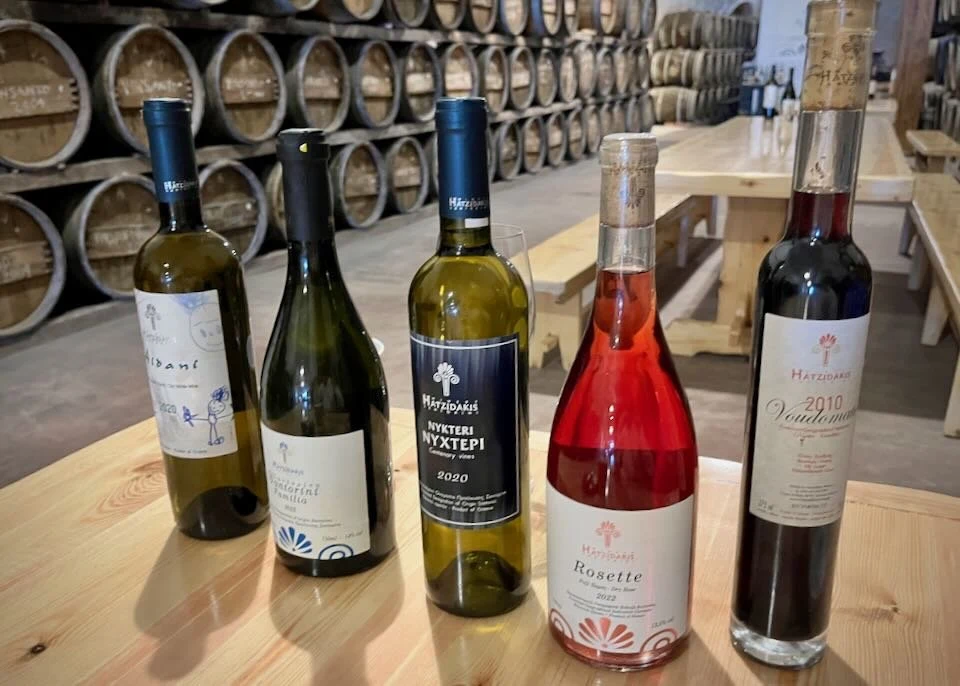
Hatzidakis built its reputation on Assyrtiko, the white variety that defines Santorini's place in the international wine conversation. The grape's combination of volcanic minerality and high natural acidity — a product of pumice-and-ash soils that no phylloxera louse has managed to colonise — produces wines that age in a way most white Aegean wines do not.
Hatzidakis Winery is located at Kallisti, Pyrgos, Thira, 84701, Santorini 847 00, Pyrgos Kallistis.
Hatzidakis is known for working with Santorini's indigenous grape varieties, particularly Assyrtiko, in one of the island's more traditional growing zones. The Pearl 2 Star Prestige award for 2025 places it among producers committed to low-intervention viticulture and the kouloura basket-trained vine system that Santorini growers have used for centuries to protect fruit from Aegean winds. The winery's location in Pyrgos Kallistis also puts it within the island's older, pre-tourist settlement layer.
No booking policy is formally documented for Hatzidakis Winery, and no phone or website contact appears in the current record. Given the production scale typical of Pearl 2 Star Prestige-tier Santorini producers, visiting without prior contact carries risk during peak summer months. The safest approach is to check the venue's official channels or arrange a visit through a Santorini wine specialist before travelling to Pyrgos Kallistis.
Pyrgos Kallistis sits inland at elevation in Santorini's south-central zone, placing Hatzidakis vineyards away from the caldera's tourist infrastructure and the coastal microclimates that characterise Oia and Imerovigli producers. The volcanic ash and pumice composition of the soil remains consistent across the island, but inland elevation typically moderates summer heat and extends ripening windows, a factor that influences Assyrtiko's acidity retention. The Pearl 2 Star Prestige award for 2025 reflects a production approach shaped by this distinct inland position within the appellation.
Kallisti, Pyrgos, Thira, 84701, Santorini 847 00
Pyrgos Kallistis