Chef in Residence
Mauritz Greeff
Chef

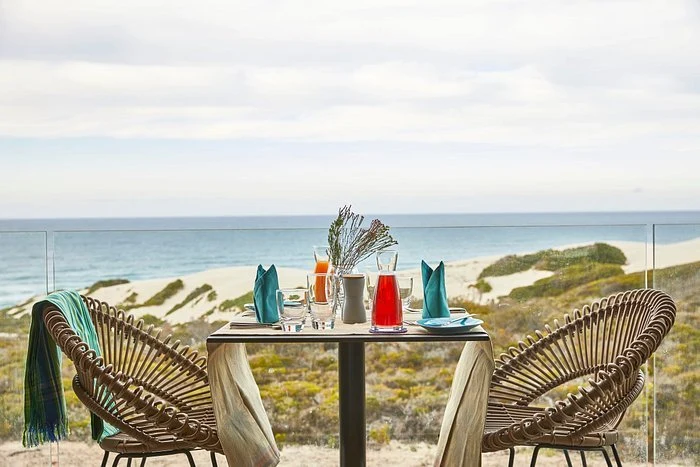
Set within the protected coastline of De Hoop Nature Reserve, Morukuru Family De Hoop positions itself at the intersection of conservation hospitality and South African cooking. Chef Mauritz Greeff works within a remote, ocean-facing setting that shapes the kitchen's approach as much as any formal training. Rated 4.9/5 by EP Club members and 4.5 on Google across 66 reviews, it draws guests who treat the table as part of the wilderness experience.
<h2>Where the Overberg Meets the Ocean</h2><p>The stretch of coastline between the Breede River mouth and Cape Agulhas carries a particular quality of light, low, salt-bleached, almost forensic in its clarity. De Hoop Nature Reserve sits within this corridor, one of South Africa's most significant protected areas, where Cape fynbos scrubland runs down to a marine reserve that ranks among the country's most productive whale nurseries. Arriving here from Cape Town via Caledon and Bredasdorp, or from the Garden Route via Swellendam, the sense of remove is immediate. The Garden Route and the Winelands both feel like different countries. Morukuru Family De Hoop is the lodge here.</p><p>South African lodge hospitality has increasingly split between properties that deploy the bush-luxury template with international-brand consistency and smaller, owner-operated places that let geography drive the experience. Morukuru Family De Hoop belongs firmly to the second category. The ocean-facing position is not incidental. It is the organising principle around which the intimate setting, the limited capacity, and the cooking all align.</p><h2>The Kitchen in Context: South African Cuisine at the Edge of the Reserve</h2><p>South African cuisine at the premium lodge level occupies an interesting position in the wider national dining conversation. In Cape Town, restaurants like <a href="https://www.enprimeurclub.com/restaurants/la-colombe-cape-town-restaurant">La Colombe</a> and <a href="https://www.enprimeurclub.com/restaurants/salsify-at-the-roundhouse-cape-town-restaurant">Salsify at the Roundhouse</a> represent one pole: technically ambitious, internationally referenced, operating in an urban fine-dining framework. <a href="https://www.enprimeurclub.com/restaurants/the-test-kitchen-cape-town-restaurant">The Test Kitchen</a> has built its reputation on the experimental edge of the same tradition. What happens at lodge tables is structurally different. The kitchen is in service to the environment as much as to the diner.</p><p>Chef Mauritz Greeff works within that constraint and, by most accounts, with it. The broader pattern at South African wildlife reserves, seen also at properties like <a href="https://www.enprimeurclub.com/restaurants/londolozi-game-reserve-kruger-national-park-restaurant">Londolozi Game Reserve</a> in Kruger and <a href="https://www.enprimeurclub.com/restaurants/jabulani-safari-hoedspruit-restaurant">Jabulani Safari in Hoedspruit</a>, is a kitchen that roots itself in regional produce and traditional technique while the setting does the heavier work of creating occasion. De Hoop adds a variable that inland lodges cannot offer: the marine reserve on the doorstep means coastal ingredients have an obvious, legitimate claim on the menu that would feel forced at a landlocked bush camp. Where <a href="https://www.enprimeurclub.com/restaurants/klein-jan-kalahari-cbdc-restaurant">Klein Jan in the Kalahari</a> draws on desert-edge foraging traditions, Morukuru Family De Hoop can draw on the biological richness of one of the most protected stretches of South African coastline.</p><p>Comparing notes across the Morukuru portfolio is instructive. <a href="https://www.enprimeurclub.com/restaurants/morukuru-family-madikwe-middlepoort-farm-restaurant">Morukuru Family Madikwe</a> operates in the Madikwe Game Reserve, a Big Five environment in the North West province where the cooking sits within a completely different ecological and cultural reference frame.</p><h2>The Intimate Setting and Why It Matters</h2><p>Lodge dining at this scale functions differently from restaurant dining in a way that affects every element of the experience. The small guest count, an intimate setting by design, means the kitchen cooks for a known number of people with known dietary requirements, which allows a degree of personalisation that a 60-cover restaurant cannot offer without a substantially larger brigade. It also means the rhythm of the meal follows the rhythm of the day: game drives or whale-watching walks in the morning, a long lunch in the heat of the afternoon, dinner timed against the sunset over the vlei or the dunes.</p><p>That temporal and physical embedding is the strongest argument for lodge dining at De Hoop over, say, driving an hour to Swellendam for dinner at a standalone restaurant. The comparison is not really about food quality in isolation. It is about whether you want the meal to be an event extracted from its surroundings or one that extends them. Properties like <a href="https://www.enprimeurclub.com/restaurants/esiweni-luxury-safari-lodge-memorial-gate-restaurant">Esiweni Luxury Safari Lodge</a> operate on the same logic in KwaZulu-Natal. The meal is inseparable from the place.</p><h2>De Hoop in the Western Cape Dining Picture</h2><p>For travellers building a South Africa itinerary with serious eating as a thread, De Hoop sits at a remove from the Winelands restaurant circuit, Le Quartier Français in Franschhoek, <a href="https://www.enprimeurclub.com/restaurants/dusk-stellenbosch-restaurant">Dusk in Stellenbosch</a>, but it is not trying to compete with them. It is offering something the Winelands cannot: a protected coastal wilderness as the dining room's backdrop, and a kitchen whose identity is shaped by that specificity rather than by proximity to an international wine tourism infrastructure.</p><p>The comparison that resonates more directly is with <a href="https://www.enprimeurclub.com/restaurants/wolfgat-paternoster-restaurant">Wolfgat in Paternoster</a>, the strandveld-foraging restaurant two hours up the West Coast that brought serious international attention to coastal fynbos ingredients. Both sit outside the Cape Town and Winelands orbit. Both use the immediate environment as the primary creative reference. The difference is format: Wolfgat is a standalone restaurant that diners travel to specifically; Morukuru Family De Hoop serves guests who are already staying, which changes the relationship between table and context entirely.</p><p>For those building out an understanding of South African dining in the wider urban sense, our <a href="https://www.enprimeurclub.com/restaurants/gigi-johannesburg-restaurant">Gigi in Johannesburg</a> listing and <a href="https://www.enprimeurclub.com/restaurants/ellerman-house-bantry-bay-restaurant">Ellerman House in Bantry Bay</a> offer reference points at the luxury-hotel and city-restaurant ends of the spectrum respectively.</p><h2>Planning a Stay: What to Know</h2><p>De Hoop Nature Reserve sits 235 kilometres from Cape Town International Airport, making a direct drive from the airport the standard arrival route, approximately 3.5 hours depending on traffic through the city. The reserve is accessible by car via Caledon and Bredasdorp from the Cape Town side, or via Swellendam from the Garden Route; detailed directions are provided at the time of booking. The remoteness is real: there is no casual drop-in dining here. Eating at Morukuru Family De Hoop means staying at the property, which makes advance booking the only practical approach. EP Club members rate the property at 4.9 out of 5, with 66 Google reviews placing it at 4.5.</p><p>Whale season along this coast runs roughly from June through November, with southern right whales using the De Hoop Marine Reserve as a calving ground. That window represents the highest-demand period for the property and the most directly nature-integrated dining context, the marine reserve visible from the lodge during the meal is also, for those months, an active nursery for one of the ocean's largest animals.</p>
The intimate setting at Morukuru Family De Hoop suits families travelling as a private group more than it suits mixed-guest hotel environments. The reserve itself — a protected coastal wilderness 235 kilometres from Cape Town — provides a focused natural context: whale watching, hiking, and ocean access rather than pool bars or resort programming. The small guest count means the lodge effectively runs as a private property when booked by a single family party.
The setting inside De Hoop Nature Reserve establishes the tone: this is a coastal wilderness lodge, not a fine-dining destination requiring formal dress. Chef Mauritz Greeff leads a South African kitchen that reflects the reserve's remoteness and the Overberg's produce rather than the dressed-up Winelands restaurant circuit. Expect relaxed, considered dinners rather than rigid service codes.
Morukuru Family De Hoop has received recognition including: HIGHLIGHTS: • PRIVATE NATURAL RESERVE • STUNNING OCEAN VIEW • THE GARDEN ROUTE • INTIMATE SETTING DIRECTIONS & ACCESS: Directions By car De Hoop Nature Reserve is an easy 3,5 hour drive from Cape Town via Caledon and Bredasdorp, or if arriv….
The kitchen under Chef Mauritz Greeff operates within a South African cuisine framework at a private reserve lodge, where menus typically respond to seasonal local produce and the Overberg coast's larder. For current menu detail, direct contact through the lodge booking process is the most reliable route.
De Hoop Avenue, De Hoop Nature Reserve, Swellendam, 6740, South Africa
De Hoop Nature Reserve
Morukuru Beach Lodge Restaurant

Japanese-influenced Californian Kaiseki
Single Thread Farm
Healdsburg, United States
★★★ · 50 Best

French Seafood Fine Dining
Le Bernardin
New York City, United States
★★★ · 50 Best

Modern Korean Tasting Menu
Atomix
New York City, United States
★★ · 50 Best

French
Sézanne
Tokyo, Japan
★★★ · 50 Best

Contemporary Plant-Based Fine Dining
Eleven Madison Park
New York City, United States
★★★ · 50 Best

Modern Seafood Fine Dining
Providence
Los Angeles, United States
★★★ · 50 Best