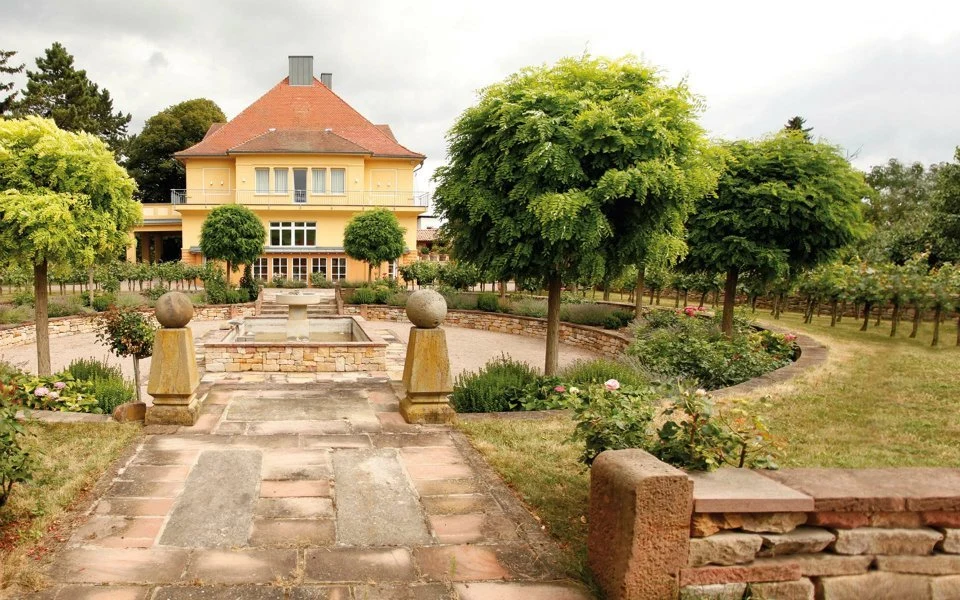
Sekthaus Raumland is a prestige sparkling wine producer in Flörsheim-Dalsheim, Rheinhessen, awarded a Pearl 2 Star Prestige rating in 2025. Operating from Alzeyer Strasse in one of Germany's most quietly serious wine villages, it occupies the top tier of the country's Sekt scene, producing méthode traditionnelle wines that compete on quality against Champagne-region benchmarks rather than the domestic mass market.
<h2>Where German Sparkling Wine Gets Serious</h2><p>Sekthaus Raumland is a winery in Flörsheim-Dalsheim, Rheinhessen. The village of Flörsheim-Dalsheim sits in the southern reaches of Rheinhessen, a region most associated internationally with bulk Liebfraumilch production from an earlier era and, more recently, with a dramatic quality renaissance led by producers like <a href="https://www.enprimeurclub.com/wineries/weingut-keller-florsheim-dalsheim-winery">Weingut Keller</a>. Against that backdrop, Sekthaus Raumland occupies a specific and less-discussed niche: it is one of the producers making the case that Germany can produce méthode traditionnelle sparkling wine at a level that warrants serious critical attention. The 2025 Pearl 2 Star Prestige award places it in the leading bracket of the EP Club assessment framework, a recognition that reflects consistency and technical command rather than a single strong vintage.</p><p>German Sekt as a category has historically suffered from a credibility gap. The domestic market absorbed enormous volumes of inexpensive, tank-fermented sparkling wine under the Sekt label, which made it difficult for bottle-fermented, extended-aged prestige producers to be seen clearly by international buyers. That gap is narrowing. A small group of producers in Rheinhessen and the Pfalz have pushed the category toward longer tirage periods, lower dosage, and site-specific base wines, the same variables that define prestige Champagne. Sekthaus Raumland belongs to that cohort.</p><h2>The Philosophy Behind the Fizz</h2><p>The winemaking approach at prestige Sekt houses like Raumland is structured around extended time on lees, which builds the autolytic complexity, toast, brioche, fine biscuit, that separates serious bottle-fermented sparkling from wines released after the legal minimum contact period. What distinguishes the leading German producers in this space is not merely technique but source material: the base wines come from established vineyard sites in Rheinhessen, a region where limestone and loess soils support both Pinot Noir and Chardonnay with enough tension to sustain the acidity needed for long aging. This geological underpinning is what makes Flörsheim-Dalsheim a defensible home for a prestige sparkling producer, rather than an arbitrary address.</p><p>The editorial comparison that recurs among critics covering German sparkling wine is with Champagne houses operating in a similar prestige tier but carrying a brand premium. The argument from producers in Raumland's position is essentially one of value and transparency: equivalent or longer tirage, comparable base wine quality, materially lower prices. Whether that value gap persists as the category gains recognition is an open question, but it currently favors the buyer willing to look beyond appellation brand recognition. Producers such as <a href="https://www.enprimeurclub.com/wineries/weingut-battenfeld-spanier-hohen-sulzen-winery">Weingut Battenfeld-Spanier in Hohen-Sülzen</a> and <a href="https://www.enprimeurclub.com/wineries/weingut-a-christmann-neustadt-an-der-weinstrasse-winery">Weingut A. Christmann in Neustadt an der Weinstraße</a> represent the still-wine side of this Rheinhessen and Pfalz quality argument; Raumland makes it on the sparkling side.</p><h2>Rheinhessen's Quiet Seriousness</h2><p>Flörsheim-Dalsheim is a small agricultural commune that most wine travelers pass through rather than stop in, even when they are specifically visiting Rheinhessen. The wine itinerary for the region tends to route through Westhofen, Nierstein, and the villages clustered around the Rhine's bend. But the commune's connection to serious winemaking runs deeper than its profile suggests. <a href="https://www.enprimeurclub.com/wineries/weingut-keller-florsheim-dalsheim-winery">Weingut Keller</a>, operating from the same village, is among the most scrutinized addresses in German wine. That proximity is not incidental: the soils and exposures that support Keller's Riesling and Burgundian varieties also underpin Raumland's base wine quality.</p><p>For visitors making a broader sweep of German wine country, Flörsheim-Dalsheim is within easy reach of Frankfurt, with the Rhine wine estates of Rüdesheim accessible via <a href="https://www.enprimeurclub.com/wineries/weingut-georg-breuer-rudesheim-am-rhein-winery">Weingut Georg Breuer in Rüdesheim am Rhein</a> and the historic monastic setting of <a href="https://www.enprimeurclub.com/wineries/kloster-eberbach-eltville-winery">Kloster Eberbach in Eltville</a> further north along the Rheingau. The Mosel, with producers like <a href="https://www.enprimeurclub.com/wineries/weingut-fritz-haag-brauneberg-winery">Weingut Fritz Haag in Brauneberg</a> and <a href="https://www.enprimeurclub.com/wineries/weingut-grans-fassian-leiwen-winery">Weingut Grans-Fassian in Leiwen</a>, represents a full separate routing from the region. Within Rheinhessen itself, the village warrants a stop as much for what it represents about the region's transformation as for any single producer.</p><h2>How It Sits in the German Sparkling Tier</h2><p>The prestige Sekt segment operates with different economics and expectations than either Champagne or the still-wine estates of the same regions. Production volumes are generally small. Distribution tends to be direct or through specialist importers rather than broad retail channels, which means availability outside Germany can be patchy. The Pearl 2 Star Prestige recognition from EP Club in 2025 positions Sekthaus Raumland at the upper end of the assessed domestic field, a comparable set that includes a relatively small number of producers nationally committed to the same tirage-focused, site-expressive approach.</p><p>For context, the German sparkling category that competes at this level internationally includes a handful of producers in Rheinhessen and the Pfalz alongside a few Franconian and Württemberg houses. The Pfalz has its own serious still-wine producers in estates like <a href="https://www.enprimeurclub.com/wineries/weingut-bassermann-jordan-deidesheim-winery">Weingut Bassermann-Jordan in Deidesheim</a> and <a href="https://www.enprimeurclub.com/wineries/weingut-dr-burklin-wolf-wachenheim-an-der-weinstrasse-winery">Weingut Dr. Bürklin-Wolf in Wachenheim an der Weinstraße</a>. Sparkling wine at prestige level remains a more isolated niche within that landscape. Internationally, the comparison set extends to grower Champagne rather than to large Champagne houses, given the scale and sourcing approach involved.</p><p> <a href="https://www.enprimeurclub.com/wineries/weingut-burgerspital-zum-heiligen-geist-wurzburg-winery">Weingut Bürgerspital zum Heiligen Geist in Würzburg</a> and <a href="https://www.enprimeurclub.com/wineries/weingut-clemens-busch-punderich-winery">Weingut Clemens Busch in Pünderich</a>, operate in still-wine categories and represent different benchmarks. Sekthaus Raumland's position is more directly comparable to estates internationally that have staked their identity on sparkling production alone, with a full range from entry non-vintage through to prestige cuvées. <a href="https://www.enprimeurclub.com/wineries/accendo-cellars">Accendo Cellars in St. Helena</a> or a Speyside distillery like <a href="https://www.enprimeurclub.com/wineries/aberlour-aberlour-winery">Aberlour in Aberlour</a>, occupy their own distinct prestige niches, illustrating how recognizable quality signals work across different categories and countries. And estate producers like <a href="https://www.enprimeurclub.com/wineries/weingut-allendorf-oestrich-winkel-winery">Weingut Allendorf in Oestrich-Winkel</a> show how Rhine producers build identity through site and consistency over time, the same framework Raumland applies to sparkling.</p><h2>Planning a Visit</h2><p>Sekthaus Raumland is located at Alzeyer Strasse 123C in Flörsheim-Dalsheim. Direct contact details and tasting visit booking information are best confirmed through current winery communications, as hours and appointment availability for specialist producers at this level typically operate on a request basis rather than open-door retail hours. Visitors combining the stop with a broader Rheinhessen itinerary should allow a full day to cover both the village and the surrounding wine area. The region connects by road to Frankfurt in under an hour, making it accessible without an overnight stay, though the concentration of quality producers in and around the village rewards a slower pace.</p>
Sekthaus Raumland is located at Alzeyer Str. 123C, 67592 Flörsheim-Dalsheim, Flörsheim-Dalsheim.
Sekthaus Raumland has received recognition including: Pearl 2 Star Prestige (2025).
Raumland specialises in traditional-method Sekt built on extended lees aging, which produces autolytic character more associated with Champagne than with most German sparkling production. The estate's Pearl 2 Star Prestige rating for 2025 points toward its top-tier cuvées as the reference point for a visit. Confirm current releases directly with the estate, as specific bottlings change by vintage and disgorgement cycle.
Raumland operates in a part of Rheinhessen that the international wine press has historically overlooked in favour of Mosel and Rheingau, yet it holds a Pearl 2 Star Prestige award for 2025, placing it among the most decorated sparkling producers in Germany. The focus is single-estate Sekt made by the traditional method, a format that remains rare enough in Rheinhessen to carry genuine distinction. That combination of regional underdog status and documented top-tier quality is what draws serious sparkling wine collectors to Flörsheim-Dalsheim.
Sekthaus Raumland is a working wine estate in a small agricultural commune, not a restaurant with a fixed reservation system, so access is less about wait lists and more about advance planning. Tasting visit bookings are best confirmed directly with the estate at Alzeyer Strasse 123C in Flörsheim-Dalsheim. Given its Pearl 2 Star Prestige recognition for 2025, demand for cellar visits has likely grown, so contacting ahead rather than arriving without appointment is advisable.
The Pearl 2 Star Prestige designation (2025) places Raumland within Germany's highest tier of traditional-method Sekt houses, a category that numbers only a handful of estates nationally. Most high-scoring German Sekt is produced in Rheingau or along the Rhine and Mosel, making a 2-Star Prestige producer based in Flörsheim-Dalsheim in southern Rheinhessen a notable outlier by geography. For context, prestige Sekt at this level is priced and positioned closer to grower Champagne than to commercial German sparkling wine.
Alzeyer Str. 123C, 67592 Flörsheim-Dalsheim
Flörsheim-Dalsheim