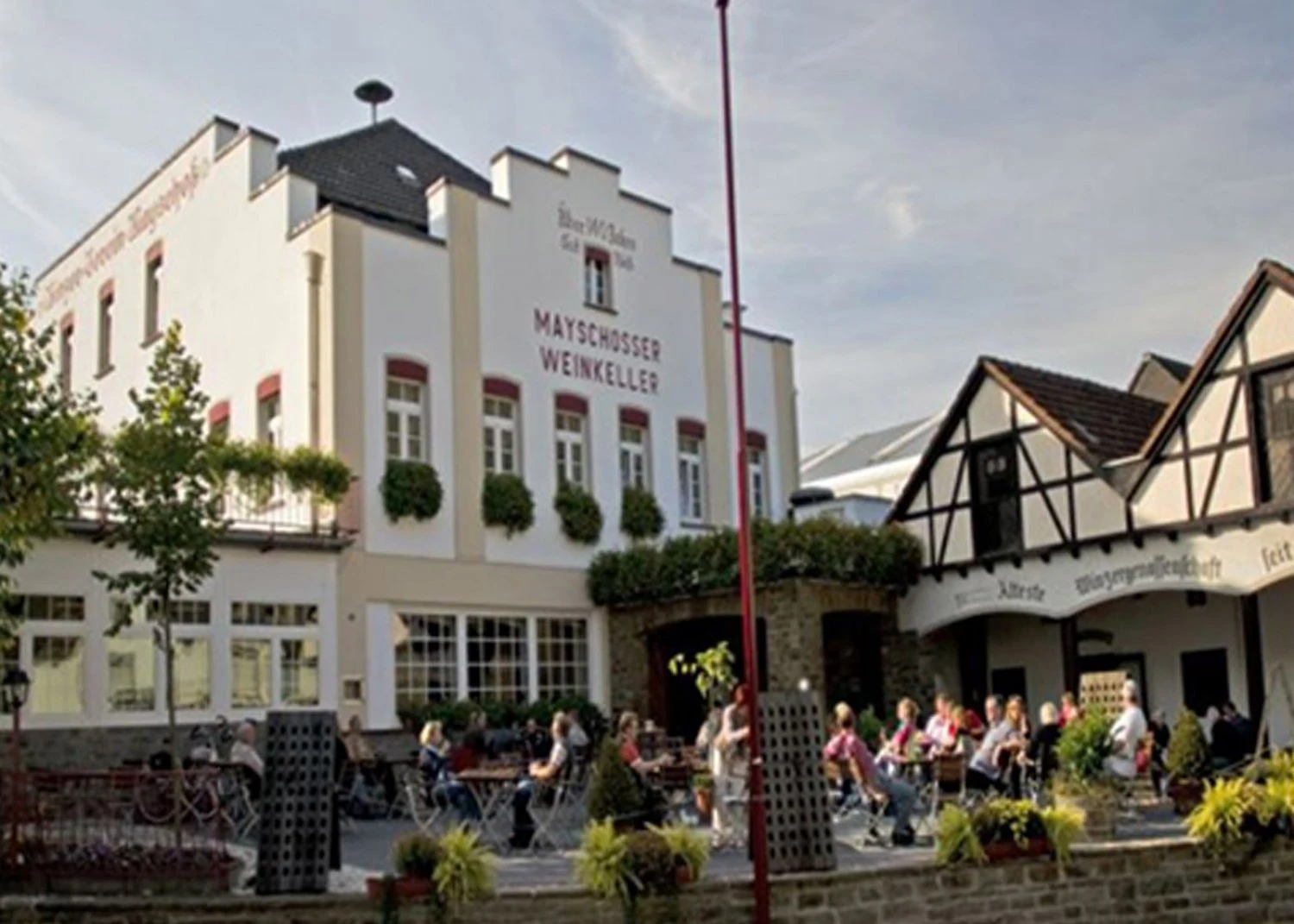
The Ahr Valley's cooperative winemaking tradition runs deep at Winzergenossenschaft Mayschoss-Altenahr, one of Germany's oldest wine cooperatives, holding a Pearl 2 Star Prestige award for 2025. Set along the Ahr-Rotweinstraße in the village of Mayschoß, the estate channels the valley's volcanic slate and sheltered microclimate into Spätburgunder-led wines that represent the Ahr at its most characterful.
Germany's wine conversation tends to default north and east: Mosel Riesling, Rheingau Riesling, Pfalz's broad church of varieties. The Ahr, a narrow river valley cutting through the Eifel highlands south of Bonn, sits at the margin of that conversation despite producing some of the country's most compelling Spätburgunder. The valley is short, roughly 25 kilometres of cultivable terrain, and its vineyards cling to steep south-facing slopes above the river in conditions that would look implausible on paper for red wine production this far north. Volcanic basalt and grey slate retain daytime heat and release it through cool nights, compressing the ripening window and concentrating phenolics in ways that differ markedly from warmer German red wine zones like Baden or Württemberg.
Winzergenossenschaft Mayschoss-Altenahr operates from Ahr-Rotweinstraße 42 in Mayschoß, sitting directly on the valley's red wine route in a position that places it within the geographic argument about what Ahr Pinot Noir can be at its most site-expressive. The cooperative holds a Pearl 2 Star Prestige award for 2025. For context on where cooperative models sit relative to estate-bottled peers across German wine regions, producers like Weingut Fritz Haag in Brauneberg or Weingut Clemens Busch in Pünderich demonstrate how different ownership structures express similar commitments to site fidelity in river valley appellations.
The cooperative model in German wine has a complicated reputation. At its lowest tier, cooperatives aggregate fruit from disparate growers and produce volume wines calibrated for supermarket shelves rather than serious cellars. At its upper tier, the model functions differently: member growers cultivate specific parcels under agreed protocols, delivering fruit that is unified and vinified collectively with the kind of quality oversight that small estates exercise over their own holdings. Winzergenossenschaft Mayschoss-Altenahr belongs to a founding generation of this approach, established in 1868 and carrying the distinction of being among the oldest continuously operating wine cooperatives in Germany.
That institutional continuity matters for understanding the wine. In the Ahr's steep-slate vineyards, where mechanisation is largely impossible and hand harvesting is the only viable method, cooperative structures allow growers to pool labour and capital in ways that make economically marginal viticulture sustainable across generations. The result is that individual parcels on classified Einzellagen sites continue to be farmed by families who could not maintain them independently, with the quality ceiling set by collective ambition rather than individual resource. Comparable dynamics around site-access and collective standards can be seen in how institutions like Kloster Eberbach in Eltville approach multi-site Riesling production across the Rheingau.
Its vineyards produce wines shaped by the Ahr's geology. The valley's terroir is heterogeneous over short distances. Moving from Altenahr toward Dernau and Mayschoß, the soil composition shifts between grey Devonian slate, blue slate, and patches of volcanic basalt that each leave discernible marks on Spätburgunder's structural character. Grey slate sites tend toward wines with more linear acidity and fine-grained tannin; basalt plots produce broader texture and darker fruit weight. The elevation and aspect of individual parcels amplify these differences, since the valley's steep walls mean that sites separated by a few hundred metres can differ significantly in cumulative heat units across a growing season.
The Ahr's thermal quirk, its sheltered position within the Eifel creating a microclimate measurably warmer than surrounding upland areas, is what makes Spätburgunder viable at this latitude at all. The river acts as a heat sink, moderating temperature swings, while the valley walls block cold winds from the north. This is viticulture operating at its climatic limits, which historically produced wines of high acidity and low alcohol but which, over the past two decades, has shifted toward fuller ripeness as regional temperatures have risen. Understanding this shift in thermal character is central to reading the Ahr against other German Pinot producers: the conversation now involves how producers manage phenolic ripeness rather than simply achieving it. For comparison, Weingut A. Christmann in Neustadt an der Weinstraße addresses analogous ripeness management questions in the Pfalz, albeit under different soil conditions.
Ahr has a small but attentive producer community, and the peer comparisons are instructive. Estate bottlers with high-profile international recognition have driven the region's contemporary reputation, but the cooperative's 2025 Pearl 2 Star Prestige award signals that institutional producers can compete on quality metrics alongside smaller names. Within Germany's broader premium winemaking scene, the award underscores the cooperative's standing alongside estate-bottled peers.
Across the German wine world, the estates that most clearly parallel the Ahr cooperative model's ambition in their respective regions include Weingut Georg Breuer in Rüdesheim am Rhein for Rheingau Riesling standards, Weingut Battenfeld-Spanier in Hohen-Sülzen for mineral-driven Rheinhessen production, and Weingut Bassermann-Jordan in Deidesheim as a reference point for Pfalz Riesling with institutional depth. None of these are direct comparators to Ahr Spätburgunder, but together they map where the 2025 award positions Mayschoss-Altenahr within Germany's tiered premium wine conversation. Additional context from Weingut Dr. Bürklin-Wolf in Wachenheim an der Weinstraße and Weingut Allendorf in Oestrich-Winkel further illustrates the range of approaches within German quality wine production. For Franconian context, Weingut Bürgerspital zum Heiligen Geist in Würzburg shows how longstanding institutional producers maintain critical standing across decades. And internationally, Weingut Heymann-Löwenstein in Winningen demonstrates how German producers on steep river-valley slopes can build reputations that translate beyond domestic audiences. Weingut Grans-Fassian in Leiwen rounds out the picture for Mosel-based slate-site expression.
Mayschoß sits along the B267, the road that follows the Ahr through the valley from Bad Neuenahr-Ahrweiler toward Altenahr. The village is reachable by the Ahrtalbahn regional railway, which connects to Remagen on the Rhine mainline, making it accessible from Cologne or Koblenz without a car, though a car gives considerably more flexibility for moving between the valley's producers in a single day. The cooperative's address at Ahr-Rotweinstraße 42 places it on the named red wine route that threads the valley, so orientation is direct once you are in Mayschoß itself.
The Ahr Valley sustained significant damage in the July 2021 flood disaster, which affected infrastructure and some producers' facilities across the region. Recovery has been ongoing since, and travellers visiting the valley should check current conditions with individual producers before visiting. The valley's rebuilding period has also generated renewed attention to its wines, with many in the German wine community making deliberate efforts to direct purchasing toward Ahr producers as a form of economic support. For broader context on what to do and eat during time in Mayschoß, see our full Mayschoß restaurants guide.
For readers whose interest extends beyond German wine into other classic regions, Aberlour in Aberlour and Accendo Cellars in St. Helena show how different production traditions address comparably specific site conditions in their own regions.
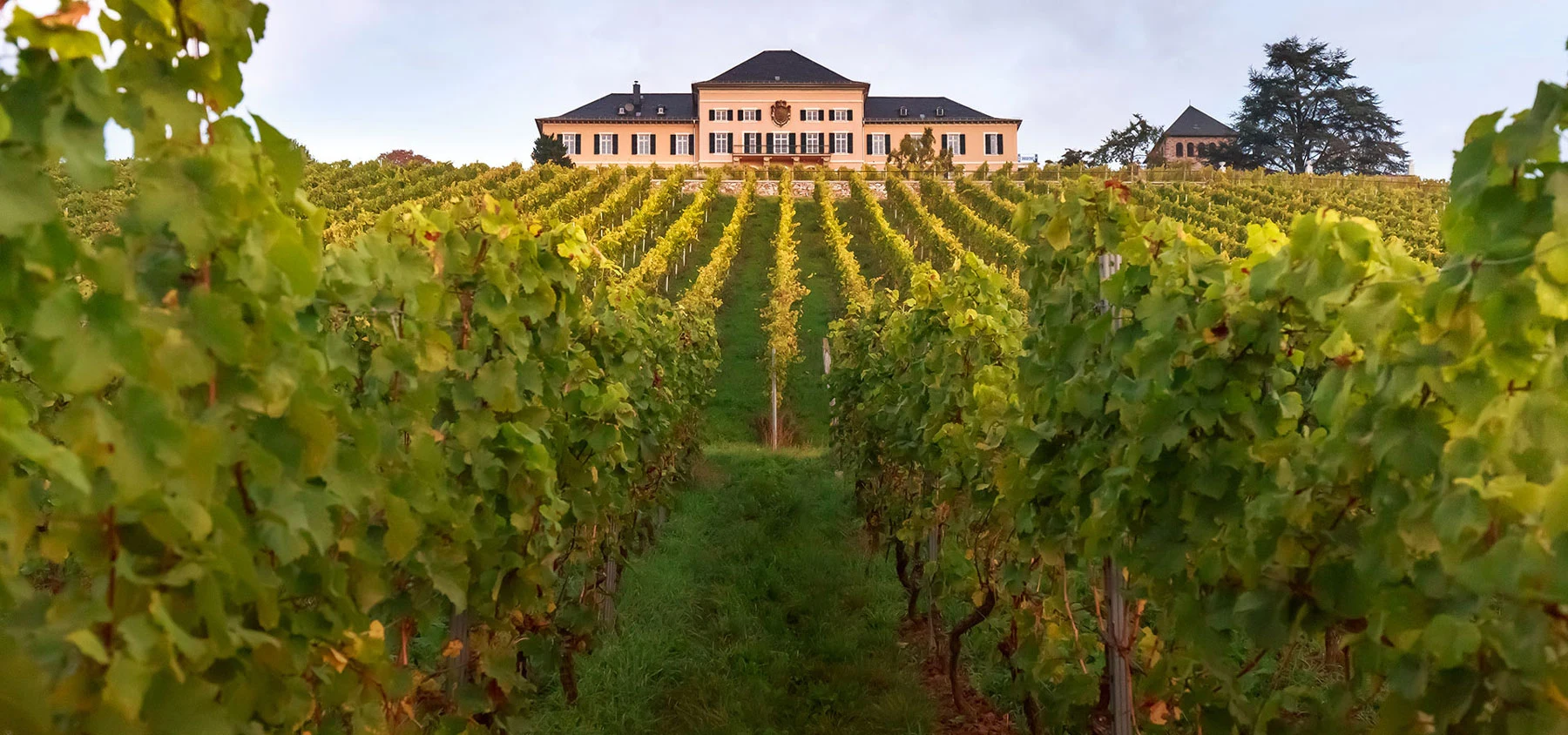
Agricultural and grounded rather than polished-estate in its presentation. The cooperative sits on the Ahr-Rotweinstraße in Mayschoß with steep slate vineyard slopes as the immediate backdrop. Its 2025 Pearl 2 Star Prestige recognition signals serious wine output without the appointment-only formality of small German estate bottlers.
Winzergenossenschaft Mayschoss-Altenahr has received recognition including: Pearl 2 Star Prestige (2025).
Spätburgunder, Germany's designation for Pinot Noir, grown on the grey and blue slate soils above the Ahr. The valley's thermal microclimate allows Pinot to ripen consistently at this northern latitude, and the cooperative's scale means it sources fruit from a range of those steep, mineral-driven sites across Mayschoß and Altenahr.
Winzergenossenschaft Mayschoss-Altenahr is located at Ahr-Rotweinstraße 42, 53508 Mayschoß, Mayschoß.
The cooperative was founded in 1868, making it one of the oldest continuous wine cooperatives in Germany, and it remains the institutional backbone of Ahr cooperative winemaking. Its 2025 Pearl 2 Star Prestige award confirms that the quality case is not purely historical. For anyone following German Pinot Noir seriously, the Ahr sits outside the usual Mosel-Rheingau circuit, and Mayschoss-Altenahr is the entry point most aligned with the valley's cooperative tradition.
Access is considerably more open than at allocation-only Ahr estates such as Meyer-Näkel or Deutzerhof, where mailing lists govern bottle availability. As a cooperative, Winzergenossenschaft Mayschoss-Altenahr operates on a retail and visitor model from its address at Ahr-Rotweinstraße 42 in Mayschoß. Specific visiting hours are not confirmed in current documentation, so contacting the cooperative directly before travelling is advisable.
Ahr-Rotweinstraße 42, 53508 Mayschoß
Mayschoß
Winzergenossenschaft Mayschoss-Altenahr
Weingut Fritz Haag
Weingut Clemens Busch
Weingut Balthasar Ress
Weingut J.J. Adeneuer
Weingut Reinhold Haart