Other
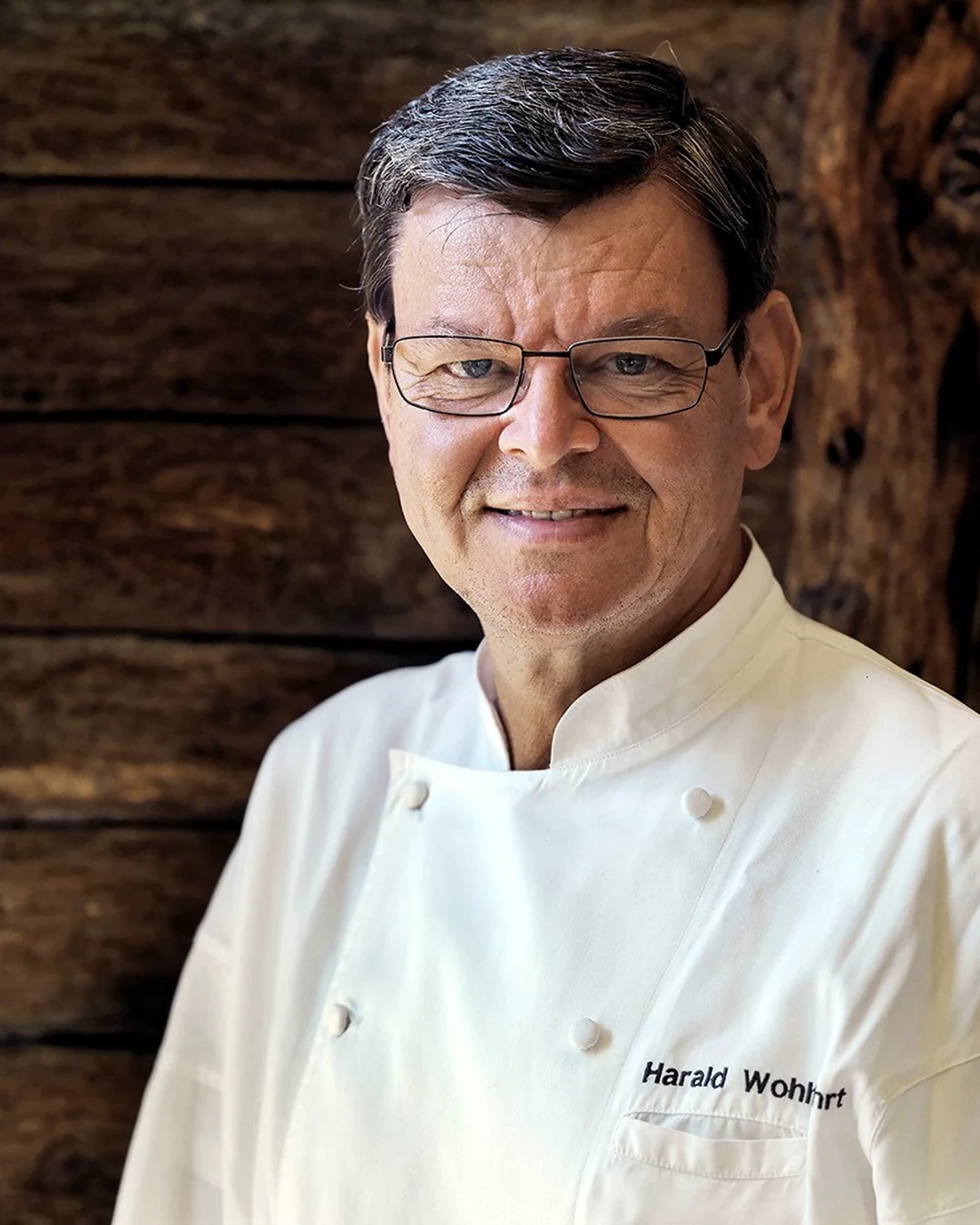
Harald Wohlfahrt
Innovative French cuisine
- Discipline
- Other

i. Biography
Black Forest produce and French technique define the working frame of Harald Wohlfahrt’s cooking. The craft sits between regional supply and classical structure: farm ingredients, controlled sauces, measured composition, and the discipline of a kitchen where each element has a job. In modern German haute cuisine, that combination became one of its clearest expressions through Wohlfahrt’s long work at Schwarzwaldstube. “My career choice was heavily influenced by my grandparents. They were part-time farmers and spending time with them as a child awoke my interest in farming and fresh products.” Harald has said.
The Making
Hotel-kitchen discipline shaped the early formation of the craft. Mönchs Waldhotel (1970) gave Harald Wohlfahrt a practical starting point, followed by the Meisterschule in Baden-Baden (1980) and Alain Chapel (1980), where French technique gave further structure to instincts already tied to the Black Forest and its produce. The early professional stations built range before long tenure. Work as commis at Restaurant Stahlbad in Baden-Baden (1974–1976) placed Wohlfahrt in a city associated with refinement and formal hospitality. The short role as chef at Tantris in Munich (1977–1977) followed, putting that developing authority into one of Germany’s most visible dining rooms of the period. Schwarzwaldstube, Hotel Traube Tonbach in Baiersbronn-Tonbach, became the decisive kitchen. The craft entered there with Wohlfahrt as sous-chef (1978–1980), then settled into long-form practice when he became head chef (1980–2017). Over those years, the work was defined less by display than by clarity, balance, and control: a sustained language in which regional ingredients were organized through French form and every component had to earn its place. A later stage kept the same classical grammar in a different setting. From 2018, Wohlfahrt has worked as chef partner at MSC Cruises, carrying German and French classical cuisine beyond the Schwarzwaldstube years without changing the underlying terms: order, structure, and technical care.
The Current Work
The Black Forest remains the central reference point for the work. Loffenau as origin, Dobel as training ground, Baden-Baden as an early kitchen, and Baiersbronn-Tonbach as the place of broad recognition form the map behind Harald Wohlfahrt’s cooking. Read through the craft, those places point to regional produce, disciplined service structures, and the French framework used to give shape to the plate. The cooking is built on the link between local ingredients and French form, handled with German precision rather than public flourish. Wohlfahrt’s reputation rests on accumulated standards: sauces with depth and polish, ingredients handled with restraint, and compositions built for coherence. The force is in control, not volume. MSC Cruises marked the later chapter after Schwarzwaldstube. The stated culinary frame remained German and French classical cuisine, continuing the vocabulary that had shaped Wohlfahrt’s work across decades: technique as foundation, produce as subject, and classical structure as the means by which flavor is made legible.
Accolades
Three Michelin stars for Schwarzwaldstube (1993) and Bundesverdienstkreuz (2005) place the work in both culinary and national registers. In Harald Wohlfahrt’s case, the recognition followed a standard of exacting craft that became a reference point within German gastronomy.
Profile updated July 2026
FAQ
Asked of Harald
Where did Harald Wohlfahrt train or study?
Harald Wohlfahrt trained at Mönchs Waldhotel and Meisterschule in Baden-Baden.
What recognition has Harald Wohlfahrt received?
Three Michelin stars for Schwarzwaldstube (1993).