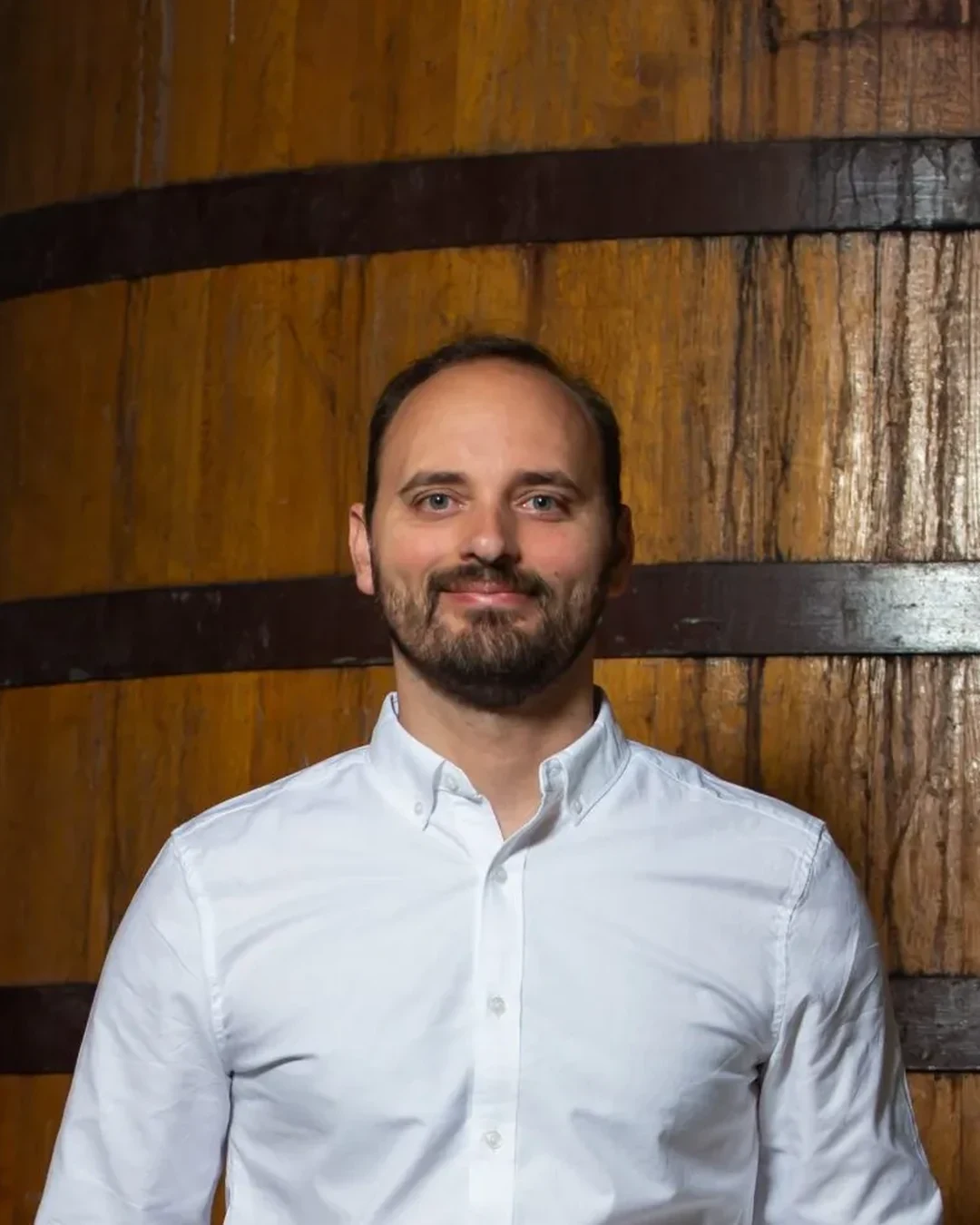
Portrait of Roelof Lotriet
i. Biography
The Path
Cellarmaster at Delheim Wine Estate is a role built on continuity: vineyard, cellar, and estate identity all have to stay in conversation. Roelof Lotriet’s position sits at that junction, with the work defined less by display than by steady custodianship. The useful measure here is not drama, but whether the wine still carries the place with clarity. France shaped that outlook. The family-owned, family-run rhythm of the chateaus left an impression on Lotriet, and that is visible in the way he frames Delheim: a bottle does not stand apart from the people behind it. It carries the weight of ownership, memory, and responsibility, and the cellar’s job is to treat that weight with care.
The Sunday email
Read about winemakers like Roelof Lotriet in the Sunday email.
Every Sunday we send a lead story and up to four more about the chefs, winemakers, sommeliers and hoteliers behind the restaurants, bars, wineries and hotels we cover.
Recent stories
Free. One email a week, and you can unsubscribe from any issue.
The Work Today
Chenin blanc is where Lotriet’s approach becomes most legible. Older barrels are used not to impose a style, but to keep the Delheim Chenin blanc fruit present in the finished wine. In his own words: “The reason for using older barrels is that I'd like to express as much Delheim Chenin blanc fruit in the wine as possible.” The logic is straightforward: preserve what the fruit already offers, and let the cellar support that expression rather than override it.
That kind of restraint defines the broader work. The cellar is not treated as a place for ornament or excess, but as a space where decisions have to earn their place. Lotriet’s method ties technique to inheritance, with each choice made in service of what Delheim already is. The result is a style grounded in listening: to the fruit, to the estate, and to the family framework that gave the winery its meaning.
In Their Words “The reason why Delheim was so appealing to me goes back to my time in France. All the chateaus are family owned and run. A bottle of wine doesn't just represent a block of vineyards, it represents a family.” “The reason for using older barrels is that I'd like to express as much Delheim Chenin blanc fruit in the wine as possible.”
Acclaim
The 2022 appointment to cellarmaster, after serving as head winemaker in 2018 at the same estate, marks Lotriet’s progression within one Stellenbosch address. It is a career line shaped by confidence built over time, not by movement for its own sake. That progression is anchored in the same principles that run through the work: wine as an extension of family, and Chenin blanc handled with restraint so the Delheim fruit remains clear. The recognition lies in the consistency of that position across roles and years.
FAQ
Asked of Roelof
Where did Roelof Lotriet train?
Roelof Lotriet trained at Stellenbosch University.
What is Roelof Lotriet's craft?
Cellarmaster — Delheim Wine Estate (Stellenbosch), 2022.
Explore
Similar Winemakers

The Sunday email
Read about winemakers like Roelof Lotriet in the Sunday email.
Every Sunday we send a lead story and up to four more about the chefs, winemakers, sommeliers and hoteliers behind the restaurants, bars, wineries and hotels we cover.
Recent stories
Free. One email a week, and you can unsubscribe from any issue.