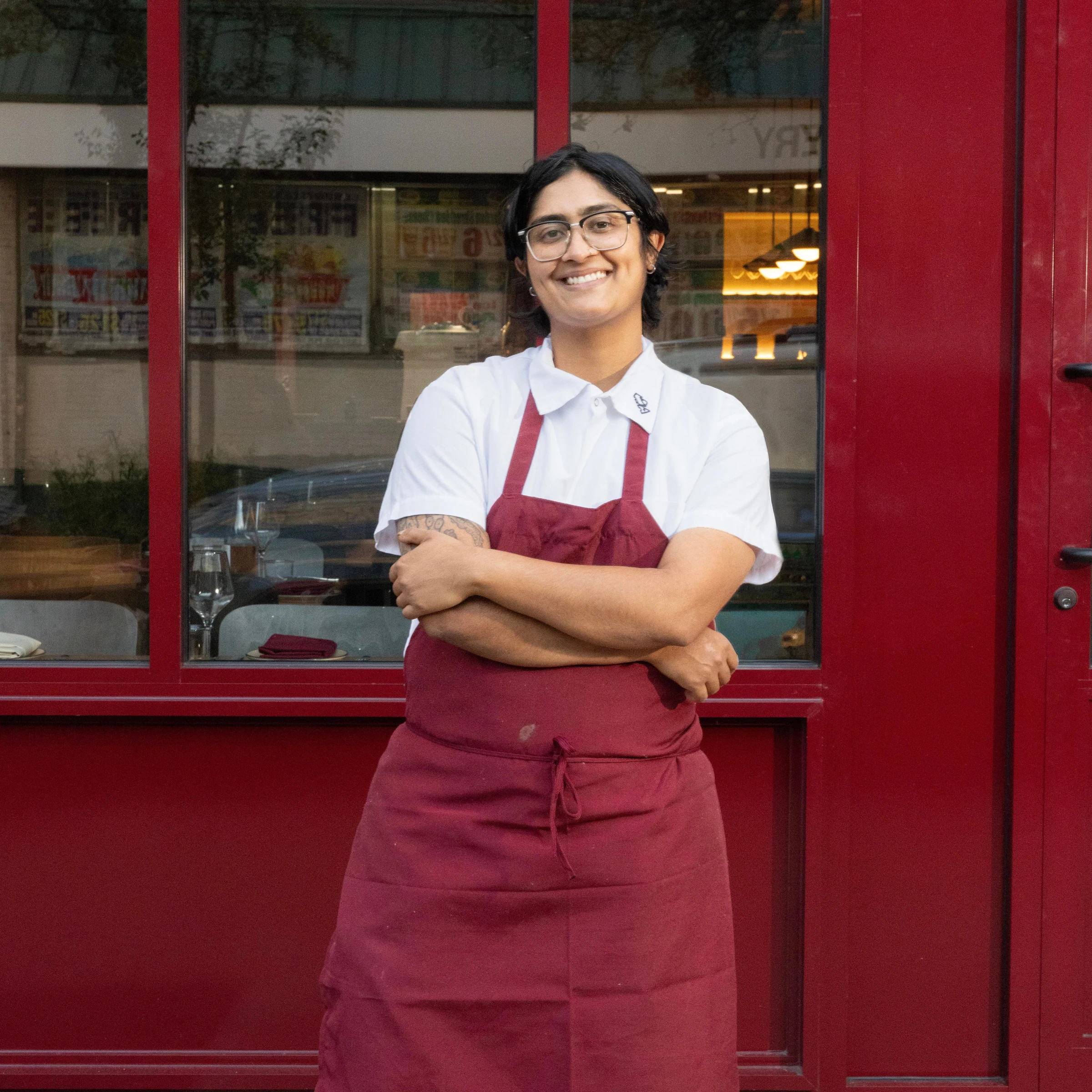
At 7 a.m. on Wednesday, September 23, Austin Johnson's new H. Valley West Village market opens at 569 Hudson Street with coffee, breads, a children's fridge, and Dion's Diet, a house dog food made with Hudson Valley trout, chicken, duck, and vegetables. Johnson, formerly executive chef of Tribeca's formerly Michelin-starred One White Street, has moved from tasting-menu service to a 2,500-square-foot West Village market and cafe built for the people, children, and dogs who pass the corner of Hudson Street and West 11th Street (Eater1).
H. Valley comes from Johnson and Eytan Sugarman's Hudson Street Hospitality, the group behind Made in New York Pizza and White Horse Tavern. Johnson arrives with the habits of One White Street and Rigor Hill Market, where he worked with the high-end grocery model next door to the restaurant. Here, he stretches that model into the West Village, less tasting menu, more heat-at-home dinner; less late-night dining room pressure, more biscuit sandwiches, prepared meats, pastas, breads, pastries, and provisions gathered under one roof.
What H. Valley West Village Brings to 569 Hudson Street
H. Valley West Village occupies the corner of Hudson Street and West 11th Street with limited cafe seating and initial Wednesday hours of 7 a.m. to 8 p.m. Those numbers matter because Johnson has framed the shop around a day that starts with coffee and bread and ends before the late-night rhythm of tasting-menu service takes over. His daughter inspired the family-friendly approach, and Johnson has emphasized a schedule that lets him wrap up around 8:30 p.m. instead of working deep into the night (Eater1).
Inside the 2,500 square feet, the market is organized around prepared food, local provisions, and high-end grocery items. The categories read like stations: coffee, pastries, breads, sandwiches, sauces, dairy, dips, raw meats, prepared dinners, children's meals, and dog food. Each one asks a practical question. What does a fine-dining chef do when the guest is not sitting for a menu, but opening a fridge door at home?
Johnson's answer begins in the morning. Grayson Claes, the head baker, provides coffee, pastries, and breads. H. Valley also serves a bacon, egg, and cheese on a biscuit, and on weekends it brings over the omelet bar that began at Rigor Hill. Lunch moves into three hot and three cold sandwiches, including a turkey sandwich built with honey mustard, pickled apple slaw, and goat cheese on honey-oat sourdough. That is a composition with acid, fat, sweetness, and grain doing work between two slices (Eater1).
From One White Street to Market Shelves: Austin Johnson's Pivot
Johnson's name carries a specific New York kitchen lineage. Before H. Valley, he was executive chef of One White Street, the Tribeca restaurant that held a Michelin star, and he worked with Rigor Hill Market, its next-door sibling. H. Valley extends a model Johnson already practiced in Tribeca, then pushes it into a neighborhood market format with more space and a wider daily use case (Eater1).
At One White Street, the restaurant form sets the terms: reservations, courses, service timing, late nights, a room that must be filled. At H. Valley, Johnson changes the unit of work. The refrigerator becomes the mise en place. The freezer becomes the holding station. The bread shelf becomes the morning anchor. The customer might be a parent buying fish sticks, a cook buying raw meat, a neighbor taking home dinner, or a dog owner picking up Dion's Diet.
The craft problem changes, too. In a dining room, a chef controls the plate until the moment it leaves the pass. In a market, the chef prepares food for another hand to finish, reheat, cut, dress, or serve later. That demands a different discipline: food must survive a container, a commute, a home oven, a distracted evening. Johnson's H. Valley project sits there, in the space between chef control and customer completion.
Sugarman's role matters because Hudson Street Hospitality already works in neighborhood formats. The group is behind Made in New York Pizza and White Horse Tavern, two names with different service rhythms from a tasting-menu restaurant. H. Valley sits within that hospitality frame but carries Johnson's kitchen DNA: prepared dinners, ready-to-cook meats, sauces, pastas, breads, and pastries built around sourcing and technique rather than convenience alone. Expect to pay well more than at an average corner grocer. The wager is that Johnson's sourcing and the prepared-food cases can carry that price into repeat use.
Amanda Reilly, Grayson Claes, and the Hands Around the Market
H. Valley is shaped by more than Johnson's cooking. Amanda Reilly, Johnson's wife, shaped the interiors, chose merchandise, and sourced antiques from around the Northeast. In a market, those choices affect how people move and what they notice. A shelf decides whether the bread reads as daily food or special purchase; a refrigerator gives children's meals the same direct access as prepared dinners.
Reilly's work gives the Hudson Valley idea a material form without turning it into set dressing. The antiques, the merchandise, the market's surfaces, all of it carries the pressure of a place meant to be used repeatedly. A neighborhood market has to take keys, strollers, school bags, dogs outside, and dinner indecision. It also has to hold enough order that a jar, a loaf, or a prepared dish can be found again next week.
Claes holds the morning station. His breads and pastries set the first daily measure of the market, before the dinner cases begin to matter. A bakery program inside a chef-led market does more than fill a pastry case. It determines whether H. Valley becomes a breakfast stop, whether the biscuit under the bacon, egg, and cheese earns the trip, whether a loaf leaves with someone who came in only for coffee.
The Product Mix: Kids' Meals, Confit Garlic Rib-Eye, and Dion's Diet
The strongest signal at H. Valley is the range. The market sells a rib-eye rubbed with confit garlic. It has raw meats, salads, dairy, sauces, dips, pastas, prepared dinners, breads, and pastries. It also has a children's fridge stocked with items meant to heat up: mac and cheese, baked fish sticks, chicken Parm cutlets, spaghetti with red sauce, baked turkey meatballs, mashed potatoes and gravy, and peas and carrots.
That children's fridge tells you which service Johnson is now trying to solve. A tasting menu asks for attention over hours. A family dinner asks for food that can meet a clock, a child's preferences, and the fatigue of a weeknight. The discipline sits in making those foods sturdy enough for reheating and direct enough for a child, without treating them as lesser work.
Then comes the dog food. H. Valley makes Dion's Diet with ingredients like Hudson Valley trout, chicken, duck, and vegetables. Johnson gives the line its own name, and he gives the reason in one sentence: “The dogs are customers, too,” he says. It lands because the West Village sidewalk already tells the same story. A neighborhood market that ignores dogs misses part of the neighborhood.
The mix should not be softened into novelty. Biscuit sandwich, turkey on honey-oat sourdough, mac and cheese, confit garlic rib-eye, birthday card made from invasive plants, dog food: each category pulls a different customer into the same room. Johnson is not leaving fine dining for a simpler form. He is stepping into a form with more kinds of demand and fewer chances to explain himself tableside.
Hudson Valley Sourcing Without the Restaurant Ritual
The name H. Valley points north, but the shop sits firmly in Manhattan. Its job is translation. The market gathers prepared food, provisions, and grocery items with a Hudson Valley frame and places them where a West Village customer can walk in on a weekday morning or evening. The sourcing ambition is carried through categories rather than a single dish: trout in dog food, confit garlic on rib-eye, honey-oat sourdough under turkey, pickled apple slaw inside a lunch sandwich.
Fine-dining sourcing usually appears at the table as explanation: a server names the farm, the course arrives, the guest receives the story in order. Retail strips away that choreography. A market shelf has to do the work through product, price, placement, and repeat use. H. Valley's prepared-food cases become a different kind of menu, one where the customer chooses sequence and portion.
The New York context is visible. H. Valley joins newer markets such as Happier Grocery, Meadow Lane in Tribeca, and the planned First Bloom expansion from Alison Roman in Brooklyn Heights. The difference here is Johnson's restaurant-driven structure. The prepared foods, ready-to-cook meats, breads, pastries, sauces, and sandwiches are not accessories to retail. They are the method.
That method also carries a risk. A tasting-menu guest has already agreed to the chef's pace before the first course arrives. A market customer can walk out with one pastry, one sauce, one package from the children's fridge, or nothing at all. H. Valley West Village has to earn the next visit by making the work legible without the comfort of a dining-room script.
Hours, Seating, and What to Watch Next
For now, H. Valley West Village opens on Wednesday from 7 a.m. to 8 p.m. at 569 Hudson Street, at West 11th Street, with limited cafe seating. The first visit should be read by time of day. Morning belongs to Claes's coffee, pastries, breads, and the bacon, egg, and cheese on a biscuit. Lunch brings the sandwich program, including the turkey with honey mustard, pickled apple slaw, and goat cheese on honey-oat sourdough. Dinner runs through the refrigerators and freezers: prepared meals, raw meats, sauces, pastas, and the children's fridge.
Visitors should also watch the events program. H. Valley plans to host private dinners, visiting chefs, pop-ups, and other events, with a larger dining program planned for later this year. That future use of the room may become the clearest expression of Johnson's pivot: a chef able to bring in a visiting cook for a weekend or host a 40-person dinner without committing every night to the demands of a tasting-menu room.
The next test is not whether H. Valley can attract opening-week curiosity. The test is whether Johnson, Sugarman, Reilly, and Claes can make the market useful enough to enter the neighborhood's routine: bread in the morning, a sandwich at lunch, a tray from the children's fridge after school, a rubbed rib-eye for dinner, Dion's Diet for the dog. If that rhythm holds, H. Valley will not read as a chef stepping away from the bench. It will read as a chef moving the bench closer to home.