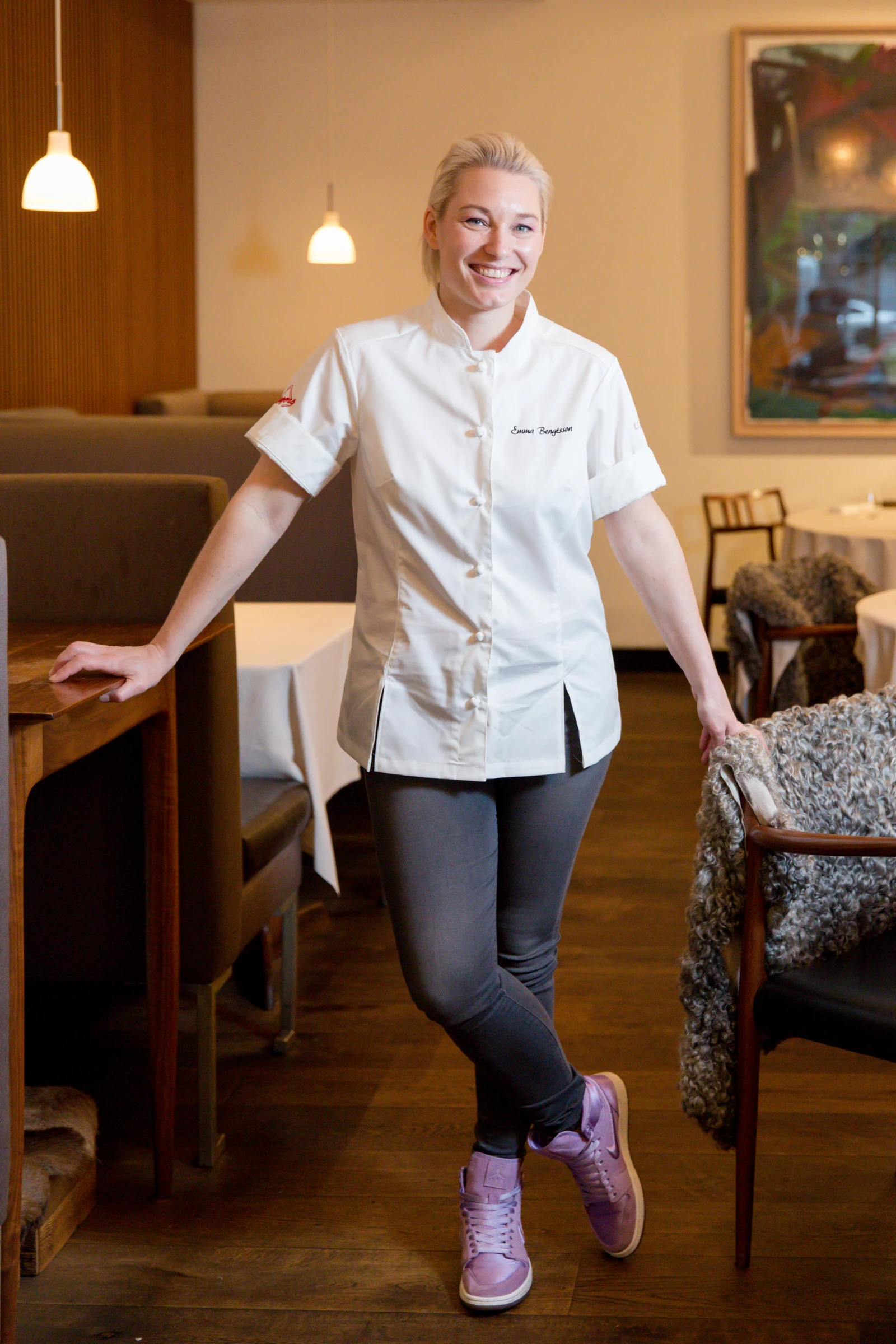
Emma Bengtsson keeps rulers in the kit and micro scales close enough to treat garnish weight as a service detail, not a pastry-room eccentricity. The Emma Bengtsson Aquavit story turns on that discipline: she became executive chef in spring 2014, after serving as Aquavit's executive pastry chef from 2010, and the restaurant received a second Michelin star in the 2015 guide. The move from pastry to the savory pass did not soften the method. It moved the method into every station.
At Aquavit in Midtown Manhattan, Bengtsson leads a Nordic kitchen whose history began in 1987, when Swedish restaurateur Håkan Swahn opened the restaurant and put gravlax, herring, and aquavit before New York diners with a seriousness that outlasted fashion cycles. The room has carried several hands through its lineage: Christer Larsson, Marcus Samuelsson, Marcus Jernmark, then Bengtsson. Samuelsson earned three stars from The New York Times during his period there; Jernmark brought the restaurant a Michelin star before Bengtsson stepped into the executive chef role. Bengtsson then received three stars from The New York Times, and Michelin added the second star in the 2015 guide.
Those credentials matter less as trophies than as pressure marks. Bengtsson has said she did not want to be the chef who let Aquavit's star slip. Her answer was not volume, decoration, or a broader menu. It was measurement, restraint, and a pastry chef's refusal to let the plate leave the pass without a reason for every gram.
The pastry foundation behind Emma Bengtsson Aquavit
Bengtsson joined Aquavit as pastry chef in 2010 after work at Edsbacka Krog and Stockholm 's Operakällaren. Four years later, in spring 2014, Swahn tapped her to lead the whole kitchen. The usual story of a pastry chef moving into savory cooking leans on surprise. Bengtsson's case is more useful if you set surprise aside and watch the transfer of technique.
Pastry teaches sequence. It teaches a cook to write the recipe before service, to weigh what a savory cook might pinch, to understand how a plate can fail from two millimeters of excess as easily as from a missed seasoning. Bengtsson did not leave that discipline behind when she moved from pastry to executive chef. She brought it with her, and Aquavit's savory station began to carry pastry-room habits: measured placement, exact garnish weight, recipes written down to the last instruction, little tolerance for drift between cooks.
"My savory kitchen is very much run the way you would run a pastry department. Everything that goes onto my plates gets measured. There's always a ruler in everyone's kit. There's a micro scale. Every recipe is down to the T. There's no room for error."1
Emma Bengtsson, executive chef, Resy Blog
The ruler is not theater. In Bengtsson's kitchen, it turns taste into repeatable form. If a goat-cheese parfait egg needs to sit in the same place every night, if a sea-buckthorn yolk has to read as yolk rather than sauce, if a Nordic plate relies on negative space as much as garnish, the hand needs a reference point. Pastry has always known this. Bengtsson made the savory cooks live with it.
That is the craft lesson inside Emma Bengtsson Aquavit: precision does not flatten feeling when the ingredients have enough clarity. It lets a plate remain legible through service, across cooks, and under the pressure of a dining room that expects the same standard at the first seating and the last.
From Falkenberg to the Stockholm bench
Bengtsson was raised near Falkenberg, on Sweden's west coast, and trained at Stockholm 's Hotel and Restaurant School. Before New York, she worked in kitchens in Sweden and Sydney, Australia. The Swedish posts named in her path matter: Edsbacka Krog and Operakällaren gave her a Nordic foundation before Aquavit gave that foundation a Manhattan address.
Her background also contains a different kind of discipline. Bengtsson is a former gymnast and equestrian. Those are not decorative biographical notes when you look at her kitchen method. Gymnastics trains repetition until the body stops negotiating with the task. Riding asks for control without panic. Bengtsson's account of the early New York period carries that same narrowing of focus: during her first six months at Aquavit, she worked without real days off, staying at the restaurant or sleeping, cleaning, and doing laundry when she was not there.
There is a certain kind of apprentice year hidden inside that sentence. Not a romantic one. A schedule. The work absorbs the body until the cook either leaves or learns how to stay. Bengtsson stayed, first on pastry, then at the pass, carrying a Swedish sense of restraint into a city dining room that can reward louder gestures.
Her food is described as seasonal, Nordic, and ingredient-driven. That phrase can turn vague in lesser hands, so it helps to attach it to the methods named around her cooking: curing, smoking, pickling, and fermentation. These are preservation disciplines before they are flavor signatures. They require salt, time, temperature, and waiting. They suit a cook who trusts control more than excess.
The Aquavit lineage Bengtsson inherited
Håkan Swahn opened Aquavit in 1987. That date gives Bengtsson's appointment weight because she did not take over a blank room. She inherited a restaurant that had already carried New York through several versions of Scandinavian cooking, from gravlax and herring to tasting-menu Nordic precision. She also inherited the memory of chefs who had already made the room visible to critics and inspectors.
Marcus Samuelsson's tenure brought three stars from The New York Times. Marcus Jernmark, Bengtsson's predecessor, earned a Michelin star. Bengtsson entered the executive chef role with both of those facts behind her, and with Swahn still the owner who had opened the place decades earlier. That is not a casual handoff. It is the kind of kitchen succession where the next chef has to change enough to lead, but not so much that the house loses its spine.
"Aquavit is such an institution of great chefs, and I didn't want to be the one who lost the star"2
Emma Bengtsson, executive chef, Resy Blog
That fear is practical. A Michelin star changes how a kitchen breathes; losing one changes how the room is read. Bengtsson moved into the role in spring 2014, and Aquavit received its second Michelin star in the 2015 guide. She has recalled thinking the call about the second star was a prank. The reaction sounds almost comic until you consider the calendar. Within roughly a year of the promotion, the former pastry chef had not only held the line, she had moved it.
The lineage at Aquavit is also a study in how restaurants survive succession. A founder can open the door, a predecessor can earn the first level of recognition, and the next chef can still fail if the method does not belong to them. Bengtsson's method did. It came from pastry, sport, Swedish training, and the long first months in New York when she did not let herself drift far from the building.
Rulers, micro scales, and Nordic restraint
The tools tell you how Bengtsson thinks. A ruler in every kit means plate architecture is not left to mood. A micro scale means garnish is not a flourish guessed by hand. Recipes written down to the last mark mean the cook on the station cannot hide behind instinct when the instruction calls for precision.
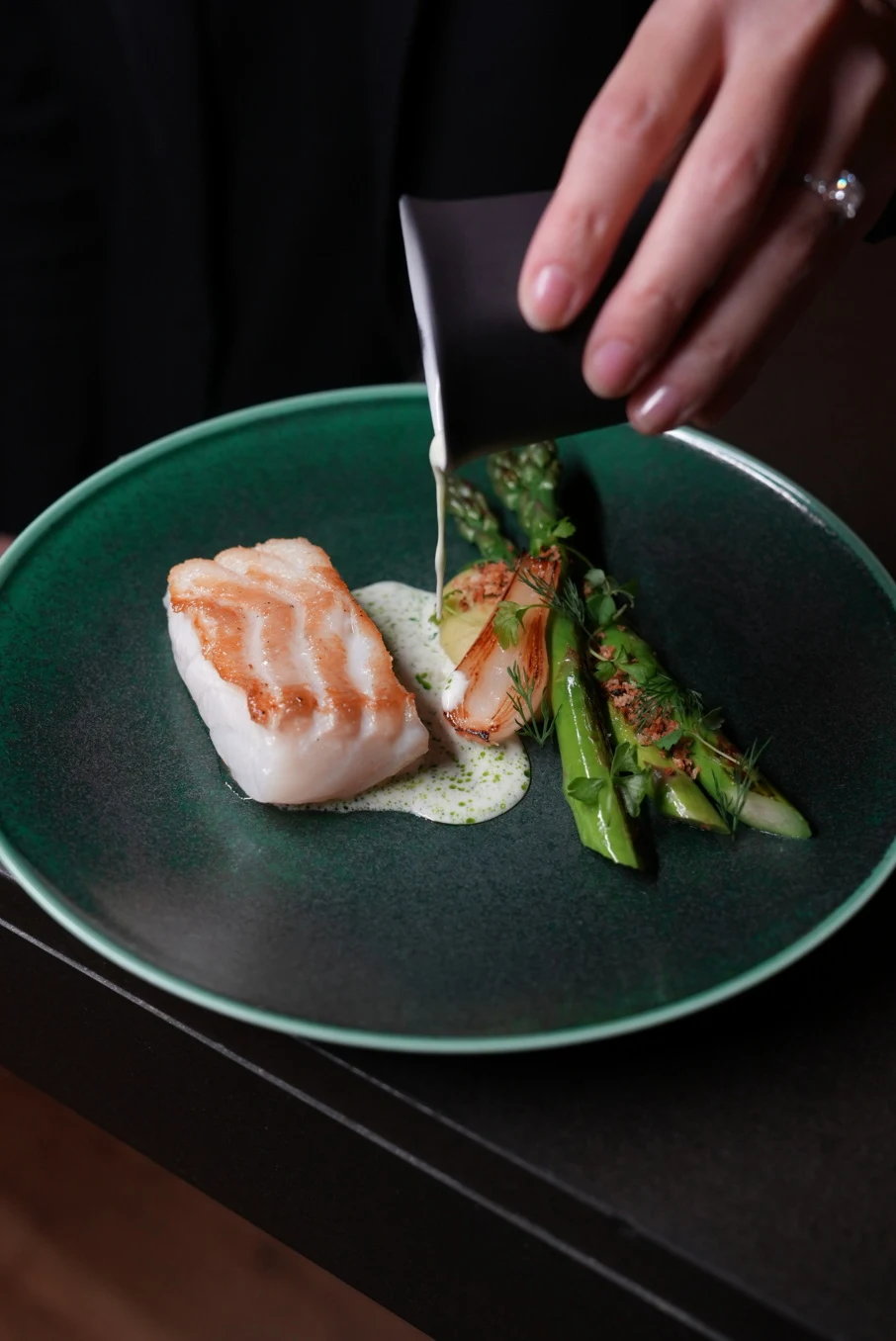
That may sound severe if you separate it from the food. Bengtsson's kitchen pairs that control with dishes that rely on clarity: halibut with salt-baked celeriac and smoked-whey beurre blanc; kombu-brined yellowtail beside watermelon granita; a savory cheesecake with sourdough crisp appearing as a pre-dessert. None of those combinations needs crowded plating to explain itself. Salt, smoke, whey, brine, fruit, sourdough. The plate gives the diner enough signals, then stops.
Her signature Arctic Bird's Nest makes the pastry connection plain without reducing the dish to technique. Goat-cheese parfait forms the eggs; sea-buckthorn yolks sit inside them. The conceit depends on construction, temperature, and proportion. Too much goat cheese and the nest becomes heavy. Too much sea buckthorn and the yolk stops behaving as an accent. The dish asks pastry questions in a Nordic dialect.
Restraint is often misread as quietness. In Bengtsson's work, it functions as a sorting tool. If an ingredient does not sharpen the plate, it has no place there. If a garnish cannot be weighed, placed, and repeated, it becomes a risk to the rhythm of service. This is where pastry precision becomes savory leadership. The method protects the kitchen from the cook's worst impulse, the urge to add another thing because the plate has room.
For diners, the practical reading is simple: at Aquavit, look for the distance between elements as much as for the elements themselves. The white space is part of the seasoning. The sour, saline, smoked, and fermented notes are not there to announce a trend; they are the old Nordic methods Bengtsson uses to keep the ingredient in view.
How Bengtsson earned Aquavit's second Michelin star in one year
The 2015 Michelin guide gave Aquavit its second star after Bengtsson had moved into the executive chef role in spring 2014. That timeline is the hinge of the profile. She was not an outside chef brought in with a new language. She was already in the building, already responsible for pastry, already familiar with the room's expectations and the founder's trust. When Jernmark exited and Bengtsson took the pass, she had to translate her own station discipline into a full kitchen system quickly.
Emma Bengtsson Aquavit is often framed through ascent, but the more useful craft question is how a chef prevents panic from entering the plate. Bengtsson's answer runs through measurement and repetition. When each recipe is exact, the kitchen can keep its center during inspection, review, or a full service. When the chef's mood stays steady, the stations have a better chance of staying steady. Leadership, in this case, is not a speech before service. It is the quiet insistence that the same tool, the same weight, and the same placement matter every time.
The New York Times later awarded Bengtsson three stars. Taken with the second Michelin star in the 2015 guide, the two recognitions mark how quickly her savory kitchen established itself. But the awards are not the beginning of the story. They are the visible edge of decisions made bench-side: what to measure, what to remove, what to preserve, what to repeat.
Aquavit's seasonal five- and eight-course tasting menus give her a format built for this kind of control. A tasting menu can collapse under its own ambition when every course tries to peak. Bengtsson's Nordic register gives her other gears: pickled brightness, smoked depth, dairy richness, brined salinity, the snap of fruit against fat. The work is not to make each course larger. The work is to make the sequence hold.
What her savory plates learned from pastry
Pastry cooks know that sweetness is only one variable. Texture, temperature, structure, timing, and geometry carry equal weight. Bengtsson's savory cooking at Aquavit uses that understanding. The goat-cheese parfait in Arctic Bird's Nest requires the discipline of a frozen or set component; the sea-buckthorn yolk requires a center that reads instantly. The dish works because the idea and the method arrive together.
The same thinking appears in the way savory ingredients are described around her menus. Salt-baked celeriac does not behave like raw celeriac. Smoked-whey beurre blanc does not behave like a standard butter sauce. Kombu-brined yellowtail takes seasoning through contact and time before it ever reaches the plate. Watermelon granita brings temperature and grain as much as flavor. Each part has a job. Each job has to fit the plate's measured space.
This is where Bengtsson's pastry past becomes more than biography. It gives the kitchen a shared grammar. The cook on fish, the cook on garnish, the cook finishing a pre-dessert all understand that the plate has been drawn before service starts. That does not make the food rigid. It makes variation visible, and in a restaurant carrying two Michelin stars from the 2015 guide, visible variation is not a harmless thing.
For practitioners watching Bengtsson's work, the lesson is not that savory kitchens should become pastry departments. It is that the tools pastry has long used can clarify savory cooking when the chef knows why they are there. A ruler without judgment is a prop. A micro scale without taste is dead weight. In Bengtsson's hands, both tools support a Nordic palate built on seasonal ingredients and controlled old methods.
The next turn of Bengtsson's Aquavit program
No announced book or relocation is needed to make Bengtsson's next work worth watching. The next visible movement is the continuing seasonal program at Aquavit, where the five- and eight-course tasting menus give her room to adjust the Nordic vocabulary without abandoning the measured system that brought the restaurant its second Michelin star in the 2015 guide.
Watch the bench, not only the dining room. Watch whether the Arctic Bird's Nest remains the final signature or becomes a reference point for younger cooks in the kitchen. Watch how Bengtsson keeps Swedish training, pastry discipline, and Midtown service pressure in the same frame. A chef who moved from executive pastry chef in 2010 to executive chef in 2014 has already shown the value of staying close to the method; the next proof will come, as it usually does, one measured plate at a time.