Concrete-aged single-vineyard Stellenbosch wines
- Falstaff Winery - Listed · 2026
Concrete before polish
Concrete, not oak, carries much of the cellar work for Mick Craven, winemaker at Craven Wines in Stellenbosch. The choice suits the scale of the house: small, direct, and built around keeping fruit and site in view rather than dressing either one for the room. Craven returned to South Africa in 2011 after four years moving through Australia, Europe, the United States, and South America, a long apprenticeship by travel, harvest work, and comparison. He brought that frame back to Stellenbosch, where Craven Wines began in 2012 with a few barrels of Pinot Noir from family vineyards.
The work here is not estate grandeur. It is a contracted-vineyard cellar, close to the vines, with attention paid to particular blocks rather than a blended house line. Craven’s own brief is plain: “We want to make wines which are interesting, both stylistically and by varietal, but also wines which have a sense of place and express where they come from.” That sentence holds the discipline of the place. Variety matters. Style matters. Origin decides the shape.
Single sites in Polkadraai Hills
The program turns on single-vineyard, single-varietal wines from Stellenbosch, especially the Polkadraai Hills, where sites including Bluegum Grove, Karibib, and Newlands sit on decomposed granite. The cellar work follows a low-intervention line: native yeasts, no industrial yeast, no additions beyond sulfur dioxide, and a preference for concrete vessels to preserve site and variety without the imprint of oak. Annual production sits around 3,000 cases, enough to make the work legible across a range, not enough to distance the maker from the method.
In the vineyards, Craven works with growers on cover crops, water retention, soil health, and farming without pesticides or herbicides. The fruit comes in with the expectation that the cellar will not correct it into anonymity. Whites lean on texture, lees contact, and vessel choice. Reds make use of stems for structure and detail. The Pinot Gris moves into ramato territory through skin contact, borrowing from both white and red winemaking without settling neatly into either camp.
A cellar without estate theatre
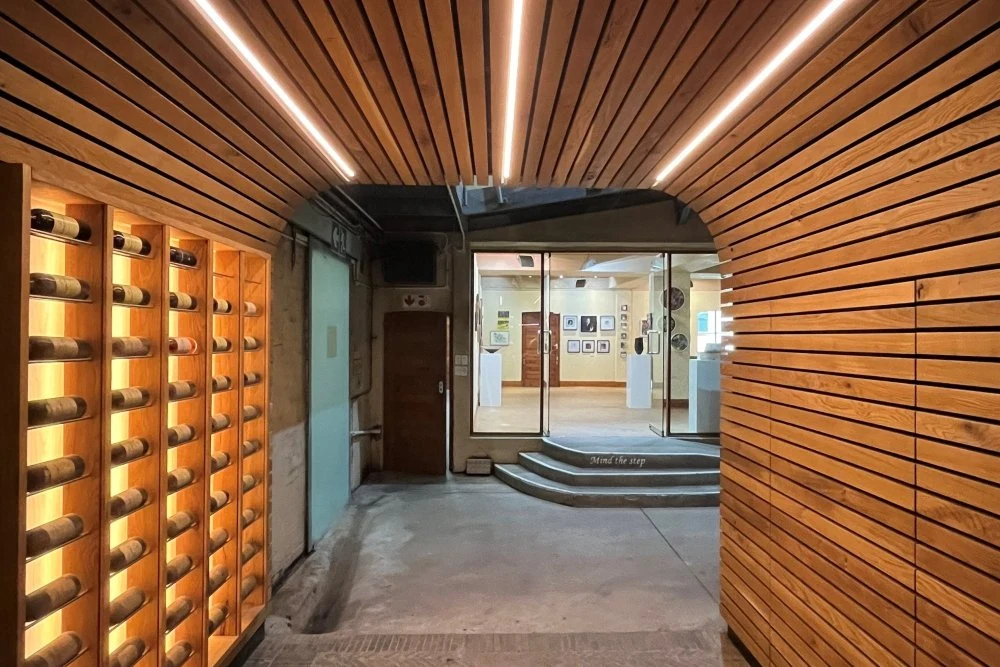
The feel is closer to a working station than a polished visitor room. The vineyards are the starting point, the cellar the place where decisions stay small enough to matter: a vessel chosen for neutrality, a ferment left to native yeast, a block kept apart because its soil has something different to say. There is quiet in that kind of production, the quiet of hoses, concrete, skins, lees, and the waiting that belongs to wine rather than display.
Craven Wines carries Stellenbosch without trying to summarize it. Syrah, Chenin Blanc, Chardonnay, Cinsaut, Grenache, and Pinot Gris each take their turn through the same argument: that a bottle can hold variety, vintage, and site at once. The place reads in Firs Vineyard Syrah and Karibib Vineyard Chenin Blanc.
Questions
Frequently asked
Who makes the wines at Craven Wines?
Mick Craven makes the wines at Craven Wines in Stellenbosch.
What kind of wines does Craven Wines make?
The winery makes single-vineyard, single-varietal wines from Stellenbosch, with an emphasis on sites in the Polkadraai Hills.
How does the cellar work there?
Concrete carries much of the cellar work, and the wines are made with native yeasts, no industrial yeast, and no additions beyond sulfur dioxide.
What is Craven Wines known for?
Craven Wines is known for site-led wines that aim to keep fruit and place in view, rather than masking them with oak or heavy cellar work.
Can visitors book a tasting or visit?
Visits are by appointment only.
The field
How it compares
| Place | Notes | Awards |
|---|---|---|
| Craven Wines | Coastal Region - Stellenbosch, $$$ | · |
| Delaire Graff Estate | Stellenbosch | World's 50 Best |
| Kanonkop Wine Estate | Stellenbosch | · |
| Neethlingshof Estate | Stellenbosch | · |
| Rust en Vrede Wine Estate | Stellenbosch | · |
| Spier Wine Farm | Stellenbosch | · |
| Tokara Winery | Stellenbosch | World's 50 Best |