Fileja
- 01CuisinePasta Omakase
- 02CityTokyo, Japan
From the people index
Recommended by
One trusted voice points here.
Southern Italian Cooking in a City That Rewards Regional Specificity
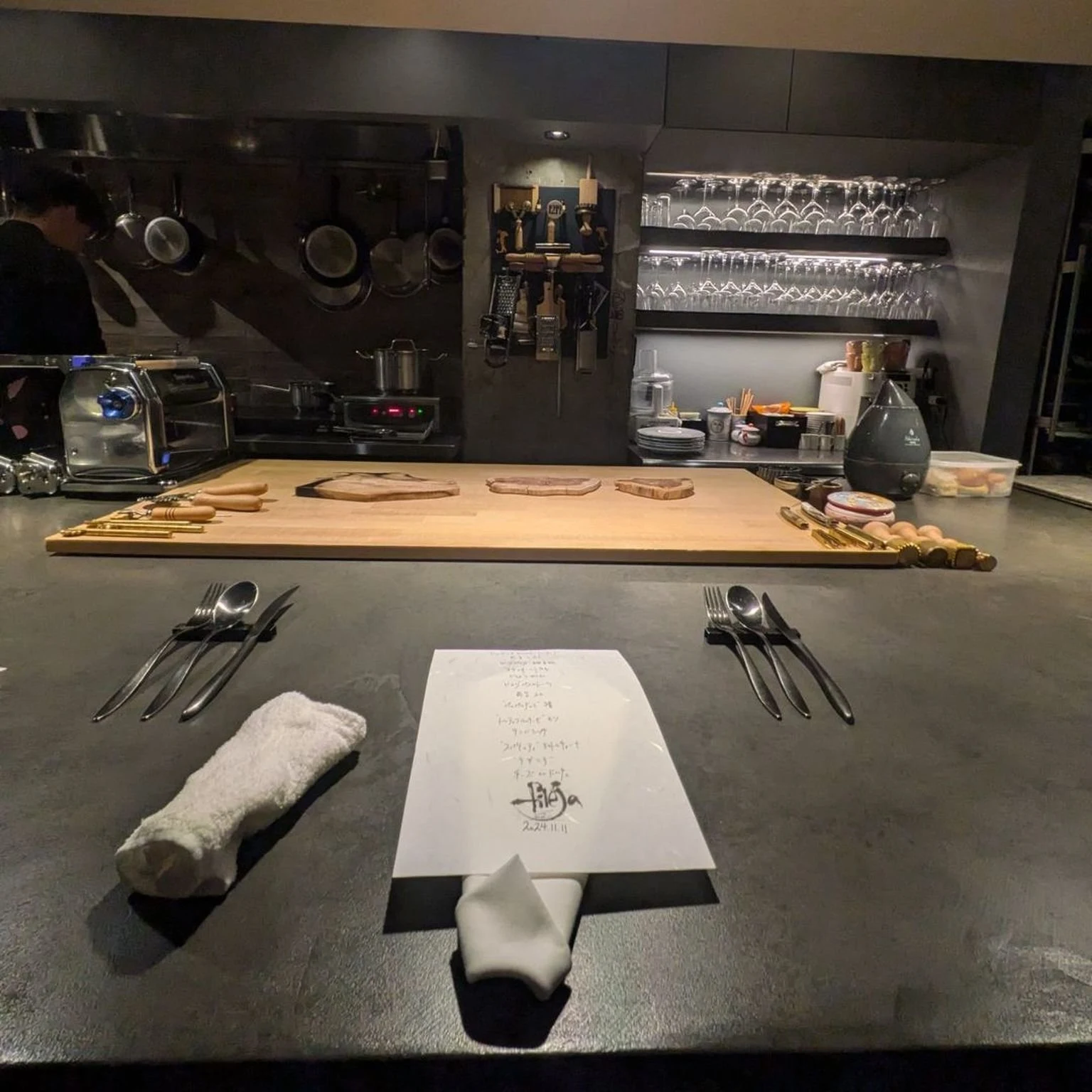
Tokyo's Italian restaurant scene operates on a spectrum that most visitors don't map until they've spent real time in it. At one end sit the heavily French-influenced tasting-menu formats, where Italian cooking is filtered through kaiseki-like precision and luxury ingredient logic. At the other end, and this is where Kanda Sudacho begins to make sense, sit smaller rooms committed to regional Italian traditions on their own terms, without the theatrical overlay. Fileja, located in the Norune Akihabara Building just off the Kanda corridor, places itself in that second register. The name references fileja, a hand-rolled pasta native to Calabria, and that specificity about a southern Italian staple sets a clear editorial line about what this kitchen is interested in.
The Kanda-Akihabara axis is not where most food-focused visitors to Tokyo instinctively look. The area is better known for electronics retail and manga culture than for serious cooking. That makes kitchens operating here a different proposition from equivalents in Ginza or Nishi-Azabu, where the address itself confers status and justifies price. In Kanda, a restaurant earns attention through the food alone, without borrowed prestige from postcode. That dynamic has historically suited smaller, ingredient-led European rooms in Tokyo, the neighbourhood provides lower overhead and a different customer than the luxury district tier, which in turn allows a kitchen to focus resources on sourcing rather than on room design or sommelier theatre.
The Sunday email
Read about the people behind restaurants like Fileja in the Sunday email.
Every Sunday we send a lead story and up to four more about the chefs, winemakers, sommeliers and hoteliers behind the restaurants, bars, wineries and hotels we cover.
Recent stories
Free. One email a week, and you can unsubscribe from any issue.
The Calabrian Reference and What It Signals
Naming a Tokyo restaurant after a Calabrian pasta form is a precise act. Fileja, the pasta, is made by rolling dough around a thin rod, producing a slightly irregular, ridged tube that holds sauces with more grip than smooth extruded pasta. It belongs to the cucina povera tradition of Italy's deep south, a tradition built around preserved proteins, legumes, dried chillies, and long-cooked vegetable preparations rather than the cream and butter logic of the north. In Tokyo, where ingredient sourcing for Italian cooking requires navigating both import constraints and a Japanese market that has spent decades developing its own high-quality vegetable and protein producers, the Calabrian framing creates an interesting problem and an interesting opportunity simultaneously.
The sourcing challenge for southern Italian cooking in Japan is worth understanding. Key flavour pillars, 'Nduja, the spreadable cured pork from Vibo Valentia; dried Calabrian chillies; specific preserved fish preparations, are either imported or require domestic analogues. Japanese kitchens working in this southern Italian tradition have, in some cases, found the domestic analogue approach more interesting than strict importation. Japan produces outstanding preserved and aged products: katsuobushi, aged misos, and regional salt-cured fish that parallel the umami density of southern Italian pantry staples in function if not in flavour.
For comparison, the broader Tokyo Italian dining scene shows how varied these sourcing philosophies become at higher price points. Rooms operating at the ¥¥¥¥ level, a tier represented nearby by French-adjacent destinations like L'Effervescence and Sézanne, tend to treat ingredient sourcing as a centrepiece narrative. Kitchens at more accessible price points make different trade-offs. The Calabrian identity of Fileja suggests the sourcing decisions here are deliberate rather than accidental, but the detail sits beyond what current data can confirm.
Regional Italian Cooking as a Minority Tradition in Tokyo
Understanding Fileja's position requires understanding what regional Italian cooking means within Tokyo's broader dining structure. The city's Italian restaurants cluster heavily around Roman and northern Italian templates, cacio e pepe, carbonara, risotto, and the Milanese cotoletta all have strong Tokyo representation. Southern Italian cooking, Campanian, Sicilian, and especially Calabrian, occupies a smaller space, with fewer restaurants committed to the specific flavour logic of the deep south. That narrower field means fewer direct comparators, but also means that a kitchen working this territory has less cover when the sourcing or execution falters.
The contrast with Tokyo's Japanese tasting-menu tier is instructive. Rooms like RyuGin or Harutaka operate within well-documented traditions where both chefs and diners share a deep reference framework. A Calabrian-focused Italian kitchen in Tokyo asks its customers to trust a less familiar tradition, and asks its kitchen to maintain fidelity to a regional cuisine that most diners in the room will encounter primarily through this restaurant rather than through travel to the source region. That asymmetry of knowledge puts the sourcing and accuracy of the cooking under particular pressure.
Innovative rooms like Crony in Tokyo resolve this by making the innovation itself the point, departing openly from any single tradition. A room with a name as regionally specific as Fileja makes a different implicit claim: that the tradition is the point, and the execution should honour it.
Questions
Frequently asked
How expensive is Fileja?
Fileja is listed at a price level of $$$$.
Where is Fileja and what does it serve?
Fileja is in Chiyoda, Tokyo, serving Pasta Omakase.
The field
How it compares
| Place | Cuisine | Notes | Awards |
|---|---|---|---|
| Fileja | Pasta Omakase | Chiyoda, $$$$ | · |
| Den | Modern Japanese Kaiseki | Tokyo | Michelin 2 Stars, 50 Best |
| Florilège | Modern French-Japanese Plant-Based Fine Dining | Tokyo | Michelin 2 Stars, 50 Best |
| Narisawa | Modern Japanese Satoyama Fine Dining | Tokyo | Michelin 2 Stars, 50 Best |
| Quintessence | Modern French Fine Dining | Tokyo | Michelin 3 Stars |
| Sazenka | Modern Chinese Fine Dining | Tokyo | Michelin 3 Stars, 50 Best |
| Sézanne | Modern French Fine Dining | Tokyo | Michelin 3 Stars, 50 Best |
Similar places
Modern Japanese Kaiseki
Den
Tokyo, Japan
★★ · 50 Best
Modern French-Japanese Plant-Based Fine Dining
Florilège
Tokyo, Japan
★★ · 50 Best
Modern Japanese Satoyama Fine Dining
Narisawa
Tokyo, Japan
★★ · 50 Best
Modern French Fine Dining
Quintessence
Tokyo, Japan
★★★
Modern Chinese Fine Dining
Sazenka
Tokyo, Japan
★★★ · 50 Best
Modern French Fine Dining
Sézanne
Tokyo, Japan
★★★ · 50 Best
The Sunday email
Read about the people behind restaurants like Fileja in the Sunday email.
Every Sunday we send a lead story and up to four more about the chefs, winemakers, sommeliers and hoteliers behind the restaurants, bars, wineries and hotels we cover.
Recent stories
Free. One email a week, and you can unsubscribe from any issue.