- Michelin Bib Gourmand · Michelin Guide
- Michelin Bib Gourmand · 2025
- Michelin Bib Gourmand · 2024
A Sichuan Counter in an Unlikely ZIP Code
Long Island City has spent the better part of a decade accumulating art galleries, converted warehouse offices, and a hotel corridor that feeds LaGuardia overflow. What it has not accumulated, at least not yet, is a serious Asian dining scene. That makes the arrival of a Michelin Bib Gourmand-recognized Sichuan restaurant at 10-07 50th Ave a minor but meaningful event in the borough's dining development. The neighborhood is not where you would go looking for fiery, umami-driven Chinese cooking. That is precisely what makes it worth noting.
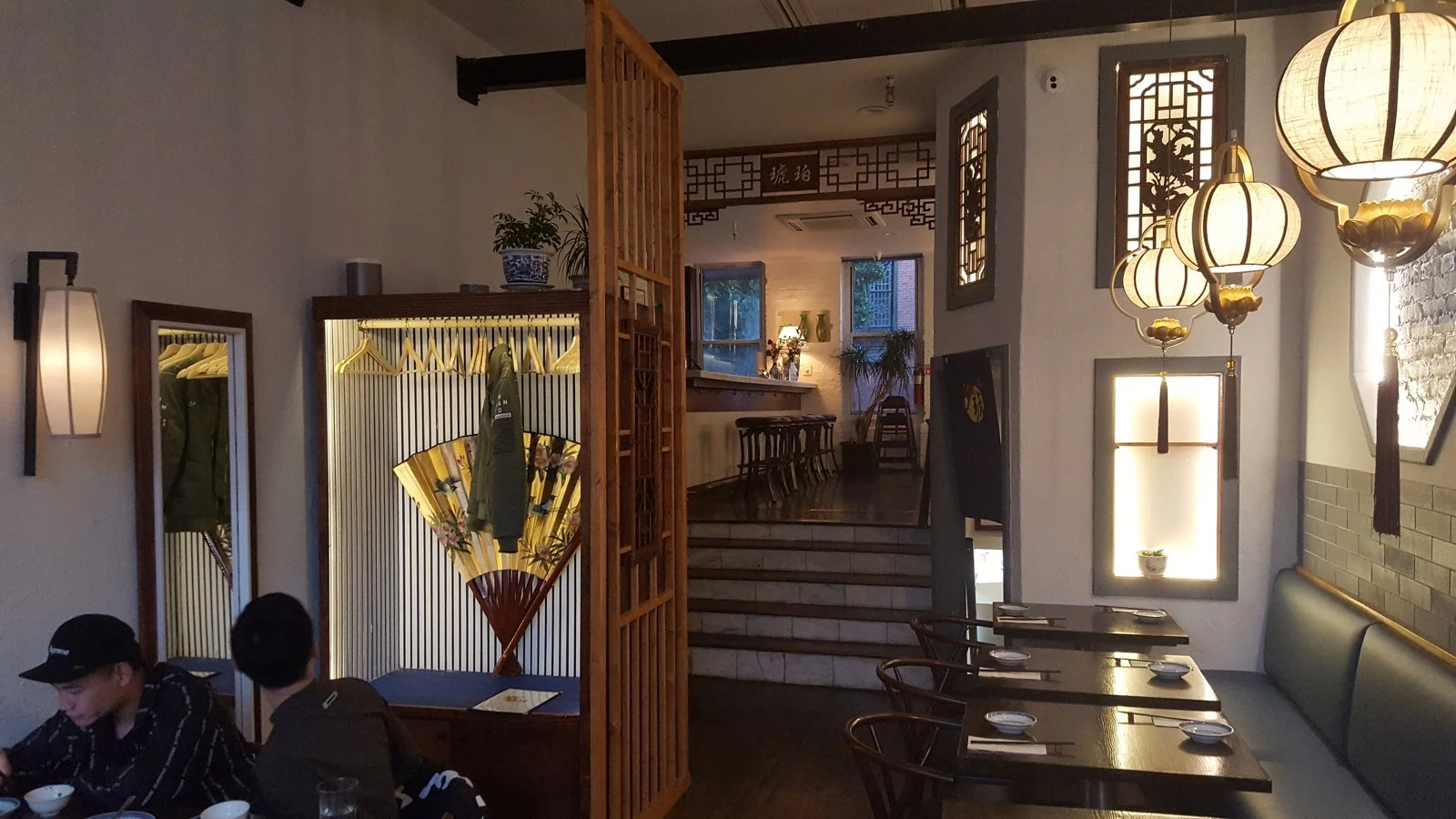
Sichuan cuisine in New York tends to cluster in Flushing and Sunset Park, where high-volume competition and established Chinese communities create a familiar reference point for both cooks and diners. The far west edge of Queens operates differently. Hupo sits in a thinner competitive set, which means it does not need to shout to be heard. The room reflects that measured positioning: narrow and long, dark hardwood floors, ceilings that give the space more air than the footprint suggests. It reads like a restaurant that knows what it is and has no interest in performing otherwise.
The Sunday letter
Find new places through the people who run them.
Our Sunday email brings you the chefs, winemakers and hoteliers behind our newest stories. See a sample before you subscribe.
See a sample of the Sunday emailOne email a week. Unsubscribe from any issue.
The Menu: Restraint as a Regional Argument
Sichuan food's reputation in the West runs toward the theatrical, numbing mala heat, dishes designed to register on arrival. The cooking at Hupo makes a quieter argument. The menu is small and focused, anchored in regional references: mapo tofu, house-made cold noodles dressed in sweet and spicy chili oil, Chungking spicy chicken, stewed fish fillet in hot chili soup. These are not reinventions. They are executions of a familiar Sichuan canon, and the emphasis falls on layered complexity rather than raw heat output.
That distinction matters for how you plan your visit. Diners expecting to test their spice tolerance will find the kitchen's calibration more considered than punishing. The stewed fish fillet, for instance, arrives with minced garlic woven through the broth, building umami depth alongside the chili rather than simply amplifying it. The cold noodles in chili oil read sweet before they read hot. This is a kitchen interested in the full register of Sichuan flavor, not just the fraction that makes headlines.
For context, places like Chongqing Lao Zao and Alley 41 represent the broader Chinese dining field in New York, while Cantonese institutions like Big Wong and Asian Jewel Seafood Restaurant anchor a different regional tradition entirely. Hupo's Sichuan focus is narrower and more deliberate than either. At the other end of the New York Chinese dining spectrum, Blue Willow occupies a different price point and format altogether. Hupo's Bib Gourmand designation places it in a specific tier: serious cooking at a price that does not require advance financial planning.
Lunch Versus Dinner: How the Room Shifts
The editorial angle that applies most directly to Hupo is the lunch-versus-dinner divide, and it is worth reading carefully because this is where the venue's value proposition becomes clearest. At the $$ price tier, Hupo already sits well below the midtown Michelin corridor. Per Se, Eleven Madison Park, Le Bernardin, and their peers operate in a $$$$ category that is structurally inaccessible to most casual visitors. Even within Chinese dining in New York, the Bib Gourmand designation signals something specific: the Michelin inspectors found value they considered notable, not just quality they considered acceptable.
During lunch service, that value proposition sharpens. Sichuan cold dishes and noodle preparations lend themselves to daytime eating in a way that heavier, table-filling formats do not. The cold noodles in chili oil work as a single-dish lunch in a way that many of the same kitchen's dinner offerings would not. The room's narrow format, with its dark wood and high ceilings, reads differently at noon than at eight in the evening. Daytime visits tend to be quieter, the kitchen audible through its sizzling woks, the pace more deliberate. Dinner service occupies the same physical space but takes on a different texture as the room fills and the ambient energy of Long Island City's evening crowd arrives.
For visitors planning around value, lunch represents the clearer opportunity. For those willing to linger, dinner allows the menu to read as a full meal rather than a single-dish stop.
Long Island City as a Dining Destination
The neighborhood context is not incidental. Long Island City's dining identity is still forming, which creates both opportunity and friction. The opportunity is that a restaurant like Hupo can define a category here without competing against an established cluster. The friction is that visitors need a reason to cross the bridge, or emerge from the 7 train, when Flushing's more established Sichuan and Cantonese options are a few stops further east.
The Michelin recognition provides that reason in concrete terms. The Bib Gourmand places Hupo in a value-conscious tier, which means the restaurant has been recognized for delivering quality at a moderate price. The 2024 designation suggests the answer is yes.
For visitors building a broader New York itinerary, the city's Chinese dining scene connects to a wider map. Internationally, Restaurant Tim Raue in Berlin represents what Chinese-influenced cooking looks like at a European fine-dining register, while Mister Jiu's in San Francisco applies a California-Chinese lens to a comparable set of questions about regional authenticity and technique. Hupo's approach is more orthodox than either: it reads as a serious regional Chinese restaurant rather than a cross-cultural interpretation. Other reference points for American fine dining at different price tiers can be found at Emeril's in New Orleans, Lazy Bear in San Francisco, Alinea in Chicago, Single Thread Farm in Healdsburg, The French Laundry in Napa, and Providence in Los Angeles, each of which operates at a different position on the American dining spectrum.
Planning Your Visit
Hupo is located at 10-07 50th Ave, Long Island City, NY 11101. Budget: Priced at the $$ tier, this is accessible Michelin-recognized dining without the commitment of a tasting menu format. Awards: Michelin Bib Gourmand 2024. Ratings: 4.4 across 547 Google reviews. Timing: Lunch visits offer a quieter room and a format that suits the cold and noodle-forward portions of the menu; dinner brings more atmosphere but the same focused kitchen.
What should I order at Hupo?
The menu is small enough that ordering across it is practical rather than ambitious. The house-made cold noodles in sweet and spicy chili oil are the clearest entry point: they demonstrate the kitchen's approach to Sichuan flavor balance, where sweetness and spice work together rather than one overwhelming the other. The mapo tofu and Chungking spicy chicken represent the more familiar Sichuan canon, executed with restraint rather than maximalist heat. For those who want to understand what the Michelin inspectors recognized, the stewed fish fillet in hot chili soup makes the strongest case: garlic-dense broth, umami depth built through layering rather than volume, and a heat level that registers without eclipsing everything else. The 2024 Bib Gourmand designation applies to the full menu rather than a single dish, which suggests consistent execution across the range.
Questions
Frequently asked
What recognition does Hupo hold?
Hupo holds a Michelin Bib Gourmand.
Who works at Hupo?
Made By profiles Sergio Ortega (Chef) at Hupo.
How expensive is Hupo?
Hupo is listed at a price level of $$.
Where is Hupo and what does it serve?
Hupo is in Long Island City-Hunters Point, New York City, serving Modern Sichuan Chinese.
The field
How it compares
| Place | Cuisine | Notes | Awards |
|---|---|---|---|
| Hupo | Modern Sichuan Chinese | Long Island City-Hunters Point, $$ | · |
| Atomix | Modern Korean Tasting Menu | New York City | Michelin 2 Stars, World's 50 Best |
| Daniel | Modern French Fine Dining | New York City | Michelin 1 Star, World's 50 Best |
| Eleven Madison Park | Contemporary Plant-Based Fine Dining | New York City | Michelin 3 Stars, World's 50 Best |
| Jungsik New York | Modern Korean Fine Dining | New York City | Michelin 3 Stars, World's 50 Best |
| Kabawa | Modern Caribbean Prix Fixe | New York City | World's 50 Best |
| Le Bernardin | French Seafood Fine Dining | New York City | Michelin 3 Stars, World's 50 Best |
In residence
Similar places
Modern Korean Tasting Menu
Atomix
New York City, United States
★★ · 50 Best
Modern French Fine Dining
Daniel
New York City, United States
★ · 50 Best
Contemporary Plant-Based Fine Dining
Eleven Madison Park
New York City, United States
★★★ · 50 Best
Modern Korean Fine Dining
Jungsik New York
New York City, United States
★★★ · 50 Best
Modern Caribbean Prix Fixe
Kabawa
New York City, United States
50 Best
French Seafood Fine Dining
Le Bernardin
New York City, United States
★★★ · 50 Best
The Sunday letter
Get the next Made By story in your inbox.
We send one email every Sunday morning with the places and people we covered that week.
See a sample of the Sunday emailOne email a week. Unsubscribe from any issue.