- Opinionated About Dining Cheap Eats in North America Recommended · 2026
- Opinionated About Dining Cheap Eats in North America Ranked #329 · 2025
- Opinionated About Dining Cheap Eats in North America Ranked #207 · 2024
- Opinionated About Dining Cheap Eats in North America in Recommended · 2023
Mott Street and the Weight of Routine
Big Wong is a Cantonese BBQ restaurant in New York City, at 67 Mott St in Manhattan's Chinatown. The neighbourhoods that define Chinese-American food culture in New York, from Mott Street's southern corridor to the northern stretch approaching Canal, are places where the same tables fill at the same hours because the cooking holds. Big Wong, at 67 Mott St, occupies exactly that kind of position. It opens at 8 am every day of the week and stays through the evening. That consistency is the point.
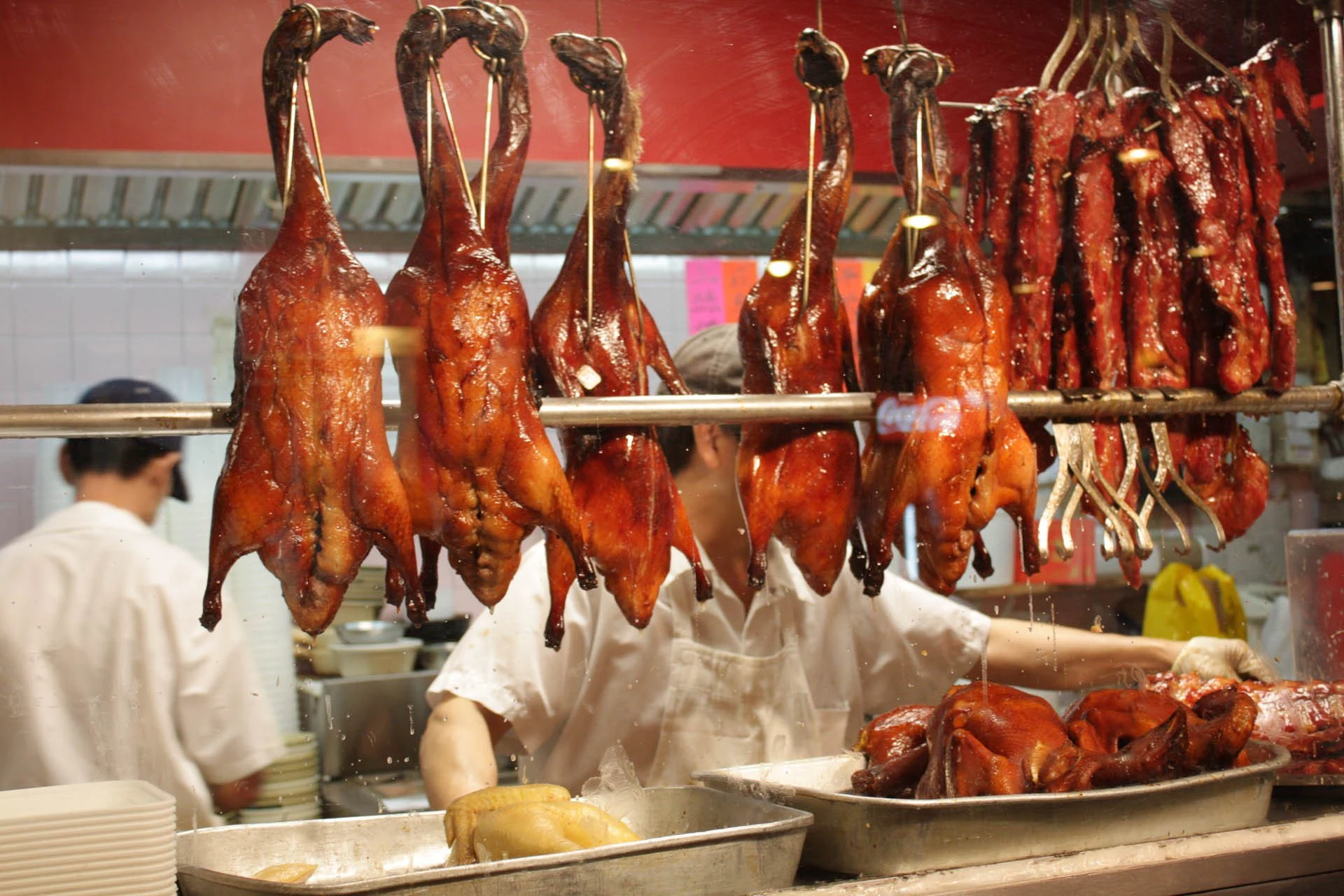
Walking along Mott Street, the pattern is familiar to anyone who knows old Chinatown: roasted ducks and slabs of char siu hanging in windows, steam rising from congee stations, the clatter of ceramic spoons on bowls. Big Wong participates in this visual grammar without fanfare. The dining room reads as utilitarian in the way that most high-throughput Cantonese roast-meat houses do: the focus is on the food leaving the kitchen, not the surfaces it passes through.
The Noodle Tradition It Sits Within
Cantonese noodle culture is among the most technically exacting in Chinese cuisine, and it is largely invisible to the broader dining conversation because it rarely operates at price points that generate reviews. The tradition is built on wonton noodle soup, beef brisket noodles, and roast-meat rice plates, dishes that depend on broth depth, noodle texture, and the precision of the roasting process rather than on elaboration. In Hong Kong, the benchmark wonton noodle soup is judged on the springiness of the egg noodle, the filling-to-wrapper ratio of the wonton, and the clarity of a shrimp-and-pork broth reduced over hours. Chinatown's leading practitioners hold to similar standards, adjusting for ingredient sourcing and kitchen scale.
The broader Chinese noodle tradition in New York has expanded considerably in recent decades. Hand-pulled lamian from Xi'an Famous Foods, the knife-shaved biang biang noodles at Sichuan specialists like Chongqing Lao Zao, and the cold sesame preparations at newer Sichuan rooms like Chuan Tian Xia all represent distinct regional noodle traditions that have arrived in the city over that period. Big Wong operates in a different, older lane: the Cantonese model, where noodles are egg-alkaline, thin, and served in broth or with roast meat on the side, rather than hand-pulled or regionally inflected in the northern or Sichuan sense. The two traditions sit in the same city but address different expectations entirely.
Where the OAD Recognition Places It
Opinionated About Dining's Cheap Eats in North America list has recognized Big Wong in recent years. Big Wong was Recommended in 2023, then ranked #207 in 2024 and #329 in 2025. The significance of the recognition is the consistency of its appearance across three consecutive years: the list is volatile enough that single-year entries are common, and sustained presence across years signals something more durable about the cooking.
At Big Wong's price tier, the competitive set is not the Michelin-starred rooms that define New York's premium dining reputation. Properties like Alinea in Chicago, The French Laundry in Napa, or Lazy Bear in San Francisco occupy a different tier entirely. Big Wong's comparable set is the handful of Mott Street and Canal Street Cantonese operations that have maintained recognisable standards through decades of rising rents and shifting neighbourhood demographics. That is a different kind of achievement and, for a daily-eating context, arguably a more useful one.
For context on how refined Chinese cooking reads elsewhere, Mister Jiu's in San Francisco represents the fine-dining interpretation of Chinese-American tradition, while Restaurant Tim Raue in Berlin shows how Chinese flavour frameworks translate into a European fine-dining format. Big Wong operates at the opposite end of that spectrum, and deliberately so. The value of what it does is not diminished by the price point; the craft is simply applied to a different register.
Chinatown's Cantonese Dining Tier
The Cantonese roast-meat house is a specific format that Chinatown has maintained even as the neighbourhood's demographics have shifted toward Fujianese and other regional Chinese communities. The format requires a roasting operation, consistent meat sourcing, and a kitchen capable of holding broth at service quality across a long operating day. Several Mott Street addresses have run versions of this model for more than thirty years. Big Wong is among them, under the direction of Judy Chan, whose presence across the operation's long run provides the continuity that these kitchens depend on.
Other Chinatown addresses worth mapping alongside Big Wong include Alley 41, Asian Jewel Seafood Restaurant, and Blue Willow. The Cantonese roast-meat model at Big Wong is the most specific of these, with a narrower format and a longer operational history than most.
Know Before You Go
- Address: 67 Mott St, New York, NY 10013
- Hours: Monday to Thursday 8 am – 9 pm; Friday to Sunday 8 am – 9:30 pm
- Chef: Judy Chan
- Recognition: Opinionated About Dining Cheap Eats in North America, Recommended (2023), #207 (2024), #329 (2025)
- Google Rating: 3.9 from 2,359 reviews
- Booking: Walk-in format; no reservation system noted
- Getting There: Mott Street is in Manhattan's Chinatown.
What Do People Recommend at Big Wong?
Big Wong's reputation within Chinatown's Cantonese dining tier rests on its roast meats and noodle soups. The char siu (barbecue pork) and roast duck are the items that appear most consistently in diner accounts, typically served over rice or alongside a broth-based noodle. Congee is the other anchor, particularly relevant at breakfast and lunch given the 8 am opening. The OAD recognition across three consecutive years points to sustained kitchen consistency rather than a single standout dish. Judy Chan's oversight of the kitchen provides the continuity that makes returning visits reliable. At a price point where margin for inconsistency is low, that track record is the most useful signal for what to expect.
Questions
Frequently asked
Who works at Big Wong?
Made By profiles Judy Chan (Chef) at Big Wong.
How expensive is Big Wong?
Big Wong is listed at a price level of $.
Where is Big Wong and what does it serve?
Big Wong is in Chinatown-Two Bridges, New York City, serving Cantonese BBQ.
The field
How it compares
| Place | Cuisine | Notes | Awards |
|---|---|---|---|
| Big Wong | Cantonese BBQ | Chinatown-Two Bridges, $ | · |
| Atomix | Modern Korean Tasting Menu | New York City | Michelin 2 Stars, World's 50 Best |
| Daniel | Modern French Fine Dining | New York City | Michelin 1 Star, World's 50 Best |
| Eleven Madison Park | Contemporary Plant-Based Fine Dining | New York City | Michelin 3 Stars, World's 50 Best |
| Jungsik New York | Modern Korean Fine Dining | New York City | Michelin 3 Stars, World's 50 Best |
| Kabawa | Modern Caribbean Prix Fixe | New York City | World's 50 Best |
| Le Bernardin | French Seafood Fine Dining | New York City | Michelin 3 Stars, World's 50 Best |
In residence
Similar places
Modern Korean Tasting Menu
Atomix
New York City, United States
★★ · 50 Best
Modern French Fine Dining
Daniel
New York City, United States
★ · 50 Best
Contemporary Plant-Based Fine Dining
Eleven Madison Park
New York City, United States
★★★ · 50 Best
Modern Korean Fine Dining
Jungsik New York
New York City, United States
★★★ · 50 Best
Modern Caribbean Prix Fixe
Kabawa
New York City, United States
50 Best
French Seafood Fine Dining
Le Bernardin
New York City, United States
★★★ · 50 Best