Chef in Residence
Kwame Onwuachi
Chef

Kwame Onwuachi, founder / chef of Maroon in Las Vegas, turns a Strip steakhouse toward jerk smoke, rum, collards and oxtail.
The jerk pit sets the first argument. Kwame Onwuachi, founder / chef of Maroon at SAHARA Las Vegas on the Las Vegas Strip, builds the restaurant around flame, heat, acidity, and the memory carried by Jamaican cooking. His route to this station did not begin in a formal dining room. It runs through his mother’s Bronx apartment, through Nigerian, Jamaican, Trinidadian, and Louisiana references, through service work, catering, and line discipline, with the Culinary Institute of America in 2013 adding professional structure to a cooking language already formed by family table and diaspora.
At Maroon, Onwuachi takes the Strip steakhouse format and changes its center of gravity. Steakhouse abundance remains, but the grammar is Afro-Caribbean: jerk, pimento, chili, thyme, rum, coconut, collards, oxtail, crawfish. The restaurant’s name reaches back to the Maroons of Jamaica, people who escaped British colonial rule in the 17th century and built subsistence lives in the Blue Mountains. That history matters because jerk cooking came from survival, resistance, land, and fire, not from menu development. Onwuachi treats that origin as working material. He does not use Caribbean flavor as a finish on a familiar steakhouse plate. He lets it decide the plate.
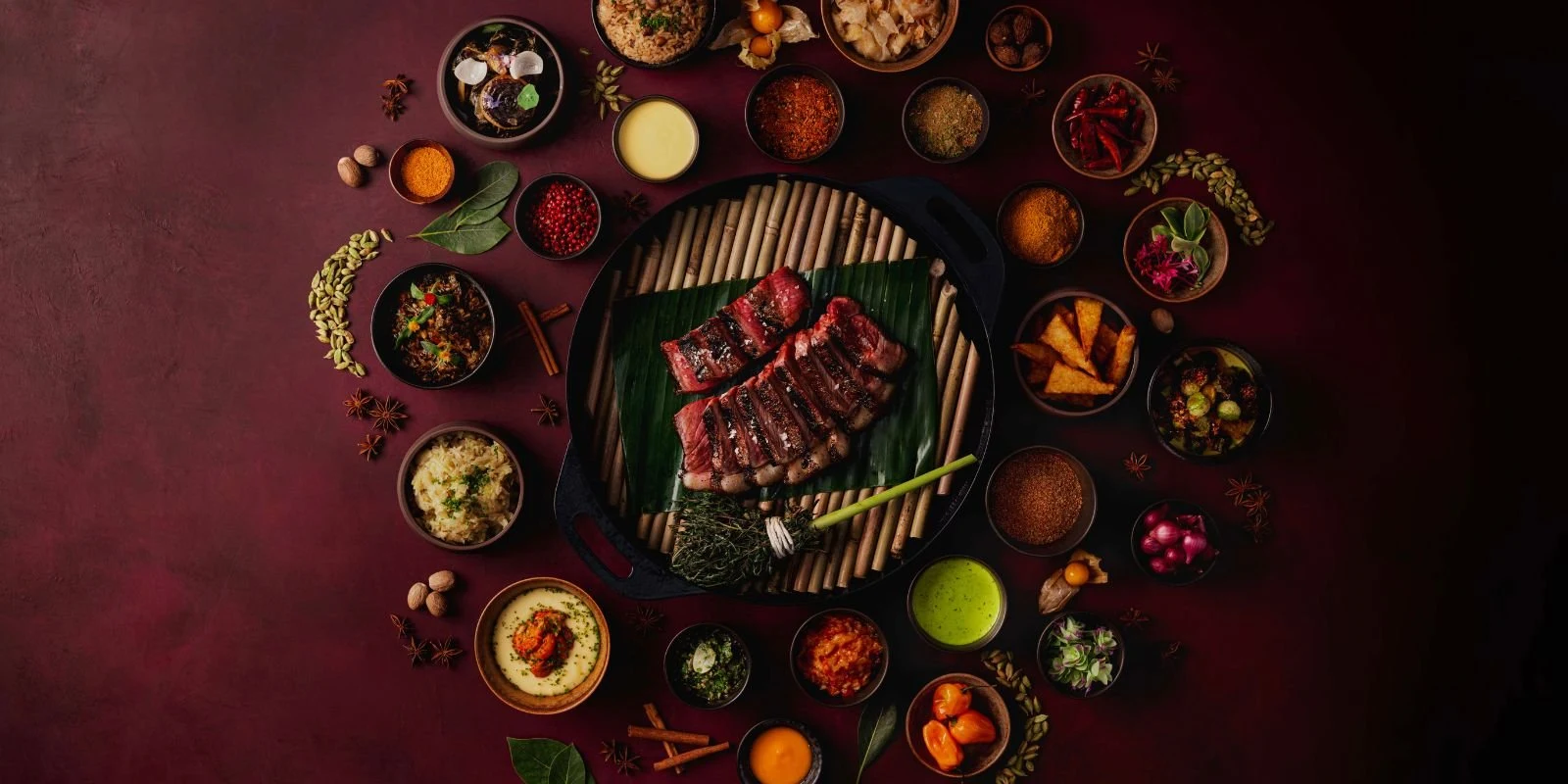
The custom-built jerk pit is the method in the room, not a decorative flourish. Jerk chicken, rack of lamb, pork tomahawk, and barbecue Brussels move through flame and smoke, with spice and acidity held as structure rather than ornament. The cooking is not arranged around mildness. Heat has a job, and so does sourness; both keep the richness of a steakhouse from settling too heavily on the pass.
The signatures make that position plain. Jerk chicken carries the central thesis. Sea bass takes the same insistence on seasoning into a lighter register. Crawfish mashed potatoes and creamed coconut collards push the sides into the main conversation, using shellfish, greens, and coconut with the confidence usually reserved for cuts of beef. Maroon patties bring the counter-language of Caribbean baking into the dining room. Oxtail fried rice, toro bujol, oxtail Wellington, and rum-aged beef widen the field without leaving the house’s point of view. The beverage program follows the same line, with cocktails and wine selected around the depth of the food; the Hurricane Negroni brings passion fruit-infused Campari and house-blended Italian vermouth into that conversation.
The room works at a lively pitch, warm rather than theatrical, with enough polish for the Strip and enough ease for conversation to hold. Maroon occupies the former Bazaar Meat space at SAHARA Las Vegas, a large inheritance for any new restaurant, and Onwuachi answers it by replacing the old steakhouse codes with a more personal set of signals. The pass does not have to hide the story. The pit, the patties, the collards, the rum, and the jerk smoke make the room read in the language of the kitchen.
That matters in Las Vegas because the Strip has long understood spectacle, but less often gave Afro-Caribbean cooking this kind of address. Maroon opened on April 24, 2026, as Onwuachi’s first restaurant outside the East Coast and the first restaurant on the Las Vegas Strip led by a Black chef. The lasting measure will be the nightly discipline of the pit, especially when the jerk chicken crosses from flame to plate at Maroon.

Three Michelin-Star French Fine Dining
Joel Robuchon at The Mansion
Las Vegas, United States

Contemporary French Fine Dining
Guy Savoy
Las Vegas, United States

Modern French Fine Dining
L'Atelier de Joël Robuchon (USA)
Las Vegas, United States

French
Le Cirque Las Vegas
Las Vegas, United States
Modern Meat-Centric Fine Dining
Bazaar Meat by Jose Andres
Las Vegas, United States

Cantonese, Shanghai & Szechuan Fine Dining
Wing Lei at Wynn Las Vegas
Las Vegas, United States