Meishan
- 01CuisineRefined Sichuan
- 02CityTokyo, Japan
- Michelin Bib Gourmand · Michelin Guide
- Michelin Bib Gourmand · 2026
- Michelin Bib Gourmand · 2024
Sichuan Cooking in an Unlikely Tokyo Postcode
Tokyo's Chinese restaurant scene has long been weighted toward central districts: Shinjuku's Kabukicho strip, the dense Chinese-food cluster around Ikebukuro's north exit, and scattered Yokohama-adjacent outposts further south. The Arakawa ward rarely appears in that conversation. Nishinippori, better known as a transit junction and the lower end of the textile district, does not register as a destination dining neighbourhood by any conventional measure. That makes the Michelin Bib Gourmand on Meishan's record more instructive than it might first appear, the guide's recognition here says something about how Sichuan home-cooking operates in Tokyo's mid-range tier rather than simply confirming a neighbourhood's culinary credentials.
The Bib Gourmand designation is specifically calibrated to identify cooking that delivers quality above what the price point would lead you to expect. At ¥¥, Meishan sits two full price brackets below the kaiseki and sushi counters that dominate Tokyo's award conversation, places like Ippei Hanten or the formal Chinese rooms at Chugoku Hanten Fureika and Chugoku Hanten Kohakukyu (Amber Palace), which occupy the formal, multi-course end of the city's Chinese dining spectrum. Meishan operates from an entirely different premise.
The Wok as the Argument
Sichuan cooking, more than most Chinese regional traditions, is inseparable from the equipment and the person using it. Wok hei, the scorched, slightly smoky quality that results from cooking over very high heat in a seasoned carbon-steel wok, cannot be replicated at lower temperatures or stored for later. It is a live quality, present in the dish for roughly the time it takes to walk from the kitchen to the table. In a basement restaurant where the kitchen is close and the room is small, that transfer time collapses almost entirely.
The stir-fried vegetables at Meishan carry this logic through. Served alongside pickled vegetables and fermented tofu, they demonstrate something important about how Sichuan cooks approach plant-based dishes: fermentation and pickling are not garnishes or afterthoughts, they are structural flavour elements that create contrast against the high-heat wok work. The sourness of pickled vegetables against fresh stir-fried greens, mediated by the salt-funk of fermented tofu, is a composition, not a side dish. The same attention to layered spicing appears in the mapo tofu, where doubanjiang and Sichuan peppercorn bring heat and the characteristic mala numbing sensation without overwhelming the silken tofu beneath.
Steamed chicken presents a different technique register entirely. Where stir-frying is about speed and direct heat, steaming demands patience and timing, the two approaches together map a broader competence in Chinese cooking methodology rather than a narrow specialisation. The spicing in both dishes is used, as the Michelin notes themselves put it, to bring out the flavours of the ingredients rather than to mask them. That distinction matters in Sichuan cooking, where the chilli and pepper compounds are sometimes treated as spectacle. Here they function as seasoning.
Two Sisters, One Kitchen, One Floor
The operational structure at Meishan is spare and deliberate. The elder sister manages the wok and flame; the younger works the floor. This division of labour, common in small family-run Chinese restaurants across Asia and increasingly rare in Tokyo's professionalised restaurant scene, creates a particular coherence between what comes out of the kitchen and how it arrives at the table. There is no translation layer between cook and guest. The person explaining the food is the person connected to the person cooking it.
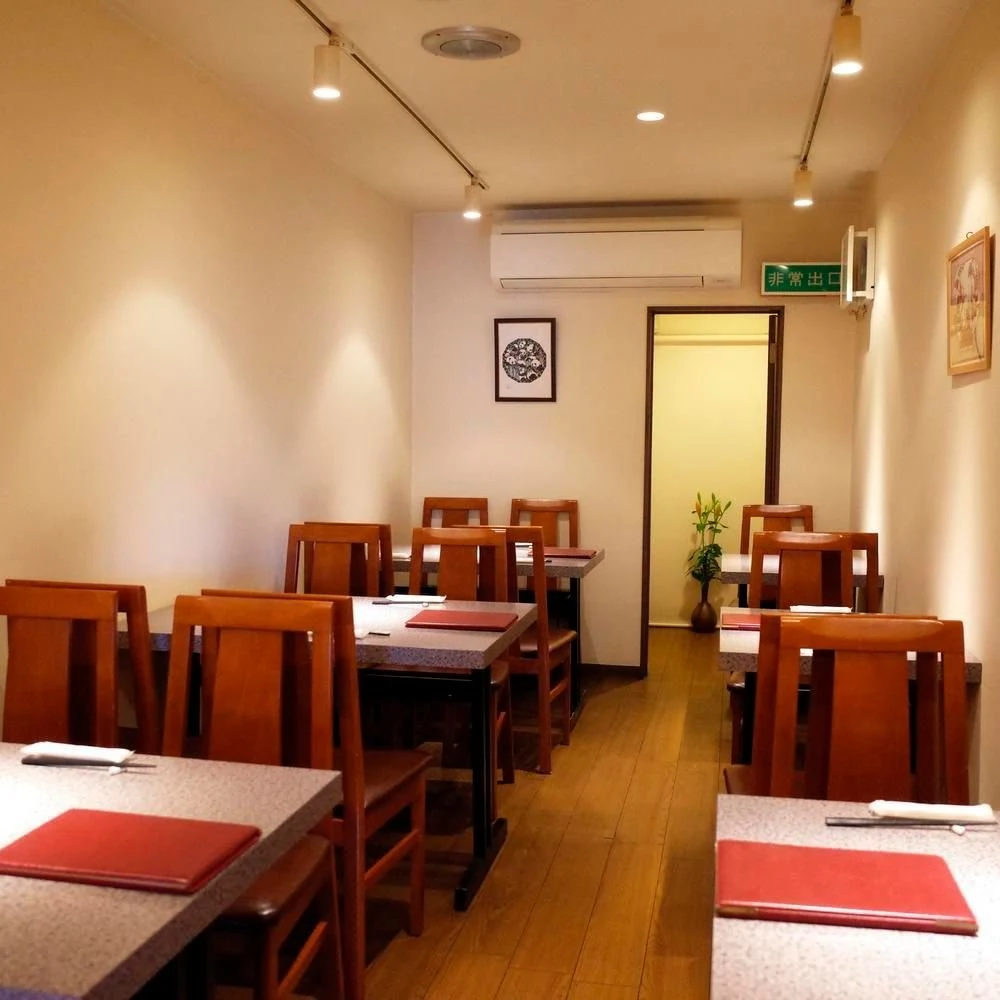
The room reinforces the same logic. Framed Chinese paper-cutout art, jiǎnzhǐ, a folk tradition with regional variation across China, lines the walls. Erhu music, the two-stringed bowed instrument associated with classical Chinese folk and court traditions, sets the ambient register. Neither element reads as decorative packaging; both signal a specific cultural grounding that the food itself shares. At a moment when Chinese restaurants in major cities globally are splitting between high-concept modernism (see Restaurant Tim Raue in Berlin or Mister Jiu's in San Francisco) and unreconstructed crowd-pleasing, Meishan's position, home-style in register, precise in execution, culturally specific in setting, occupies a third category that Tokyo's dining scene accommodates more readily than most cities.
Where It Fits in Tokyo's Broader Dining Picture
Tokyo's mid-range dining tier is intensely competitive and geographically dispersed. A ¥¥ Chinese restaurant in Nishinippori does not compete directly with the kaiseki counters of Ginza, the experimental omakase rooms of Shibuya, or even the formal Chinese banquet houses of central Tokyo. Its competition is the neighbourhood Chinese restaurant, a format that Tokyo has refined over decades through the influence of Chinese communities in Koenji, Shin-Ōkubo, and Ikebukuro, and through the Japanese absorption of Chinese-influenced dishes into the broader ramen, gyoza, and chahan culture. Against that backdrop, Meishan's commitment to specifically Sichuan home cooking, with its fermented and pickled supporting cast and its flame-forward technique, positions it as a more focused proposition than the generalised Chinese restaurant that serves every regional style at once.
For context on how Tokyo handles other cuisine traditions at comparable or refined price points, itsuka and Koshikiryori Koki represent adjacent quality tiers in different genre categories. Beyond Tokyo, the Michelin network connecting regional Japanese dining runs through HAJIME in Osaka, Gion Sasaki in Kyoto, akordu in Nara, Goh in Fukuoka, 1000 in Yokohama, and 6 in Okinawa, a set that maps how the guide distributes recognition across different price tiers and regional traditions. Meishan's Google rating of 4.3 across 400 reviews adds a separate data point.
Planning a Visit
Meishan is located at 5 Chome-24-2 Nishinippori, Arakawa City, on basement level one, an address most easily reached via Nishi-Nippori Station, served by the JR Yamanote Line and the Chiyoda subway line. The ¥¥ price range makes it one of the more accessible entry points in the Bib Gourmand tier across any Tokyo cuisine category. Given the small scale typical of family-run Sichuan restaurants and a Google review count suggesting steady regular traffic, arriving early or checking availability in advance is advisable. Reservations are recommended.
Questions
Frequently asked
What recognition does Meishan hold?
Meishan holds a Michelin Bib Gourmand.
How expensive is Meishan?
Meishan is listed at a price level of $$$.
Where is Meishan and what does it serve?
Meishan is in Arakawa, Tokyo, serving Refined Sichuan.
The field
How it compares
| Place | Cuisine | Notes | Awards |
|---|---|---|---|
| Meishan | Refined Sichuan | Arakawa, $$$ | · |
| Den | Modern Japanese Kaiseki | Tokyo | Michelin 2 Stars, World's 50 Best |
| Florilège | Modern French-Japanese Plant-Based Fine Dining | Tokyo | Michelin 2 Stars, World's 50 Best |
| Narisawa | Modern Japanese Satoyama Fine Dining | Tokyo | Michelin 2 Stars, World's 50 Best |
| Quintessence | Modern French Fine Dining | Tokyo | Michelin 3 Stars |
| Sazenka | Modern Chinese Fine Dining | Tokyo | Michelin 3 Stars, World's 50 Best |
| Sézanne | Modern French Fine Dining | Tokyo | Michelin 3 Stars, World's 50 Best |
Similar places
Modern Japanese Kaiseki
Den
Tokyo, Japan
★★ · 50 Best
Modern French-Japanese Plant-Based Fine Dining
Florilège
Tokyo, Japan
★★ · 50 Best
Modern Japanese Satoyama Fine Dining
Narisawa
Tokyo, Japan
★★ · 50 Best
Modern French Fine Dining
Quintessence
Tokyo, Japan
★★★
Modern Chinese Fine Dining
Sazenka
Tokyo, Japan
★★★ · 50 Best
Modern French Fine Dining
Sézanne
Tokyo, Japan
★★★ · 50 Best