- Opinionated About Dining Top Restaurants in Japan Recommended · 2026
- Chef's Table Featured on Chef's Table · 2025
- Tabelog 100 #23: 3.7pts · 2025
Sakyo Ward and the Logic of the Address
Kyoto's serious dining tends to cluster in two directions: the kaiseki corridors of Gion and Higashiyama, where centuries of tea-ceremony culture shaped a cuisine of restraint and ritual, and the newer wave of European-influenced counters that have spread across the city's central wards. Jodoji, a quiet sub-district of Sakyo Ward near the eastern foothills, fits neither pattern cleanly. The neighbourhood sits closer to Nanzenji's canal walks and the student density of Yoshida Hill than to the lacquered lantern streets most visitors photograph. That remove is not incidental. Kitchens that choose addresses like 147 Jodoji Shimominamidacho are, in most cases, choosing a particular kind of guest: one who looks up a neighbourhood before booking, not one who wanders in from a main street.
Sakyo Ward has produced a cluster of considered, low-footprint dining rooms in recent years, a pattern visible across Japan's secondary dining cities where real estate pressure is lower and operators can prioritise format over footfall. The same logic applies in areas around akordu in Nara, where proximity to the city's temple district shapes both the guest profile and the kitchen's sensibility. Monk sits in that broader current.
The Collaborative Model: Kitchen, Floor, and Bottle
The editorial angle most relevant to a place like Monk is how the room functions as a system. In the tier of Kyoto dining where this address places it, the relationship between kitchen, front-of-house, and beverage program is the operational core. This is the model that has defined serious counter dining across Japan for the past decade, from Harutaka in Tokyo to HAJIME in Osaka: a tightly coordinated team where the sommelier's sequencing and the front-of-house timing are not decorative additions to the food but structural parts of how a meal lands.
At the counter format that Jodoji-area restaurants tend to favour, that collaboration is visible in real time. The pass is close enough that guests observe the handoff between kitchen and floor. When service is calibrated well, the gap between a plate leaving the kitchen and a beverage adjustment arriving at the table is a matter of seconds, not minutes. The quality of that coordination, more than any single dish or pour, is what separates a competent small restaurant from one that earns repeat visits. Gion Sasaki in Kyoto operates under a similar principle at a different scale and price tier, and the contrast is instructive: at smaller rooms, the team dynamic is exposed rather than managed.
Internationally, this model has a well-documented parallel in how collaborative tasting-menu formats function at places like Le Bernardin in New York City or Lazy Bear in San Francisco, where the front-of-house is trained to read the table and adjust pacing in conversation with the kitchen, not simply to execute a fixed script. The geography changes; the principle does not.
Kyoto's Broader Dining Context
Understanding where Monk sits requires a brief mapping of Kyoto's current dining terrain. The city's highest-recognition tier is dominated by kaiseki institutions, many of which trace lineages back several generations and operate on seasonal kaiseki formats that Kyoto has exported as a reference point across Japan. Kiharu and Kiharu Brasserie represent different tiers within that broader Kyoto sensibility, while Hyōto Shijō Karasuma operates in the central corridor where footfall and destination dining intersect. Tofu-focused traditions, documented at Junsei, and temple dining at Kanga-an Temple represent the city's Buddhist-influenced culinary heritage, a category with almost no direct parallel in other Japanese cities.
Monk's Jodoji address places it outside all of those established categories. It is not a kaiseki room, not a temple-adjacent dining experience, and not a central-ward counter targeting international visitors. That positioning, whatever the specific format turns out to be, puts it in a comparable set that includes smaller, neighbourhood-rooted rooms operating on conviction rather than category recognition. Goh in Fukuoka occupies a comparable position relative to that city's dining hierarchy, and affetto akita in Akita demonstrates how this model translates even into Japan's smaller regional cities. See our full Kyoto Shi restaurants guide for a broader map of where different dining formats sit across the city's wards.
Planning a Visit
Jodoji sits in the northeastern reach of Sakyo Ward, reachable by bus from Kyoto Station or by a short taxi ride from the Higashiyama area. The neighbourhood has no central landmark in the tourist sense, which is precisely the point: guests arriving here have planned to arrive here. Monk is open Tue to Fri, 5:00 to 8:30 PM, and reservations are essential. For comparable small rooms elsewhere in the Kansai region, Abon in Ashiya and Aji Arai in Oita illustrate the booking dynamics typical of rooms in this category. Further afield, Akakichi in Imabari and Ajidocoro in Yubari District show how deeply the format has dispersed across Japan's regional dining circuit.
The Sunday letter
Get new places like Monk every Sunday.
One email a week with the restaurants, bars and hotels we have just written up, and the people who run them.
One email a week. Unsubscribe from any issue.
Questions
Frequently asked
Who works at Monk?
Made By profiles Imai-san (Chef-Owner) at Monk.
How expensive is Monk?
Monk is listed at a price level of $$$$.
Where is Monk and what does it serve?
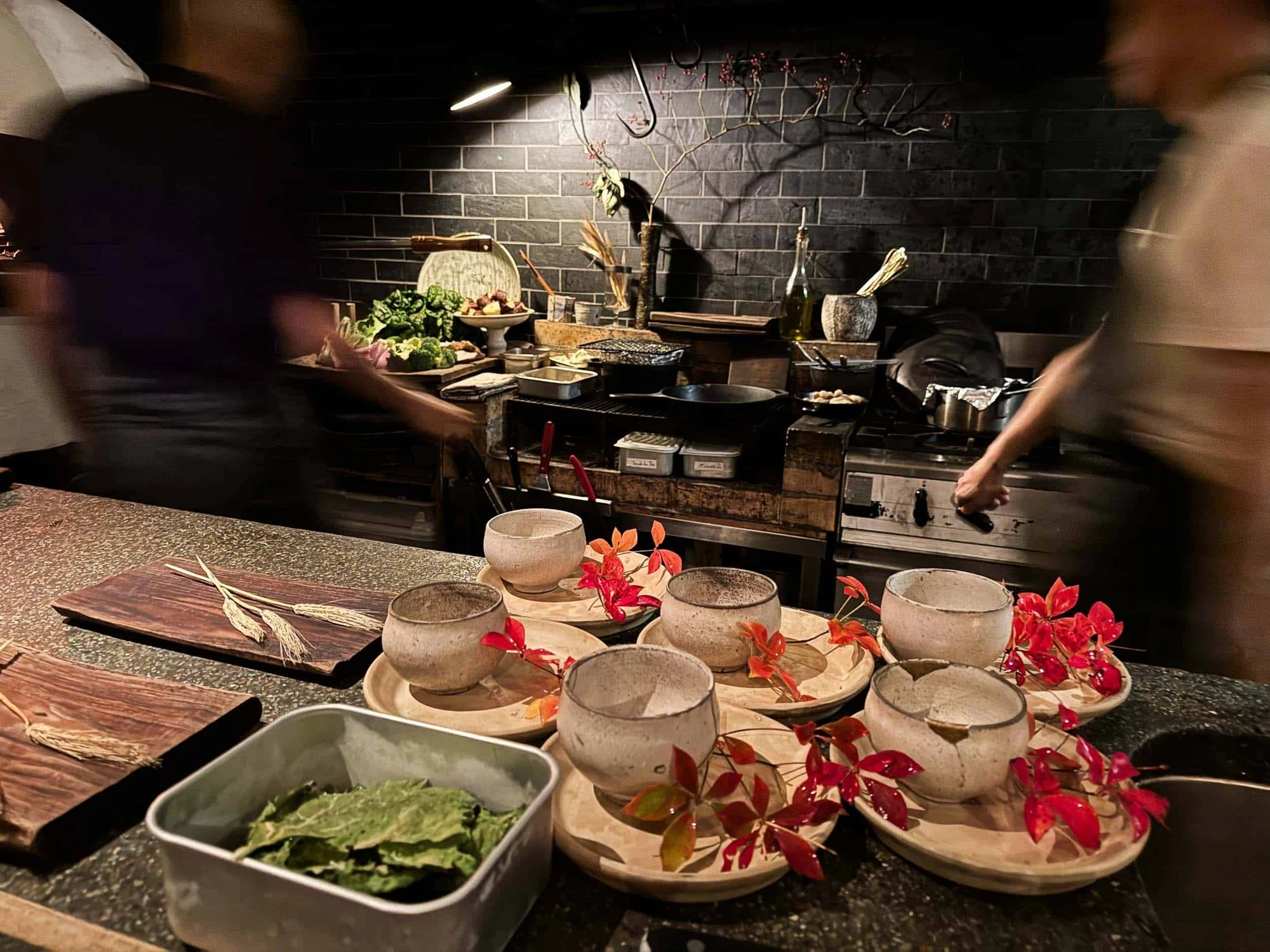
Monk is in Sakyo Ward, Kyoto Shi, serving Modern Japanese Wood-Fired Pizza Omakase.
The field
How it compares
| Place | Cuisine | Notes | Awards |
|---|---|---|---|
| Monk | Modern Japanese Wood-Fired Pizza Omakase | Sakyo Ward, $$$$ | · |
| Addison | Modern California Fusion Fine Dining | San Diego | Michelin 3 Stars, World's 50 Best |
| De Librije | Modern Dutch Fine Dining | Zwolle | Michelin 3 Stars, World's 50 Best |
| Gaggan Anand | Progressive Indian | Bangkok | Michelin 1 Star, World's 50 Best |
| Jaan by Kirk Westaway | Modern British Fine Dining | Singapore | Michelin 2 Stars, World's 50 Best |
| Per Se | French Fine Dining Tasting Menu | New York City | Michelin 3 Stars, World's 50 Best |
| The Inn at Little Washington | Contemporary American Fine Dining with French Influence | Washington | Michelin 3 Stars |
In residence
Similar places
Modern California Fusion Fine Dining
Addison
San Diego, United States
★★★ · 50 Best
Modern Dutch Fine Dining
De Librije
Zwolle, Netherlands
★★★ · 50 Best
Progressive Indian
Gaggan Anand
Bangkok, Thailand
★ · 50 Best
Modern British Fine Dining
Jaan by Kirk Westaway
Singapore, Singapore
★★ · 50 Best
French Fine Dining Tasting Menu
Per Se
New York City, United States
★★★ · 50 Best
Contemporary American Fine Dining with French Influence
The Inn at Little Washington
Washington, United States
★★★
The Sunday letter
Get the next Made By story in your inbox.
We send one email every Sunday morning with the places and people we covered that week.
One email a week. Unsubscribe from any issue.