Patsy’s Pizzeria

In Residence
Frank Brija
Chef
- 01CuisineItalian-American Pizza
- 02CityManhattan, United States
Coal-fired thin crust, kept close
- Opinionated About Dining Cheap Eats in North America Ranked #106 · 2026
Coal heat before the hand
Coal heat sets the terms before Frank Brija, chef at Patsy’s Pizzeria in Manhattan, sends a thin crust toward the oven. His formation came the long way, inside the house, through years working alongside the Lancieri family and Carmella Lancieri before the restaurant passed to him in 1991. Brija, an Albanian from Kosovo, did not enter the room as a maker looking for a new script. He learned the pace already there, the oven’s habits, the way a New York pie has to leave the bench with enough structure to meet heat without losing its snap.
That inheritance matters because Patsy’s was not simply sold away from its past. In 1991, the original East Harlem pizzeria passed to Brija and longtime employees, people who already knew the regulars, the oven, and the daily rhythm. The role he holds is a form of custody: chef as keeper of a coal-fired method tied to the Lancieri line, with the thin crust still carrying the memory of 117th Street.
The narrow discipline of thin crust
The program here is built around a small set of constraints: coal heat, New York-style thin crust, and a pizzeria vocabulary that has little patience for ornament. A coal oven does not forgive drift. The dough has to be opened thin enough for speed and crackle, but not so thin that sauce and cheese collapse the center before the pie reaches the table. The method asks for judgment at the bench and again at the mouth of the oven.
Patsy’s is associated with traditional coal-fired pies and with a slice story that reaches deep into New York pizza lore. The house is widely credited with being the first to sell pizza slices in New York City, though that claim has always had its challengers. Brija’s work does not depend on settling the argument. It depends on keeping the pie itself legible: thin crust, direct heat, a clean line between chew and char, and a style that still reads as East Harlem even when the address is 801 2nd Ave.
The room near Grand Central
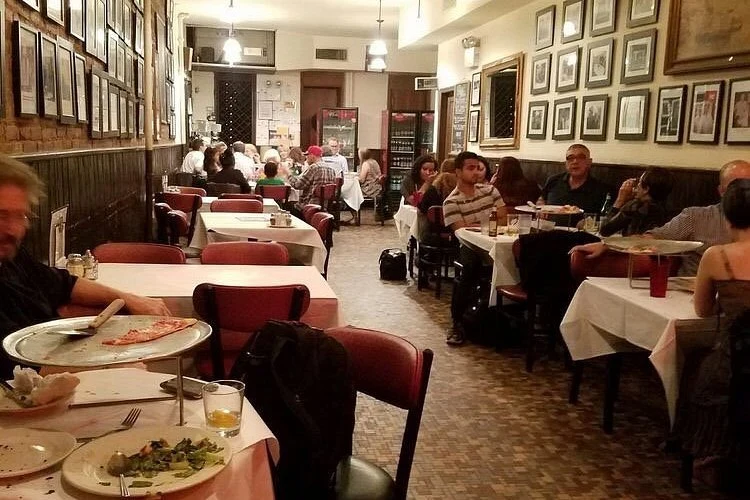
At the Manhattan room, the craft happens in the ordinary traffic of a neighborhood pizzeria: pies moving off the pass, plates of pasta and calzones following, regulars folding into a room that favors continuity over theater. The setting is relaxed, but the oven gives the work its clock. Once a pie is committed to heat, the hands have a short window in which to turn, read, and pull.
The counter carries more than pizza. Reviews of the room mention arugula salad, Patsy’s chips, calamari with red sauce, chicken Parmesan, and white pizza waiting for another visit. Those dishes give the table its range, but the center of gravity remains the coal-fired crust. Brija’s station is not an argument for reinvention. It is a daily return to a method learned beside Carmella Lancieri and the Lancieri family, still measured against 117th Street.
Questions
Frequently asked
Who is the chef at Patsy’s Pizzeria?
Frank Brija is the chef at Patsy’s Pizzeria in Manhattan. He learned the work alongside the Lancieri family and Carmella Lancieri before the restaurant passed to him in 1991.
What is Patsy’s Pizzeria known for?
Patsy’s is known for coal-fired New York thin crust pizza, made with direct heat and a narrow, disciplined method. The house is also widely credited with being the first to sell pizza slices in New York City, though that claim has challengers.
What kind of pizza does the oven shape here?
The coal oven sets the pace for thin-crust pies that need to be opened carefully so they hold their structure through the heat. The style is associated with a clean line between chew and char.
What else is served at Patsy’s besides pizza?
The room also serves pasta and calzones. Reviews mention arugula salad, Patsy’s chips, calamari with red sauce, chicken Parmesan, and white pizza.
The field
How it compares
| Place | Cuisine | Notes | Awards |
|---|---|---|---|
| Patsy’s Pizzeria | Italian-American Pizza | East Harlem, $$ | · |
| Arca | Modern Yucatan Fire-Cooked Small Plates | Tulum | World's 50 Best |
| Arpège | Vegetable-Focused French Fine Dining | Paris | Michelin 3 Stars, World's 50 Best |
| Casa Marcial | Modern Asturian Fine Dining | Arriondas | Michelin 3 Stars |
| Disfrutar | Avant-Garde Catalan Fine Dining | Barcelona | Michelin 3 Stars, World's 50 Best |
| Kumiko | Japanese Dining Bar | Chicago | · |
| Martin Berasategui | Modern Basque Fine Dining | Lasarte - Oria | Michelin 3 Stars, World's 50 Best |
In residence
Similar places
Modern Yucatan Fire-Cooked Small Plates
Arca
Tulum, Mexico
50 Best
Vegetable-Focused French Fine Dining
Arpège
Paris, France
★★★ · 50 Best
Modern Asturian Fine Dining
Casa Marcial
Arriondas, Spain
★★★
Avant-Garde Catalan Fine Dining
Disfrutar
Barcelona, Spain
★★★ · 50 Best
Japanese Dining Bar
Kumiko
Chicago, United States
Modern Basque Fine Dining
Martin Berasategui
Lasarte - Oria, Spain
★★★ · 50 Best