- Falstaff Winery - Listed · 2026
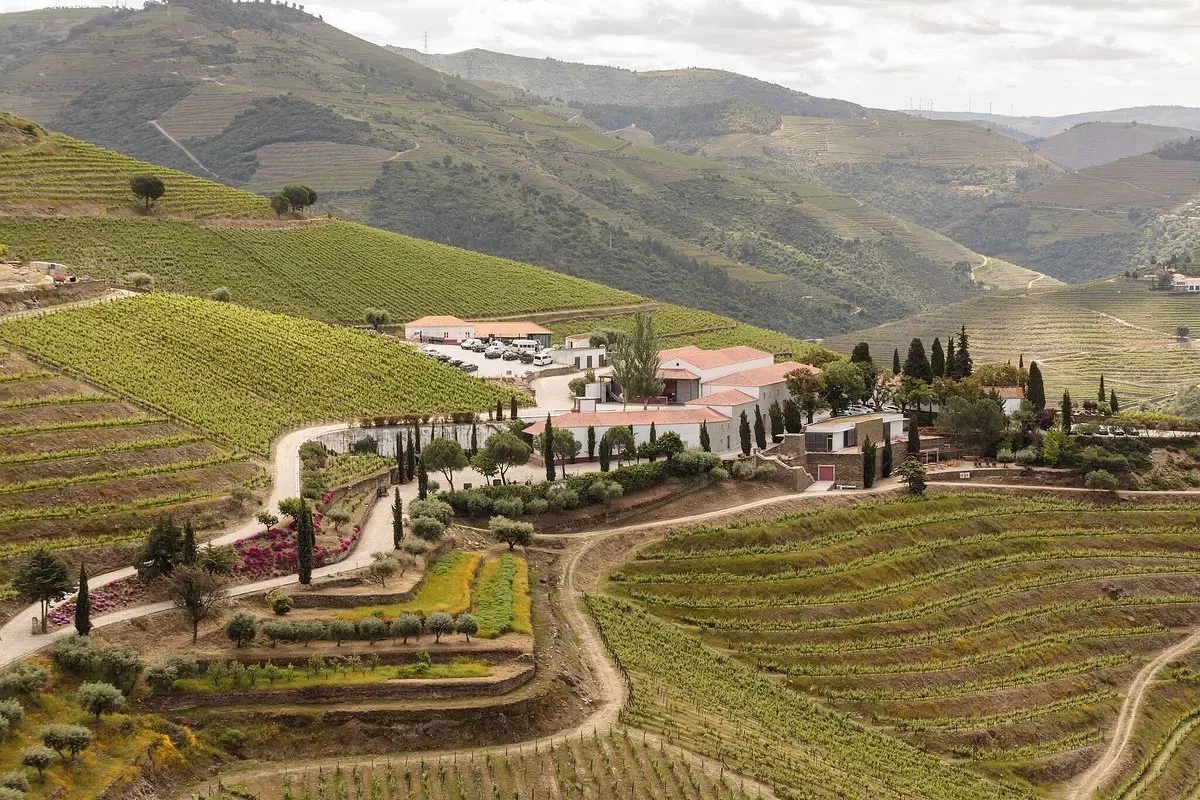
Quinta da Carolina is a small, family-run Douro estate in Adorigo, set among old north-facing schist terraces. The setting is rural and intimate, with a traditional farmhouse and basement winery keeping the focus close to the vineyard rather than on grand hospitality architecture. Its appeal comes from that modest scale: the sense that the estate is rooted in the working landscape, and that the surrounding terraces are not just scenery but the defining frame for the place.
The picture is deliberately simple: an authentic, quietly elegant estate atmosphere shaped by schist terraces, a family scale and handcrafted wines. For travelers looking at Adorigo through the lens of the Douro landscape, Quinta da Carolina is best understood as a vineyard-focused rural estate rather than a large visitor complex. It reads as the kind of address where the experience is less about spectacle and more about proximity to the land, the farmhouse, the cellar and the particular quiet of a small Douro property.
North-facing schist gives the estate its character
The most grounded way to describe Quinta da Carolina is through its setting. Old north-facing schist terraces define the estate’s visual and agricultural identity, while the farmhouse and basement winery reinforce its traditional, family-run character. In the Douro, terraces are part of the language of the landscape, and here they provide the essential context for understanding the estate: a compact property shaped by stone, slope and vineyard work rather than by expansive visitor infrastructure.
What is confirmed is the broader atmosphere: intimate, authentic and centered on the vineyard and handcrafted wines. Those words are useful because they set expectations at the right scale. The estate should not be approached as a polished destination built around a long list of hospitality features. Instead, its confirmed identity points toward a quieter kind of wine-country experience, one in which the physical setting and the family-run nature of the property carry most of the weight.
That restraint matters. It keeps the description honest and also clarifies the appeal. Quinta da Carolina’s character lies in the absence of overstatement: old north-facing schist terraces, a traditional farmhouse, a basement winery and a rural Douro atmosphere. For some travelers, that will be exactly the point. The place is best imagined as close to the vineyard and close to the rhythms of a small estate, with elegance coming from simplicity rather than from scale.
A compact estate impression rather than a detailed menu
Publicly verifiable details do not establish a specific menu, tasting lineup, food service, bottle list or hospitality format. The safest description is therefore general: Quinta da Carolina is a small Douro wine estate in Adorigo with a traditional farmhouse, basement winery and old north-facing schist terraces. That may sound limited, but it is also the clearest way to present the estate without adding detail that is not confirmed.
This means the venue is better understood through its atmosphere than through a checklist of services. The available picture does not support promises about what a visit includes, how tastings are structured, what is poured, or whether food is part of the experience. Instead, the strongest reliable impression is of a compact, family-run Douro estate whose identity is anchored in place: the terraces, the farmhouse, the cellar and the broader feeling of a rural property oriented around wine.
Visitors considering it should treat the estate as a place defined by vineyard atmosphere and family scale. Any current visit options, availability or wine details should be confirmed directly with the estate before planning around them. That is especially important for a small property, where public-facing information may be limited and where the experience, if available, may depend on direct communication rather than a standardized visitor program.
The price category for Quinta da Carolina is listed as $$. In practical terms, that gives only a broad positioning, not a detailed guide to what any particular visit or purchase might involve.
Who this Douro visit is for
Quinta da Carolina suits travelers drawn to quiet rural estates, traditional farmhouse settings and the range of Douro vineyards. It is especially relevant for anyone who wants an intimate, authentic atmosphere rather than a large-scale venue experience. The estate’s appeal is likely strongest for visitors who appreciate the texture of the Douro landscape itself: schist terraces, a small family scale and a sense of continuity between the vineyard and the farmhouse.
It is not the place to frame primarily around guaranteed hospitality features, elaborate dining or a detailed published tasting format, because those details are not established in the available description. Instead, it is best approached as a rural wine estate with a restrained profile. Travelers who are comfortable with that quieter, more direct form of Douro encounter may find the estate’s simplicity more compelling than a more built-out venue.
For broader planning in Adorigo, compare Quinta da Carolina with other dining or wine-related options in the area generically, and confirm current details directly before making plans. The key is to keep expectations aligned with what is known: a small, family-run Douro estate, old north-facing schist terraces, a traditional farmhouse, a basement winery and an authentic vineyard-centered atmosphere.
Questions
Frequently asked
Who works at Quinta da Carolina?
Made By profiles Luís Pedro Cândido da Silva Jr. (Winemaker) at Quinta da Carolina.
How expensive is Quinta da Carolina?
Quinta da Carolina is listed at a price level of $$.
The field
How it compares
| Place | Notes | Awards |
|---|---|---|
| Quinta da Carolina | Cima Corgo, Douro Valley, $$ | · |
| Ardbeg | Port Ellen | · |
| Bodegas Salentein | Tunuyán | World's 50 Best |
| Château Cheval Blanc | Saint-Émilion | · |
| Château Rayas | Châteauneuf-du-Pape | · |
| Domaine de la Romanée-Conti | Vosne-Romanée | · |
| Domaine La Barroche | Châteauneuf-du-Pape | · |