Saya
- 01CuisineAuthentic Isan Thai
- 02CityHong Kong, Hong Kong
- Michelin Bib Gourmand · Michelin Guide
- Michelin Bib Gourmand · 2026
- Michelin Bib Gourmand · 2025
- Michelin Bib Gourmand · 2024
Isan Cooking in a City That Mostly Orders Pad Thai
Hong Kong's Thai restaurant scene has long been anchored to a narrow repertoire: green curry, pad thai, larb of variable authenticity. The restaurants that operate outside that shorthand, venues where Northeast Thai fermentation logic and chilli heat take precedence over sweetness, occupy a smaller, more specific tier. Saya, located in Tai Kok Tsui's Square Mile II development, belongs to that tier. Its menu centres on Isan cuisine, the regional cooking of Thailand's northeastern plateau, which draws on Lao influences and leans toward sour, funky, and forceful flavours rather than the gentler central Thai profile most diners in Hong Kong encounter first.
That positioning matters in a city where Chachawan has spent years establishing Isan as a credible dining category and where Samsen and Samsen (Wan Chai) have built loyal followings around northern Thai noodle formats. Saya is not trying to compete in the same neighbourhood or on the same format. It operates at a lower price point and in a residential district where the clientele skews local rather than expat or tourist. That combination, regional specificity plus accessible pricing plus a community-adjacent address, is its clearest value argument.
What the Room Communicates
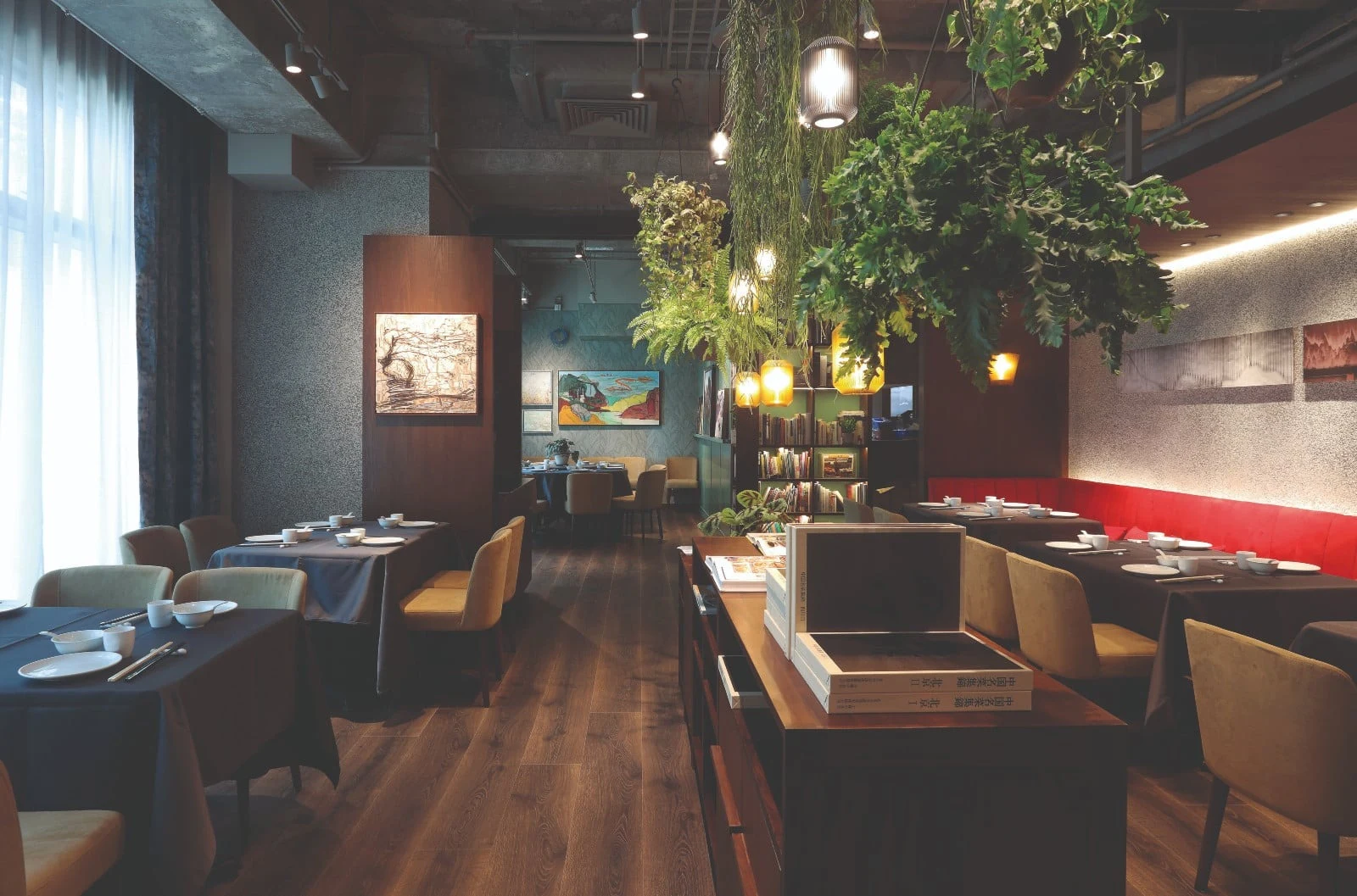
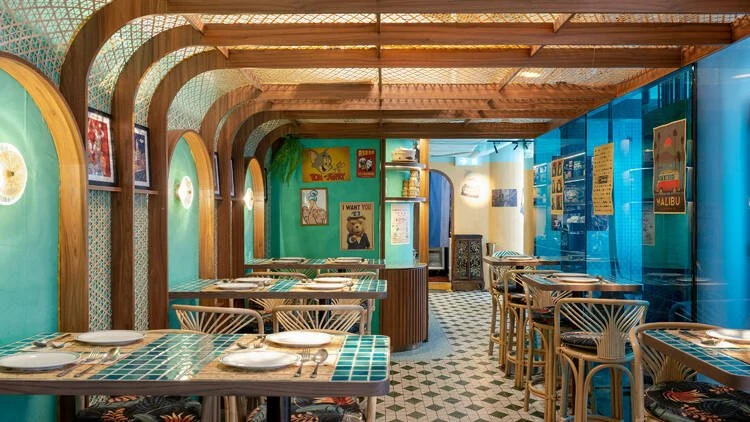
The interior signals its intent before the food arrives. A turquoise colour scheme runs across the walls, offset by rattan furniture and woven wall coverings that reference the visual vocabulary of mid-century Southeast Asian interiors without tipping into theme-park literalism. The effect is warm rather than overwrought, the kind of space that encourages table-sharing and longer sittings rather than quick turnover. Generous portion sizes reinforce that message: this is food designed for groups, for ordering broadly, for the kind of meal where dishes arrive at the centre of the table and everyone reaches across.
That social format is consistent with how Isan food is eaten in Thailand, where communal eating and sharing across multiple dishes is the default rather than the exception. Bringing that logic to a Hong Kong mid-market setting, at $$ pricing, is a practical editorial point: the cost per person drops as the table size increases, which makes Saya considerably better value for four than for two.
The Menu: Isan as the Editorial Spine
The kitchen team is Thai, which matters when the cuisine in question depends on specific fermentation inputs, fresh herb ratios, and chilli varieties that are easy to approximate and difficult to replicate accurately. Isan cooking's defining characteristics, the sourness from lime and fermented ingredients, the heat from fresh and dried chillies, the textural contrast between ground and whole ingredients, require both sourcing discipline and technique familiarity that an outside kitchen often flattens.
Two dishes illustrate the approach. The Laab Moo Isan arrives with the tangy-spicy profile the dish demands, and the addition of diced pig ears introduces a crunchy, cartilaginous texture against the ground pork base. That textural decision is not decorative, it is the dish working as intended, the way offal and secondary cuts integrate throughout Isan cooking as a matter of tradition rather than novelty. The khao soy, a coconut milk curry noodle dish more commonly associated with Northern Thailand than the Northeast, appears here with chargrilled chicken and an aromatic depth that comes from the curry paste rather than from cream or sugar additions. It is a dish that shows up across the Thai restaurants of Hong Kong but rarely with this degree of smoke and spice integrity at this price.
For context on how Thai cuisine is being treated at the higher end elsewhere in the region, Nahm in Bangkok and Samrub Samrub Thai represent the research-led, fine-dining register of the same tradition. Aksorn and Chim by Siam Wisdom sit in Bangkok's heritage-focused middle tier. Saya is operating at a different register entirely, unpretentious, portion-generous, and priced for regular use rather than occasion dining. The comparison that matters is not with fine-dining Thai but with what the same budget buys at comparable mid-market addresses across Hong Kong.
The Value Argument at $$
At the $$ price tier, Hong Kong's dining options split between fast-casual formats with limited ambition and sit-down restaurants where the value proposition depends heavily on portion size and specificity. Saya sits closer to the latter: a full-service restaurant with a regional culinary focus, a designed interior, and a kitchen producing food from an area of Thai cuisine that most Hong Kong diners have limited exposure to.
That specificity has measurable value. A 4.3 Google rating across 256 reviews at a mid-market price point, in a neighbourhood that does not draw destination diners, suggests repeat visitors and local loyalty rather than tourist traffic inflating the number. The Thai Pai Dong format common elsewhere in the city serves street-food codes at lower price points; Saya is doing something with more editorial depth at a step up in terms of kitchen investment and room quality.
For diners interested in how Thai cooking travels internationally at various price points, Kin Khao in San Francisco and Boo Raan in Knokke represent how the cuisine adapts to Western markets. AKKEE in Pak Kret and L'Orchidée in Altkirch offer further points of comparison. Saya is not in dialogue with those addresses, it is serving a local Hong Kong community with a defined regional cuisine, but the context helps locate what Isan cooking means outside its home territory.
Planning Your Visit
| Venue | Cuisine | Price Tier | Format |
|---|---|---|---|
| Saya | Thai (Isan focus) | $$ | Communal, group-friendly |
| Chachawan | Thai (Isan) | $$–$$$ | Soho, higher-profile |
| Samsen | Thai (Northern) | $$ | Noodle-focused |
| 8½ Otto e Mezzo Bombana | Italian | $$$$ | Fine dining, occasion |
| Thai Pai Dong | Thai (street-food) | $ | Casual, fast-casual |
Saya is located at G701, G/F, Square Mile II, 18 Ka Shin St, Tai Kok Tsui. The Tai Kok Tsui neighbourhood sits on the western Kowloon waterfront, accessible from Olympic MTR station. For broader city planning, see our full Hong Kong restaurants guide, hotels guide, bars guide, wineries guide, and experiences guide.
Questions
Frequently asked
What recognition does Saya hold?
Saya holds a Michelin Bib Gourmand.
How expensive is Saya?
Saya is listed at a price level of $$.
Where is Saya and what does it serve?
Saya is in Yau Tsim Mong North, Hong Kong, serving Authentic Isan Thai.
The field
How it compares
| Place | Cuisine | Notes | Awards |
|---|---|---|---|
| Saya | Authentic Isan Thai | Yau Tsim Mong North, $$ | · |
| 8 1/2 Otto e Mezzo Bombana (Hong Kong) | 3 Michelin-Star Italian Fine Dining | Hong Kong | Michelin 3 Stars, World's 50 Best |
| Amber | Contemporary French Fine Dining | Hong Kong | Michelin 3 Stars, World's 50 Best |
| Caprice | Contemporary French Fine Dining | Hong Kong | Michelin 3 Stars, World's 50 Best |
| The Chairman | Traditional Cantonese | Hong Kong | Michelin 1 Star, World's 50 Best |
| Vea | Modern Chinese-French Fusion | Hong Kong | Michelin 1 Star, World's 50 Best |
| WING Restaurant | Modern Chinese Fine Dining | Hong Kong | World's 50 Best |
Similar places
3 Michelin-Star Italian Fine Dining
8 1/2 Otto e Mezzo Bombana (Hong Kong)
Hong Kong, Hong Kong
★★★ · 50 Best
Contemporary French Fine Dining
Amber
Hong Kong, Hong Kong
★★★ · 50 Best
Contemporary French Fine Dining
Caprice
Hong Kong, Hong Kong
★★★ · 50 Best
Traditional Cantonese
The Chairman
Hong Kong, Hong Kong
★ · 50 Best
Modern Chinese-French Fusion
Vea
Hong Kong, Hong Kong
★ · 50 Best
Modern Chinese Fine Dining
WING Restaurant
Hong Kong, Hong Kong
50 Best