Sequeirinha
- 01CityPenajoia, Portugal
- Falstaff Winery - Listed · 2026
Approach the Douro through Penajoia and the wine story turns physical: vineyard rows, olive groves, almond trees, old stone facilities, and the slower tempo of an estate that treats agriculture as the main event. This is not the Porto lodge version of Port, where barrels and branding dominate the room. The reference point here is the valley itself, with a visit shaped by vines, orchards, cellars, and the open-air rhythm of rural wine country.
Sequeirinha belongs to the quieter side of Douro hospitality: family-run, small in production scale, and framed by Port Wine Route countryside rather than by urban tasting-room theatre. For readers mapping Penajoia, it makes sense to place it alongside the area’s broader wine circuit through Our full Penajoia wineries guide, with nearby drinking, dining, and overnight planning handled separately in Our full Penajoia restaurants guide, Our full Penajoia hotels guide, Our full Penajoia bars guide, and Our full Penajoia experiences guide.
Port in its agricultural setting, not its city-lodge costume
The Douro’s great advantage is that fortified wine can be read through terrain as much as through age. Sequeirinha’s setting among vineyards and orchards gives the tasting a useful frame: Port is not only a cellar category, it begins in a hot, steep, labor-intensive agricultural region where local varieties and extraction choices matter. The estate works within Douro DOC territory and lists Touriga Nacional, Touriga Franca, Tinta Barroca, Tinta Amarela, and Sousão among its varieties, a set that points toward classic structure rather than international-varietal gloss.
The stronger production signal is traditional technique. Stone lagares and foot treading connect the experience to an older Douro grammar, especially for Port styles where controlled extraction and texture are central. That matters more than nostalgia. In a region where modern winemaking can sometimes flatten place into polished fruit, the lagar remains a concrete sign of how the Douro has historically translated thick-skinned grapes into fortified wine with grip, color, and longevity.
Portfolio makes the estate’s point through range rather than a single hero bottle. Tawny Port sits at the center, with 10-, 20-, 30-, 40-, and 50-year expressions showing how oxidative aging changes the register from fruit toward nuttier, more contemplative tones. The rarest cue is the Sequeirinha Old Tawny, released as 133 numbered bottles, described around more than 100 years of concentration and bottled without filtration. In Port culture, that sort of release functions less like a tasting-room souvenir and more like a cellar-history document.
Why the tasting works for Douro education
A useful Douro visit should teach the difference between place, process, and time. Sequeirinha has enough breadth to do that without turning the estate into a technical seminar. Ruby-style Port, Late Bottled Vintage, Vintage, Colheita bottlings, White Port, age-stated Tawny, and still Douro wines create a natural comparative structure: fruit-driven versus oxidative, youthful density versus long cask development, white fortified wine versus red fortified wine, estate agriculture versus finished cellar expression.
White Port is not treated as an afterthought in this range. The presence of aged White Port and Colheita White gives the tasting a more complete Douro argument, especially for visitors used to seeing white fortified wine only as an aperitif category. It also connects neatly to the estate’s broader pantry identity, which includes olive oil and gourmet products. That agricultural mix matters in the Douro, where serious estates often read as farms first and wine brands second.
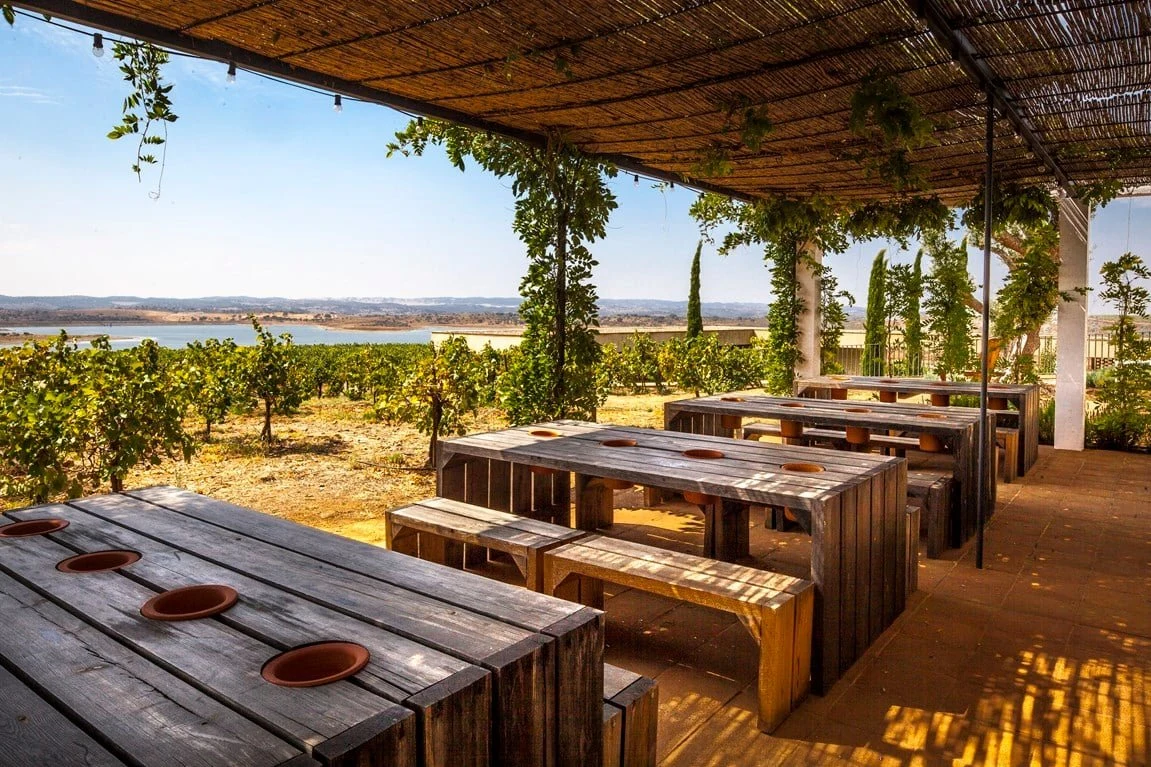
The hospitality format is guided, with estate tours and Port tastings available in Portuguese, English, and French. The tone suits families, small groups, wine-education outings, and travelers who want the rural Douro without a heavy luxury overlay. Outdoor seating and estate grounds give the visit its visual logic, while historic buildings and private tasting options place the wines back inside their production context. Rita Sequeira is named as winemaker, but the more interesting editorial point is not biography; it is the continuity between family holdings, cellar work, and a portfolio built to explain time in the Douro.
How to position it in a Portugal wine itinerary
Portugal wine travel often splits between cooperative scale, urban cellars, and estate visits. Sequeirinha belongs to the estate-led category, where the value is not only what is poured but how much context surrounds it. For contrast across the country, larger regional and cooperative models can be explored through Adega Cooperativa de Borba in Borba, Adega Cooperativa de Ponte de Lima in Ponte de Lima, Adega Cooperativa Regional de Moncao in Monção, and Adega Cooperativa de Vale Cambra, CRL in Vale De Cambra. More estate-driven Portuguese references include Aneto Wines, 1912Winemakers LDA in Porto, Adega Cartuxa (Fundação Eugénio de Almeida) in Évora, and Adega do Monte Branco in Estremoz.
For travelers comparing European wine visits more broadly, the useful distinction is scale and setting. Urban merchants and international producers can be rewarding, but a Douro estate visit has a different instructional value because vineyard, cellar, and fortified-wine aging sit in one frame. That is the reason this stop belongs on a Penajoia day built around wine education rather than casual drinking. Cross-border comparisons such as »der Steiner« Hans Steiner in Podersdorf am See and & Handwein in Mannheim underline the point: the strongest wine experiences are often those that make regional method legible, not merely available by the glass.
Questions
Frequently asked
How expensive is Sequeirinha?
Sequeirinha is listed at a price level of $$.
The field
How it compares
| Place | Notes | Awards |
|---|---|---|
| Sequeirinha | Penajóia, $$ | · |
| Aneto Wines | Penajoia | · |
| Château La Fleur-Pétrus | Pomerol | · |
| Château Rieussec | Fargues | · |
| Domaine Arnaud Ente | Meursault | · |
| Herdade do Esporão | Reguengos de Monsaraz | World's 50 Best |
| Weingut Egon Müller | Wiltingen | · |