
- Opinionated About Dining Casual in North America Ranked #693 · 2025
MacDougal Street and the Broader Shift in New York's Middle Eastern Dining
New York's relationship with Middle Eastern food has long been stratified in a way that mirrors the city's demographic complexity. For decades, the genre split between neighborhood staples, falafel counters, shawarma windows, family-run Lebanese spots in Bay Ridge, and the occasional upscale outlier attempting to dress the cuisine in white-tablecloth formality. The middle tier, where technique and sourcing are taken seriously without the tasting-menu apparatus, was thinner than it should have been. That gap has narrowed considerably over the past decade, and MacDougal Street in SoHo has become one of the addresses where the shift is visible. Shuka, occupying a room at 38 MacDougal St, represents this recalibrated middle: cooking from across the Levant and North Africa, delivered through a format that is convivial rather than ceremonial.
Middle Eastern dining in New York now has genuine range. Al Badawi draws on Palestinian tradition with a studied seriousness; Ayat in Brooklyn has built a following on Palestinian home cooking scaled to a restaurant format; Kubeh goes deep on a single dish tradition; and Mamoun's anchors the accessible end of the category. Shuka occupies a different coordinate: broader in geographic reference, more deliberate in its execution, and pitched at a dining occasion that sits between a quick meal and a formal dinner.
The Sunday letter
Find new places through the people who run them.
Our Sunday email brings you the chefs, winemakers and hoteliers behind our newest stories. See a sample before you subscribe.
See a sample of the Sunday emailOne email a week. Unsubscribe from any issue.
The Table Before the Food: Bread as the Organizing Logic
In much of the Middle East and North Africa, bread does not arrive as an amenity, it arrives as architecture. Pita, lavash, manakish, sangak: these are not side items but the structural language through which a table is organized. Sauces exist to meet bread. Salads are built for it. The communal breaking of bread, in traditions stretching from the Levant to Persia to the Maghreb, is the gesture that signals a meal has begun and that the table belongs to everyone at it equally.
This logic matters at Shuka because the restaurant's format depends on it. Shared plates are only as coherent as the vehicle that connects them, and the quality of the bread program signals whether a kitchen understands the tradition it is working in or is simply borrowing its aesthetics. At restaurants operating in this genre more seriously, including comparisons further afield like Bait Maryam in Dubai and Baron in Doha, bread service is treated as a course in itself, with timing and temperature given the same attention as any protein. The shared-plate format at Shuka inherits this logic: the table is meant to be read collectively, not sequentially.
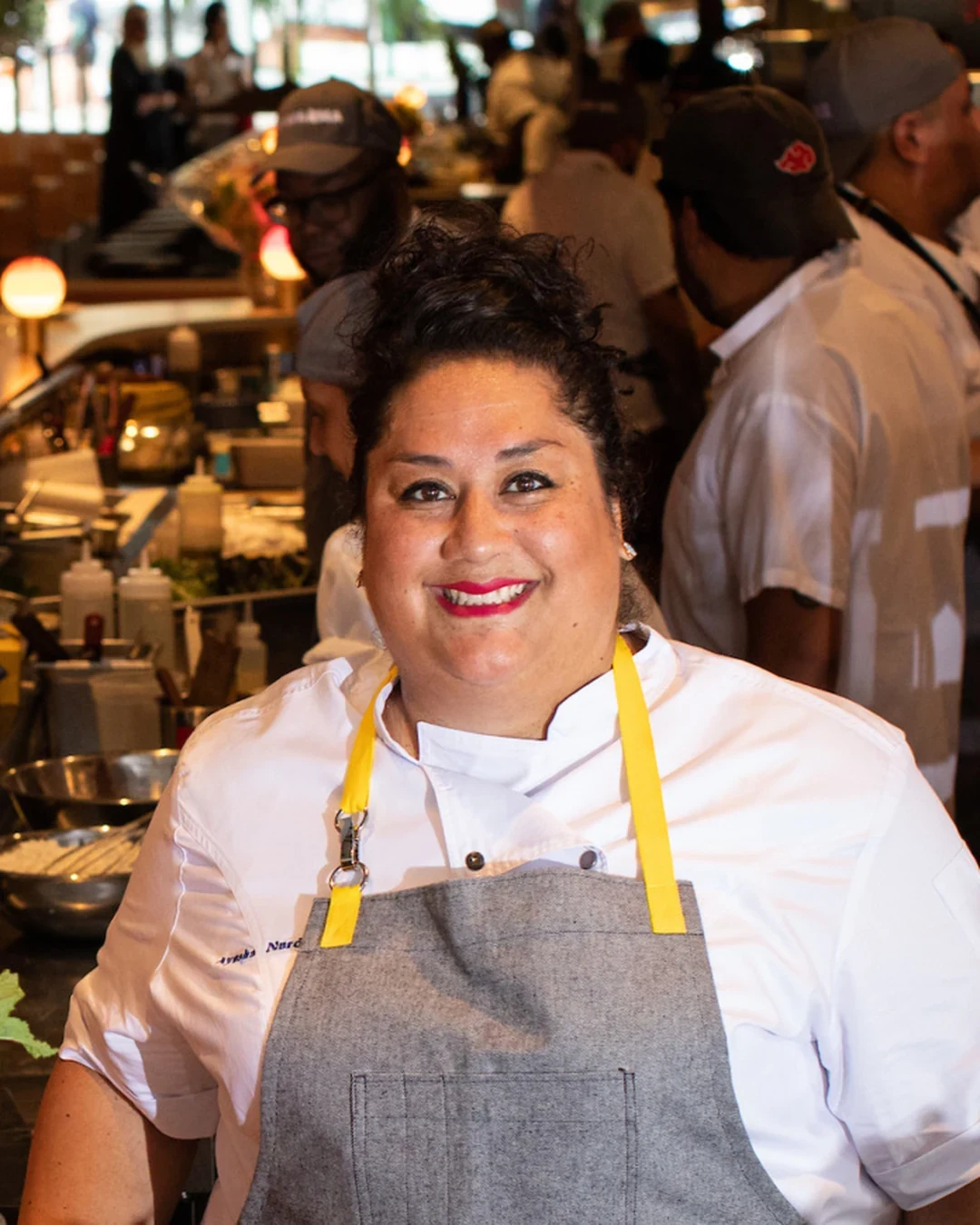
Chef Ayesha Nurdjaja leads the kitchen. Her leadership situates Shuka within a professional culinary tradition: this is a restaurant where training and technique shape the output, and where the cuisine is taken as a discipline rather than a backdrop. The menu moves across regional references without collapsing them into a homogenized pan-Middle Eastern shorthand, which is the more common failure mode in this category.
Recognition and What It Implies About Consistency
Appearing on that list at all places Shuka in a cohort that filters out restaurants sustained by novelty or location rather than cooking. The 4.6 rating across 3,770 Google reviews reinforces the same conclusion: this is a restaurant that performs reliably across a wide range of dining occasions, not one that depends on a particular table, season, or mood to land well.
For comparison, the restaurants that dominate New York's most-discussed fine dining tier, Alinea in Chicago, Lazy Bear in San Francisco, The French Laundry in Napa, Single Thread Farm in Healdsburg, Providence in Los Angeles, and Emeril's in New Orleans, operate at a different price point, format, and occasion entirely. Shuka is not competing in that category, and that is precisely the point: it occupies a format that allows the cuisine itself to be the focus.
The SoHo Context and What MacDougal Street Offers
MacDougal Street carries a particular kind of New York credential. It has housed serious eating and drinking for decades, threading between the NYU-adjacent commerce of the Village and the more curated stretch of SoHo to its south. The street has historically skewed toward the affordable and the casual, which means that a restaurant like Shuka, at roughly $50 per person, reads as well-placed rather than out of context. The neighborhood attracts a dining public that eats across categories and price points rather than reserving special occasions for particular cuisines, which suits a format built around communal sharing and table-length ordering.
SoHo more broadly has seen its restaurant density increase at the mid-market level, with a cluster of destinations operating in the $40-70-per-person range that have begun to challenge the dominance of downtown Italian and American formats. Middle Eastern cooking, with its natural orientation toward shared plates and vegetable-forward abundance, fits the moment: it is a cuisine structure well suited to tables that want variety without the overhead of a multicourse tasting format. Astoria Seafood represents a different but comparable expression of this same appetite for serious cooking in unfussy contexts.
Planning a Visit
Shuka is located at 38 MacDougal St, New York, NY 10012. Reservations are recommended, particularly for dinner on weekends. Dress: smart casual. Budget: roughly $50 per person. Getting there: the address is walkable from multiple downtown subway lines serving the Village and SoHo corridors.
Questions
Frequently asked
Who works at Shuka?
Made By profiles Ayesha Nurdjaja (Chef) at Shuka.
How expensive is Shuka?
Shuka is listed at a price level of $$.
Where is Shuka and what does it serve?
Shuka is in SoHo-Little Italy-Hudson Square, New York City, serving Modern Mediterranean.
The field
How it compares
| Place | Cuisine | Notes | Awards |
|---|---|---|---|
| Shuka | Modern Mediterranean | SoHo-Little Italy-Hudson Square, $$ | · |
| Atomix | Modern Korean Tasting Menu | New York City | Michelin 2 Stars, World's 50 Best |
| Daniel | Modern French Fine Dining | New York City | Michelin 1 Star, World's 50 Best |
| Eleven Madison Park | Contemporary Plant-Based Fine Dining | New York City | Michelin 3 Stars, World's 50 Best |
| Jungsik New York | Modern Korean Fine Dining | New York City | Michelin 3 Stars, World's 50 Best |
| Kabawa | Modern Caribbean Prix Fixe | New York City | World's 50 Best |
| Le Bernardin | French Seafood Fine Dining | New York City | Michelin 3 Stars, World's 50 Best |
In residence
Similar places
Modern Korean Tasting Menu
Atomix
New York City, United States
★★ · 50 Best
Modern French Fine Dining
Daniel
New York City, United States
★ · 50 Best
Contemporary Plant-Based Fine Dining
Eleven Madison Park
New York City, United States
★★★ · 50 Best
Modern Korean Fine Dining
Jungsik New York
New York City, United States
★★★ · 50 Best
Modern Caribbean Prix Fixe
Kabawa
New York City, United States
50 Best
French Seafood Fine Dining
Le Bernardin
New York City, United States
★★★ · 50 Best
The Sunday letter
Get the next Made By story in your inbox.
We send one email every Sunday morning with the places and people we covered that week.
See a sample of the Sunday emailOne email a week. Unsubscribe from any issue.