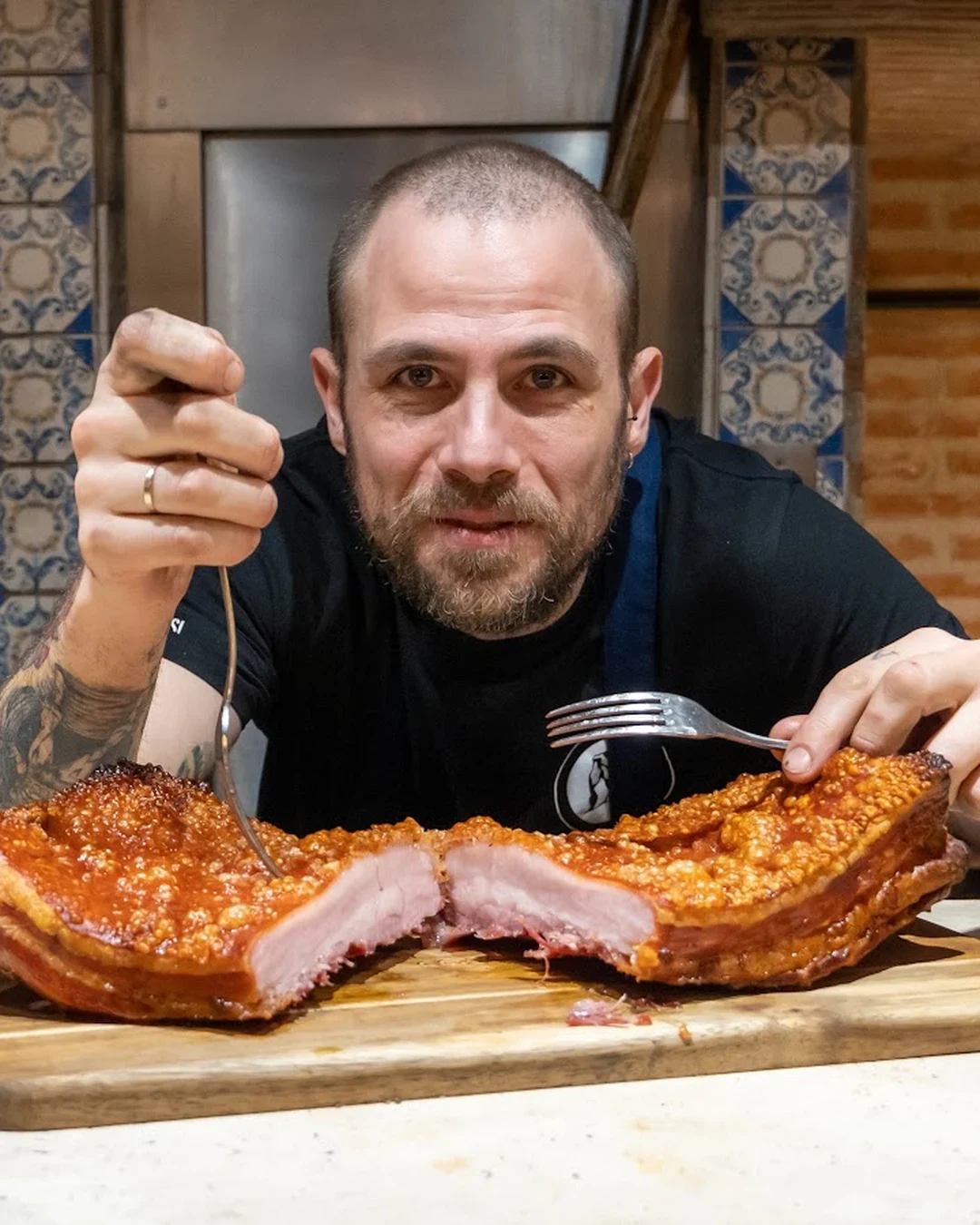
Portrait of Gonza de Pedro
i. Biography
The continuity is practical: recipes held in use, heat managed by hand, and a stove discipline that treats inheritance as daily work rather than display. Castilian cooking gives the house its grammar. Product, traditional recipes, and fire set the limits and the measure. Wood-fired roasts, slow legumes, flavor, technique, and exact execution are the structure here; in Gonza de Pedro’s kitchen, they read as operating principles, not decoration.
The Sunday letter
Read Made By's new profiles every Sunday.
Meet the chefs, winemakers and sommeliers behind the places we cover. See a sample below before you subscribe.
See a sample of the Sunday emailOne email a week. Unsubscribe from any issue.
The Path
The chef’s role at El Pedrusco de Aldealcorvo is one of continuity. Gonza de Pedro works inside a form of cooking that depends on patience, timing, and respect for inherited recipes, with the emphasis placed on keeping the method legible from prep to service. The craft stays close to the embers. At El Pedrusco de Aldealcorvo, de Pedro’s work treats tradition as something renewed through use: a roast watched through its cooking, a legume softened slowly, a dish sent when texture, heat, and flavor meet.
The Work Today
The restaurant’s cooking is organized around a century-old wood-fired oven and the kitchen stoves. From those tools come subtle, elegant traditional stews and roasts, built on time, heat, restraint, and a clear hand. The oven functions as the central instrument of the kitchen, carrying warmth, smoke, and memory in its walls. Judión cooked in a wood-fired oven with a veil of Iberian pork jowl states the house method without excess. The dish is built from legume, smoke, fat, patience, and a recipe that does not ask for complication. Its balance rests on the depth of the bean, the quiet perfume of fire, and the richness of the pork jowl held in check. Cochinillo asado con patata panaderas is served as the main course in a direct nod to Traditional Castilian roasting. Another preparation of cochinillo uses only water and salt, with skin described as fine as onion paper and dissolving at the touch of the tongue. Both preparations depend on disciplined roasting: crackle, tenderness, seasoning, and the confidence to leave the meat unobscured. Slow-cooked legumes also use the residual heat of the wood-fired oven. The key information is the work sequence itself: sixteen hours, residual heat, smoke, butter, silk, flavor.
Career - Chef — El Pedrusco de Aldealcorvo, Juan de Austria, 27, Chamberí, Madrid
Signature
The signature dishes named by Gonza include cochinillo, cordero, and torreznos. Taken together, they define the house appetite through crisp skin, yielding meat, rendered fat, and food given the time it requires.
Acclaim
Roast lamb, suckling pig, judión with Iberian pork jowl, and legumes finished by the old oven’s leftover heat all return to one discipline: recognizable flavor, traditional technique, and precision at the moment of serving. The recognition in this cooking is not spectacle but legibility. In Madrid, the work at El Pedrusco de Aldealcorvo carries Traditional Castilian cooking through product, recipes, and flame, with Gonza de Pedro serving as the chef responsible for that continuity.
FAQ What is Gonza de Pedro's current role? Gonza de Pedro is Chef at El Pedrusco de Aldealcorvo. What is Gonza de Pedro known for? Traditional Castilian cooking in Madrid.


The Sunday letter
Get the next Made By profile in your inbox.
We send one email every Sunday morning with the people we profiled that week.
See a sample of the Sunday emailOne email a week. Unsubscribe from any issue.