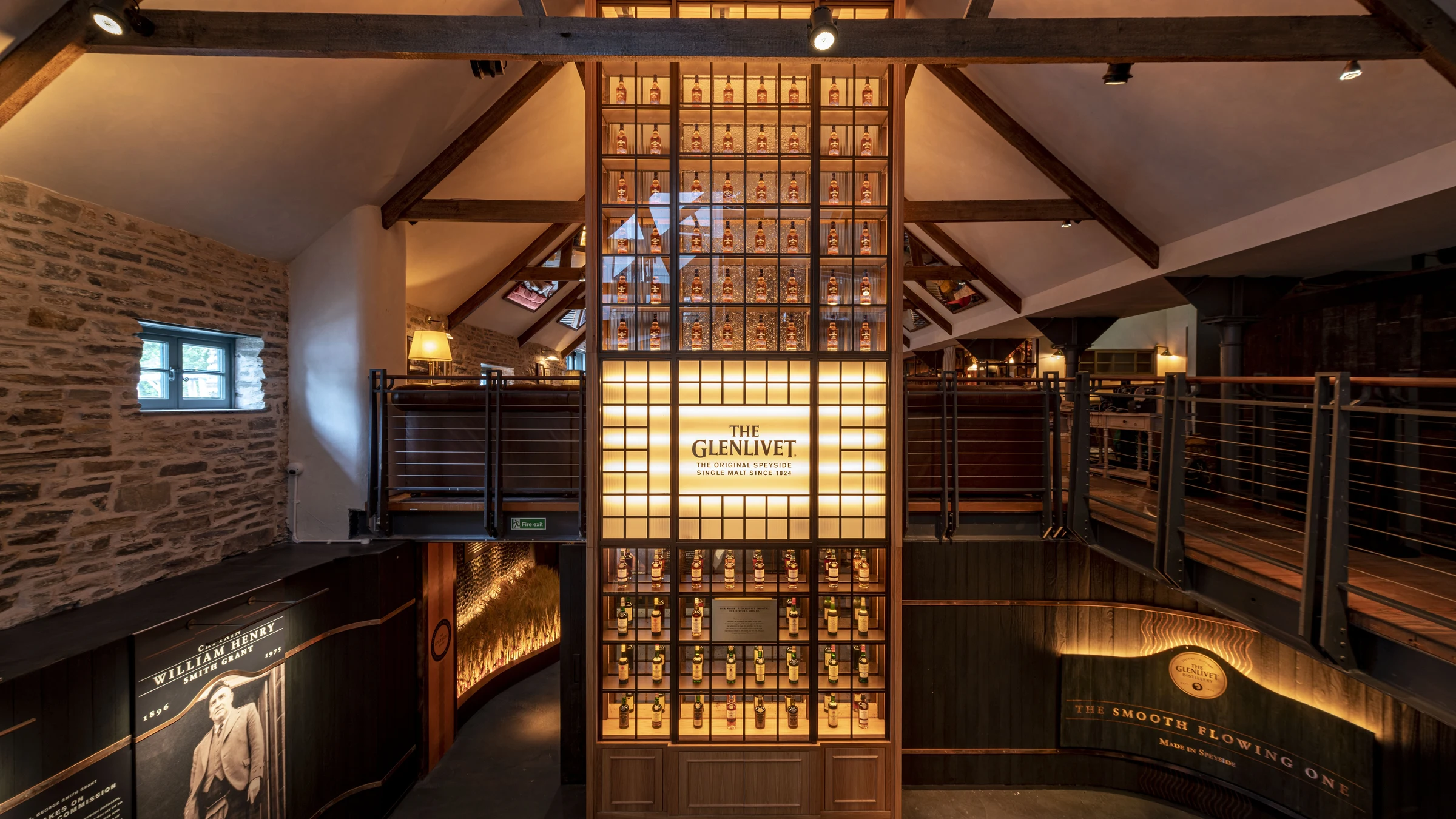
The Glenlivet sits in the Livet valley of Speyside, one of Scotland's most historically significant whisky corridors. Awarded Pearl 4 Star Prestige recognition in 2025, the distillery occupies a position in Speyside's upper tier alongside a handful of estates where geography and production heritage carry genuine weight. Visitors encounter a distillery shaped by the landscape and legal history that defined legal Scotch whisky production.
<h2>Where Speyside's Legal History Begins</h2><p>The Glenlivet is a winery in Ballindalloch, Speyside, at Glenlivet, Ballindalloch AB37 9DB, UK. This stretch of Banffshire, remote even by Highland standards, with the river cutting through moorland and birch, was the corridor where illicit distilling thrived for generations before the Excise Act of 1823 brought the trade above ground. That legislative moment is the foundation on which The Glenlivet's reputation rests, not as sentiment, but as a documented market fact: the distillery became the first in the Highlands to operate under the new licensing regime, and its commercial success under that framework helped define what legal Speyside whisky meant to a sceptical London market in the following decades. For visitors arriving at Ballindalloch today, that context gives the physical site a weight that most distillery visits lack.</p><p>Speyside has developed into the highest-concentration whisky corridor in Scotland, with more distilleries per road mile than any comparable region. The character of the area runs toward lighter, more floral and fruited spirit profiles than the peat-heavy expressions associated with Islay or the coastal Highland style found at producers like <a href="https://www.enprimeurclub.com/wineries/clynelish-distillery-brora-winery">Clynelish Distillery in Brora</a> or <a href="https://www.enprimeurclub.com/wineries/balblair-distillery-edderton-winery">Balblair Distillery in Edderton</a>. Within that regional profile, the Livet sub-region carries its own identity: the altitude, the water source from springs feeding the river, and the local barley traditions all feed into a style that distilleries in this valley have been refining across two centuries.</p><h2>The 2025 Pearl 4 Star Prestige Recognition</h2><p>EP Club's Pearl 4 Star Prestige award in 2025 places The Glenlivet in the upper bracket of evaluated Scotch whisky producers. In a region where Speyside competition is dense, <a href="https://www.enprimeurclub.com/wineries/glenfarclas-distillery-ballindalloch-winery">Glenfarclas Distillery</a>, located nearby in Ballindalloch, and <a href="https://www.enprimeurclub.com/wineries/aberlour-aberlour-winery">Aberlour</a> both operate at comparable prestige levels, a prestige-tier classification signals consistent production standards and visitor experience quality rather than casual category membership. That distinction matters in Speyside specifically, where the density of distilleries makes peer differentiation harder to read from the outside.</p><p></p><h2>Production Philosophy in the Livet Valley</h2><p>Speyside distilleries divide broadly between those whose identity is anchored in cask maturation strategy and those where the new-make spirit character does more of the work. The Livet valley, with its relatively cool temperatures and clean water, tends toward the latter: the spirit coming off the stills carries enough inherent character that the maturation program amplifies rather than corrects. This is a production philosophy shared by a number of estate-style distilleries in the region, where the proximity of the water source, the mash composition, and the still shape all figure explicitly into what ends up in the glass.</p><p>The still design at distilleries in this corridor has historically favored tall copper stills with long necks, which promote copper contact during distillation and result in a lighter, more refined new-make spirit. That design choice sits in contrast to the squat, wide stills favored at some Lowland producers like <a href="https://www.enprimeurclub.com/wineries/auchentoshan-distillery-clydebank-winery">Auchentoshan Distillery in Clydebank</a>, where triple distillation pushes a different style entirely. Understanding that technical divergence explains more about why Speyside expressions taste the way they do than any amount of marketing language about heritage.</p><p>Among Scottish distilleries operating outside the Speyside heartland, the contrast becomes sharper. <a href="https://www.enprimeurclub.com/wineries/bladnoch-distillery-bladnoch-winery">Bladnoch Distillery in Bladnoch</a>, Scotland's most southerly distillery, operates in a completely different climatic and botanical environment; its lighter Lowland character shares some surface-level similarities with floral Speyside expressions but arrives through different means. <a href="https://www.enprimeurclub.com/wineries/cardhu-knockando-winery">Cardhu in Knockando</a>, sitting within Speyside proper, operates on similar terrain to the Livet valley and provides a useful regional reference point for how sub-regional micro-conditions inflect the broader Speyside house style.</p><h2>Visiting the Livet Valley</h2><p>The Glenlivet sits at Glenlivet, Ballindalloch AB37 9DB. Getting there requires commitment: the nearest significant town is Grantown-on-Spey, and the approach from any direction involves single-track roads through exposed moorland. That remoteness is not incidental, it is the condition that shaped the distillery's history, when distance from excise officers made this valley the centre of Scotland's illicit whisky trade. Arriving by car from the south, the B9136 through Tomintoul offers the most direct Highland approach and gives a clear sense of the elevation and exposure of the site.</p><p>Seasonal timing affects the visit in practical ways. Summer months, June through August, bring extended daylight and the clearest visibility across the valley, with the added benefit of distillery visitor infrastructure operating at full capacity. Spring and autumn visits reward those willing to accept shorter days in exchange for fewer crowds and the dramatic light shifts that come with the Cairngorm weather patterns. Winter access to this part of Speyside can be complicated by road conditions on the higher ground, and visitors should check local road conditions before attempting the valley approach in December through February.</p><p>For those building a wider Scotland whisky itinerary, the Livet valley sits within reasonable reach of other significant Highland and Speyside producers. <a href="https://www.enprimeurclub.com/wineries/glen-garioch-distillery-oldmeldrum-winery">Glen Garioch Distillery in Oldmeldrum</a> lies to the east in Aberdeenshire, while <a href="https://www.enprimeurclub.com/wineries/dunphail-distillery-dunphail-winery">Dunphail Distillery in Dunphail</a> and <a href="https://www.enprimeurclub.com/wineries/deanston-deanston-winery">Deanston in Deanston</a> mark the southern and western edges of the broader Highland circuit. Building a multi-day itinerary around Speyside as a base makes geographic sense, with the Livet valley functioning as the historical anchor of the region rather than a peripheral stop.</p><p> Producers like <a href="https://www.enprimeurclub.com/wineries/accendo-cellars">Accendo Cellars in St. Helena</a> in Napa or <a href="https://www.enprimeurclub.com/wineries/achaia-clauss-patras-winery">Achaia Clauss in Patras</a> each carry their own form of regional founding narrative, but the Livet valley's claim to legal origination in the Scotch whisky category is specific to this geography in a way that has few direct equivalents.</p><h2>What to Know Before You Visit</h2><p>The Glenlivet holds EP Club Pearl 4 Star Prestige recognition for 2025. Given the distillery's location in a remote part of the Livet valley, pre-visit planning is worth the effort: confirm opening hours and tour availability directly before travel, particularly outside the peak summer season when reduced programming is common across Speyside distilleries. Reservations are recommended. Arriving without confirmed access to a remote Highland site of this type is a meaningful logistical risk, especially for international visitors building the stop into a tight itinerary.</p>
Remote and deliberate. The distillery sits in the Livet valley at Ballindalloch AB37 9DB, where the Cairngorm plateau presses in from the east and the nearest significant town is Grantown-on-Spey. The setting is functional Highland rather than heritage theme park — this is a working Speyside distillery that earned EP Club Pearl 4 Star Prestige recognition in 2025 on the strength of its production, not its visitor amenities.
The Glenlivet has received recognition including: Pearl 4 Star Prestige (2025).
The Livet valley's soft water and the distillery's house style have long been associated with a lighter, fruited new-make character — the foundation on which the range is built. Tasting sessions at the distillery give access to expressions that rarely read the same way outside this valley context. Check directly with the distillery for current tasting options before visiting, as programming changes seasonally.
The Glenlivet is located at Glenlivet, Ballindalloch AB37 9DB, UK, Ballindalloch.
The Glenlivet holds EP Club Pearl 4 Star Prestige for 2025, placing it in the upper bracket of evaluated Scotch whisky producers. Beyond the award, the Livet valley itself is the draw: this is the site where licensed Speyside distilling effectively began in 1824, and the geography that defines the whisky is immediate and legible when you are standing in it. The drive from Grantown-on-Spey alone orients you to why this specific valley matters.
Given the distillery's position in a remote part of the Livet valley, pre-visit planning is essential — arriving without a confirmed experience reserved risks a limited visit. The distillery's official website is the correct starting point for tour and tasting availability. Allow time for the drive from Grantown-on-Spey, and factor in road conditions if visiting outside summer months.
Glenlivet, Ballindalloch AB37 9DB, UK
Speyside